When to send mohair to the laundry
Decision criteria: when you can safely hand-wash a mohair sweater at home, and when it is better to leave it to a professional

Everything you've read in the earlier mohair guides is enough for everyday care: washing at a low temperature, gentle rinsing and drying flat. There are, however, situations where it's better not to risk hand-washing and to take the item to a specialist instead. Below are five specific cases where it's worth doing so.
- Items labeled "dry cleaning only": blazers, coats and upholstery fabrics have no safe home alternative, because a crossed-out wash tub on the label means a total ban on contact with water.
- Brushed mohair sweaters with flattened fuzz: professional steam brushing gives a real chance of restoring fluffiness that you can't achieve on your own.
- Heavily soiled clothing: dried stains or stains of unknown origin, where home stain-remover experiments risk permanent discoloration.
- Large and heavy items: mohair blankets or throws, where the risk of deformation under the weight of water during home drying is real.
- High-value kid mohair items: the cost of a mistake, such as permanently flattened fuzz, far exceeds the cost of the professional service.
Kid mohair or adult mohair
Why the fiber class decides how the item should be cleaned
Two mohair classes, two different approaches to washing
Kid mohair
First 1 to 2 shearings
A thin, soft fiber where every washing mistake shows fastest and hurts your wallet the most.
Kid mohair comes from the first shearings of a young Angora goat. It mostly goes into clothing worn directly on the skin, where softness matters most, which is why it needs the most careful handling.
Adult mohair
Mature goat, later shearings
A thicker fiber that withstands friction better than kid mohair, but it usually ends up in more expensive, heavier items.
Adult mohair comes from a mature goat, from its later shearings. The thicker fiber suits face fabrics and upholstery better, where durability matters more than softness against the skin.
Why the fuzz flattens
The felting mechanism: friction, temperature and moisture acting together
Mohair's characteristic fuzz, called halo in the industry, is made up of loose fibers sticking out from the yarn. It comes from the same smooth cuticle that gives mohair its high luster. The fiber is slippery and shifts easily, so with careless washing the fuzz readily lies down, tangles and loses volume.
Permanent flattening happens when three factors act together: high water temperature, mechanical friction and a sudden temperature change between washing and rinsing. Heat opens the keratin scales, friction tangles the protruding fibers with each other, and thermal shock seals the effect before the fiber can straighten back out.
At home, this exact combination of factors is the hardest thing to keep under control through an entire wash cycle.
What you gain by leaving mohair to professionals
Conditions you can't recreate in a home washing machine
Controlled temperature
Electronically maintained water in the range of 20 to 30°C eliminates risk of thermal shock, hard to avoid in home washing machines.
Gentle drum mechanics
Low speed and counter-rotating agitation minimize friction, the main cause of fuzz flattening.
Flat form drying
Drying on screens or forms in chambers with controlled temperature and humidity, unavailable at home.
Steam brushing
Specialized halo and luster restoration, a service rarely offered for other fibers, dedicated specifically to mohair.
It must be said frankly: no professional method fully reverses advanced felting or severely "damaged" fuzz on large areas of garments worn for years without rotation. A good laundry will assess realistic improvement potential before accepting the order.
If you live in Lublin, Gorące Żelazko laundry at ul. Wrońska 2 works with delicate fabrics daily, including mohair, and inspects fuzz condition and stain type before accepting an order to honestly assess what can be restored.
What sending mohair to the laundry looks like
Three simple steps from your request to getting the item back
Contact
You call or message us, we arrange a pickup time for your mohair item.
Pickup and assessment
We check the label, fuzz condition and stain type before starting work.
Return
The refreshed item comes back to your address, ready to wear.
Mohair: handle it yourself or take it to the laundry
Do
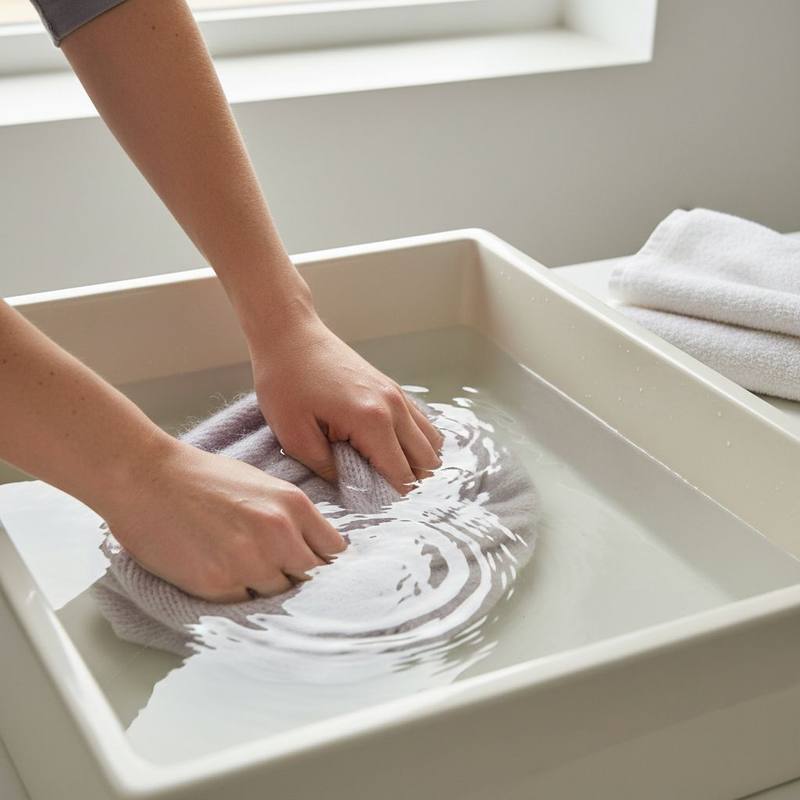
- Hand-wash sweaters and scarves without a no-water symbol yourself, in lukewarm water up to 30°C
- Dry flat and gently comb the fuzz with your fingers while it dries
- Check the label before every wash, especially for items bought secondhand
Don't
- Don't hand-wash items labeled dry cleaning only
- Don't try to straighten already flattened fuzz by washing it again and again
- Don't dry large, heavy mohair items on a hanger or in a tumble dryer
The costliest mistake
The biggest mistake is repeatedly hand-washing the same already-damaged item at home, hoping the next attempt will finally restore its fluffiness. Every further wash under the wrong conditions deepens the felting instead of reversing it, and an item that could still have been saved professionally ends up in the trash after a few such attempts.
Before deciding, check the label for a no-water symbol and check whether the stain is fresh or dried in. A fresh, small stain on an item without the no-water symbol you can usually remove safely at home yourself, following the rules described in the mohair washing guide.

Now you know the theory. Practice can be less forgiving.
If you would rather not risk your favourite piece, leave it to the specialists at Gorące Żelazko laundry in Lublin.


Frequently asked questions
Mohair is a fiber obtained from the hair of the Angora goat, an animal completely separate from the Angora rabbit. It is built from keratin, the same protein as other animal fibers, but is distinguished by a smooth cuticle and high luster.
Mohair comes from the hair of the Angora goat, and angora, if the fabric lacks the "mohair" designation, usually means rabbit Angora down. These are two different animal species and two different fibers: mohair has distinct luster, rabbit angora is matte and noticeably finer to the touch.
Kid mohair comes from the first 1 to 2 shearings, is around 23 to 26 micrometers thick and goes into clothing worn directly on skin. Adult mohair, from adult goats, is 32 to 38 micrometers or thicker and mainly goes into face fabrics and furniture upholstery.
Yes, especially if you see fuzz flattening, heavy soiling or have a valuable kid mohair item. Sweater washing starts at 40 PLN, and the cost of a home washing mistake often far exceeds this price.
It depends on the extent of the damage. Professional steam brushing usually improves light fuzz flattening noticeably. Deep, years-long felting over a large area of the item won't fully reverse with any method, which is why the laundry assesses the item's condition first, before accepting the order.
About the author
Małgorzata Małecka
Owner of the Gorące Żelazko laundry
Małgorzata Małecka runs the Gorące Żelazko laundry in Lublin. Together with her team, she makes sure customers' clothes, shoes and fabrics come back clean and in the best possible condition.