Vintage Lace and Curtains
Why they yellow and how to safely refresh them

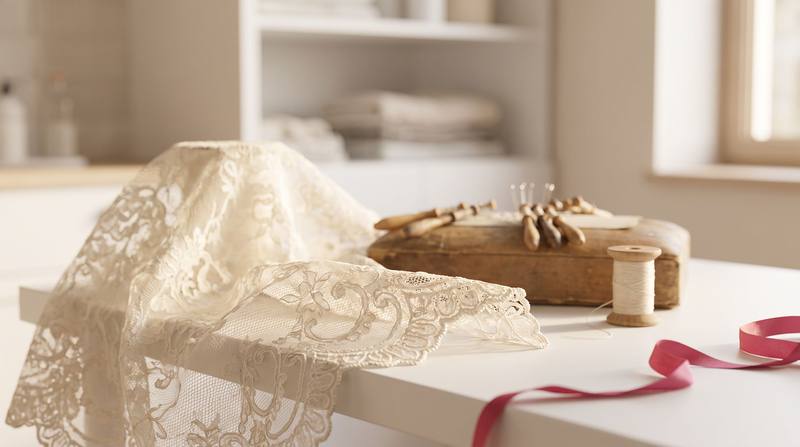
Yellowing of white or cream lace rarely has a single cause. Usually it's a combination of several independent processes, which explains why a gentle method works better than reaching for bleach.
- Cellulose oxidation (cotton, linen, viscose). Under atmospheric oxygen and trace metal ions such as iron or copper, hydroxyl groups of cellulose oxidize to carbonyl and carboxyl groups. This is what gives the fiber a yellowish tint. The process accelerates with moisture and elevated storage temperature.
- Degradation of silk fibroin. Silk yellows from sweat, that is, acids and salts, and long-term light exposure. Unlike cotton, this process involves partial breakdown of peptide bonds in the protein fiber.
- Loss of optical brighteners (OBA). Fluorescent compounds added during production gradually wash out and degrade under UV light, revealing the natural, slightly yellowish tone of the base fiber. This effect is often confused with 'dirt,' though washing cannot reverse it because it is irreversible.
- Acid migration from packaging. Untreated cardboard and wood contain lignin and organic acids that migrate to cellulose fiber during long-term contact, thus catalyzing further oxidation. This is precisely why proper storage materials matter so much, as you'll read about in the section below.
Gentle Whitening for Vintage Lace
- 1
Prepare whitening bath
Dissolve sodium percarbonate in a ratio of 10 to 15 g per liter of water at 40 degrees Celsius and soak lace for 60 to 90 minutes. A home alternative is 3% hydrogen peroxide diluted in a ratio of 1:6 to 1:10 with water, soaking for 30 minutes to a maximum of 2 hours, checking progress every 30 minutes.
- 2
Test on an invisible area
Before immersing the entire lace, test the reaction on a small, hidden area. Without precise temperature and time control, there is a risk of creating uneven, 'tiger stripe' bleaching patterns.
- 3
Neutralize and rinse
After the bath, rinse the lace thoroughly in clean water at the same temperature to remove whitening agent residue and neutralize the reaction.
Limitations of Home Method
Hydrogen peroxide and sodium percarbonate at home conditions do not give repeatable results without precise temperature and time control. Always test on an invisible area before the full whitening bath, and if the lace is truly valuable, consider professional assessment instead of experimentation.
How to Store Lace
Preventing yellowing, decay and damage to vintage pieces
You prevent yellowing, brittleness and so-called foxing (reddish-brown spots on old fabrics) through good storage, which is the cheapest form of conservation available.
This matters especially for family heirlooms and vintage lace: unique items, partly irreparable, that you cannot simply buy again in a shop.
Lace Storage Conditions
45 to 55% RH
Stable 18 to 20 degrees Celsius, without daily fluctuations exceeding a few degrees
Acid-free tissue paper, buffered with calcium carbonate, pH around 8 to 9.5 (typically 8.5)
Sealed plastic containers (condensation, mold) and untreated wood or acidic cardboard (acid migration)
Storage in darkness or minimal lighting; even diffuse daylight cumulatively degrades fiber
Wrap lace in acid-free tissue instead of folding it along the same lines each time. Long-term creasing in one place weakens the fiber exactly along the fold line, which after years ends in cracking right at that spot.

Now you know the theory. Practice can be less forgiving.
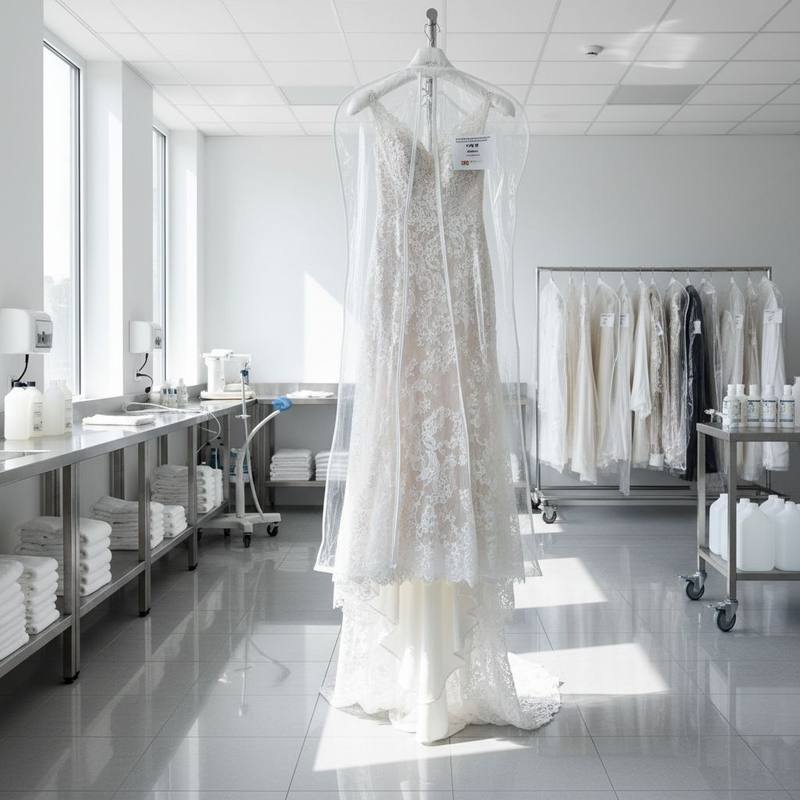
If you would rather not risk your favourite piece, leave it to the specialists at Gorące Żelazko laundry in Lublin.


Frequently asked questions
Use the same sodium percarbonate bath as for vintage lace, or alternatively 3% hydrogen peroxide diluted 1:6 to 1:10, soaking for 30 minutes to a maximum of 2 hours. Always test on an invisible area first.
Wrap the dress in acid-free tissue paper buffered with calcium carbonate. Keep it at stable 18 to 20 degrees Celsius with 45 to 55% RH, away from light. Avoid sealed plastic containers because they promote condensation and mold.
Use sodium percarbonate (10 to 15 g per liter of 40°C water, soak 60 to 90 minutes) or 3% hydrogen peroxide diluted 1:6 to 1:10, never chlorine, which permanently damages the fiber. Always test on a hidden section, and take genuinely valuable lace for professional assessment. Store it in acid-free tissue.
About the author
Małgorzata Małecka
Owner of the Gorące Żelazko laundry
Małgorzata Małecka runs the Gorące Żelazko laundry in Lublin. Together with her team, she makes sure customers' clothes, shoes and fabrics come back clean and in the best possible condition.