Vinegar as a natural fabric softener and washing machine descaler
Towels and clothes can come out of the wash stiff and rough, even when you regularly add store-bought fabric softener.

Towels and clothes can come out of the wash stiff and rough, even when you regularly add store-bought fabric softener. The usual culprit is leftover detergent residue that settles on fibres and doesn't disappear even after an extra rinse.
Vinegar is a proven, cheaper alternative, not an internet curiosity. Below you'll find exact doses, the correct dispenser, and the point where vinegar stops being enough.
Standard laundry powders are alkaline, with a pH around 9-11. Gels and liquid detergents are usually less alkaline, pH around 7-9.5, because a lower pH protects the enzymes and dyes in the formula.
Acetic acid from vinegar neutralises these alkaline detergent residues and loosens the fibre structure, which you feel as extra softness. That's a different mechanism than a store-bought softener: it builds a cationic layer on the fibre that physically lubricates it. Vinegar doesn't create that layer, so the effect is weaker and less lasting than with an industrial product.
Detergent dispenser or fabric softener dispenser: where does vinegar actually work?
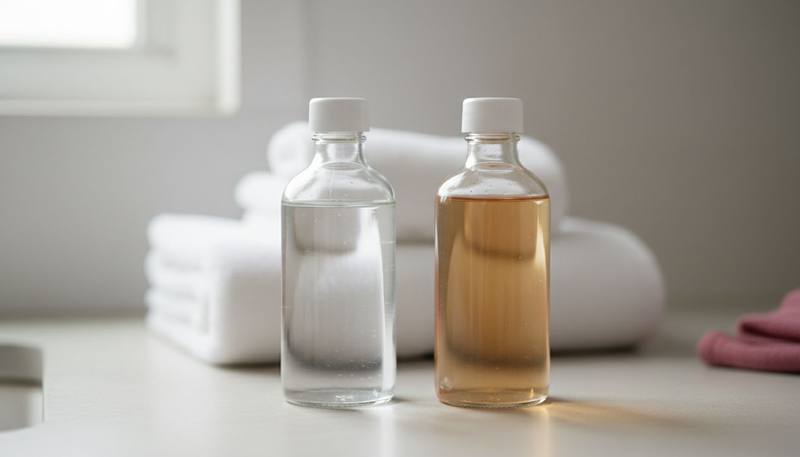
For laundry and descaling, choose only clear distilled white vinegar (10%) or spirit vinegar (6-10%). Never balsamic or coloured vinegar: the dye permanently stains light fabrics and the washing machine's seals.
Vinegar essence, meaning acetic acid at a concentration of 30-80%, isn't suitable for laundry. It's corrosive and needs dilution before it can go anywhere near fabric.
- 1
Choose the right vinegar
Clear distilled white vinegar (10%) or spirit vinegar (6-10% acetic acid). Never vinegar essence (30-80%): it's strongly corrosive to skin and eyes and needs dilution before use.
- 2
Pour it into the right dispenser
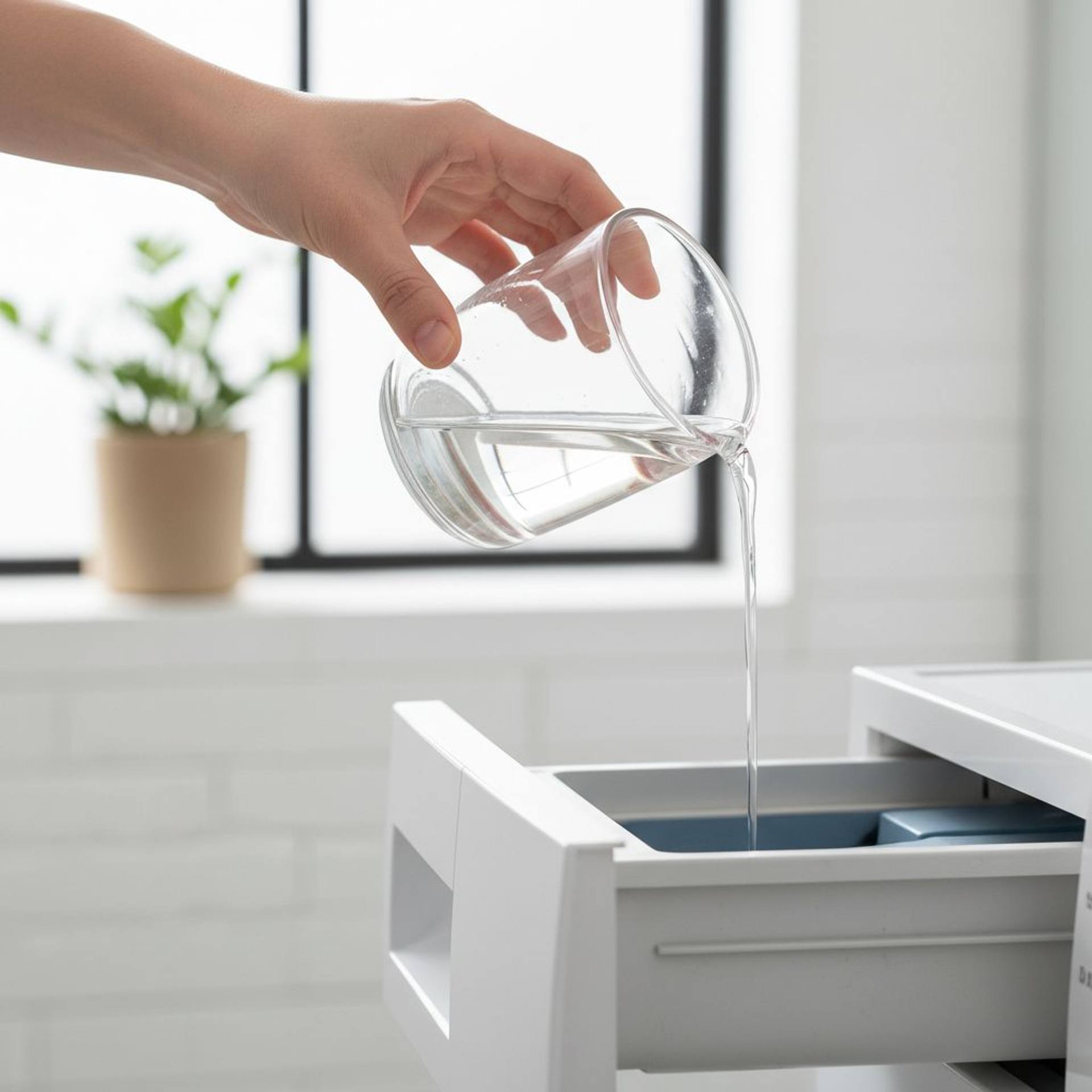
Pour 100-250 ml of vinegar per load into the fabric softener dispenser, never the detergent dispenser.
- 3
Add it separately from the powder
If your dispenser has a single shared compartment for liquids, don't mix vinegar with laundry powder in the same wash. Add them separately.
Before vinegar goes anywhere near your washing machine, one safety rule is non-negotiable, and it concerns what you combine it with.
Never combine vinegar with chlorine bleach, meaning sodium hypochlorite (CAS 7681-52-9). The reaction between the acid and the hypochlorite releases toxic chlorine gas, even at low concentrations of both agents. This also applies to other chlorine-based sanitary cleaning products, not just laundry bleach. If you suspect this reaction has happened, ventilate the room immediately and stop all contact with the products.
The rubber door seal on a washing machine handles a single contact with vinegar without any problem. Some industry sources indicate that prolonged, frequent contact with undiluted vinegar can speed up the ageing of the rubber. That's why you should pour vinegar into the dispenser, not directly onto the seal.
The smell of vinegar doesn't stay in the fabric permanently. It evaporates during rinsing and drying, as long as the dose is correct and the rinse cycle runs in full.
Why vinegar doesn't descale a washing machine as well as citric acid: comparing pH
The limescale that builds up on a washing machine's heating element and drum is mainly calcium carbonate (CaCO3) from hard water. Acetic acid reacts with it according to the equation: CaCO3 + 2 CH3COOH → Ca(CH3COO)2 + H2O + CO2. The resulting calcium acetate is water-soluble and disappears during the rinse cycle.
A descaling cycle works best at 60-90°C, run empty with no laundry inside. Pour 200-500 ml of vinegar directly into the drum. Frequency depends on your water hardness: once a month for very hard water, once a quarter for soft water.
Do
- Clear vinegar, 200-500 ml, on an empty, hot cycle at 60-90°C, once a month to once a quarter for hard water.
- Ventilate the bathroom or laundry room during the cycle: the vinegar smell dissipates once it's done.
Don't
- Don't mix vinegar with chlorine bleach in the same cycle or the next one.
A simple rule to remember: vinegar works well for the everyday care of cotton and linen, not for delicate fabrics or stubborn stains.
Wool, silk, and fabrics with a high elastane content, when they keep coming out stiff or staticky, are better entrusted to a laundry that matches the product to the specific fibre.
Vinegar ignores grease or protein stains: it lacks the surfactant properties typical of detergent.

Now you know the theory. Practice can be less forgiving.
If you would rather not risk your favourite piece, leave it to the specialists at Gorące Żelazko laundry in Lublin.


Frequently asked questions
Partly. It neutralises alkaline detergent residue and loosens the fibre, but it doesn't build a cationic layer on the fabric the way store-bought softener does. The effect is noticeable, but weaker and less lasting.
Pour 100-250 ml of clear white or spirit vinegar per load into the fabric softener dispenser, never the detergent dispenser. Acetic acid neutralises the alkaline residue from powder or gel that stays on the fibres, which makes the fabric noticeably softer. If your dispenser has a single shared compartment for liquids, add the vinegar separately, not mixed with detergent in the same wash.
A single contact doesn't cause harm. With prolonged, frequent use of undiluted vinegar directly on the seal, some industry sources point to a risk of accelerated rubber ageing, so pour vinegar into the dispenser, not onto the door seal.
Fresh, thin deposits, yes: 200-500 ml of vinegar on an empty 60-90°C cycle dissolves calcium carbonate. Thick, years-old limescale on the heating element usually needs a service call or a product with a higher acid concentration.
Both dissolve calcium carbonate, but citric acid has a different pH and tends to be more effective on thicker deposits. Vinegar is cheaper and easier to find, while citric acid handles tougher cases better.
About the author
Małgorzata Małecka
Owner of the Gorące Żelazko laundry
Małgorzata Małecka runs the Gorące Żelazko laundry in Lublin. Together with her team, she makes sure customers' clothes, shoes and fabrics come back clean and in the best possible condition.