What never to mix: hydrogen peroxide and vinegar
Mixing hydrogen peroxide with vinegar creates caustic peracetic acid. Learn what to do after contact and how to safely remove stains.

You're standing by the laundry with two bottles: hydrogen peroxide and food-grade vinegar. You want to boost your homemade stain remover or replicate something you read online about disinfection.
The answer is simple: never mix them, not in one container or one after the other on the same fabric without thorough rinsing between applications.
This applies equally to people experimenting with homemade chemistry, parents seeking a gentler alternative to bleach, and anyone battling stubborn protein stains or mould.
Intuition suggests two strong agents together will work better. In this case, intuition is wrong.
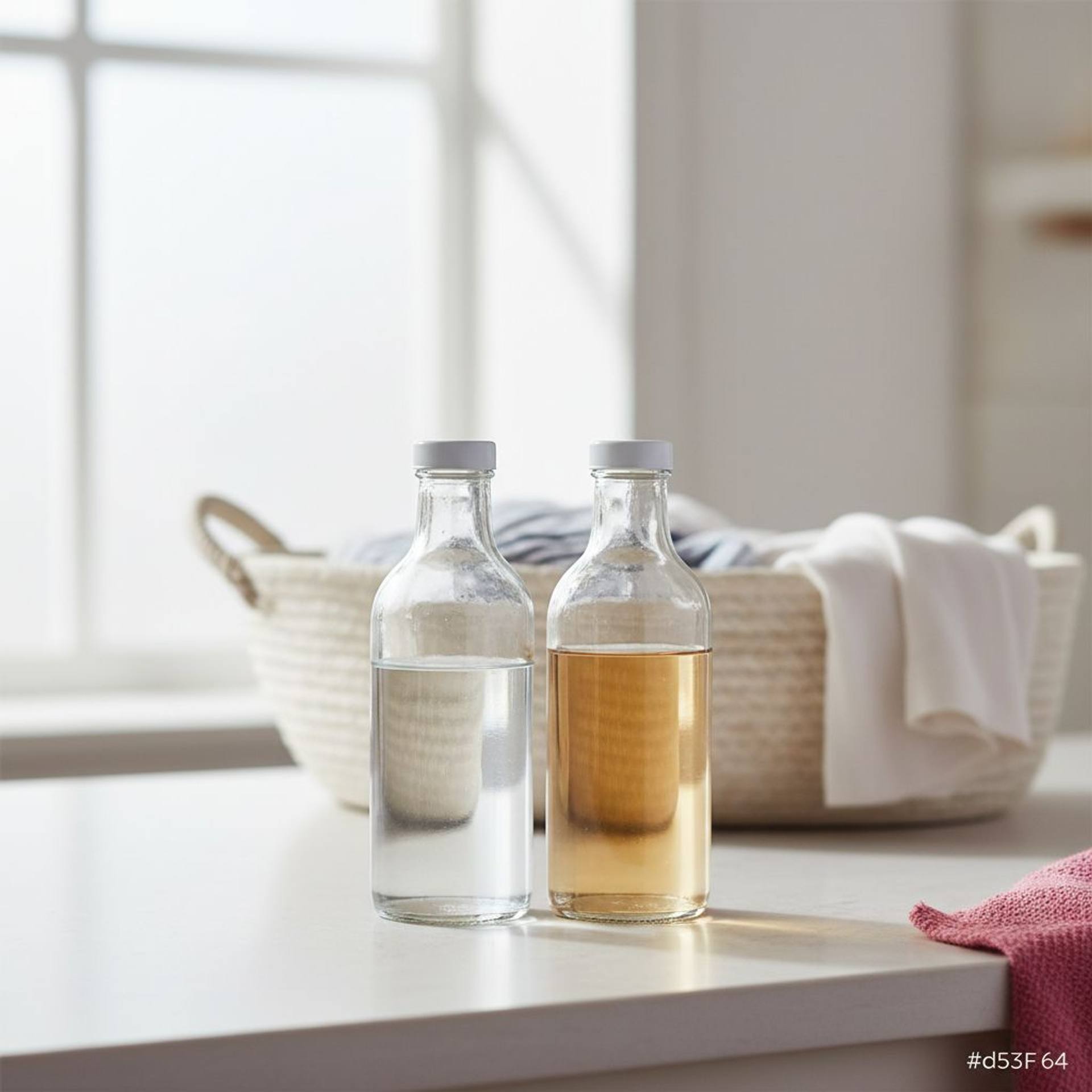
Never mix these two liquids
Never mix hydrogen peroxide and vinegar in one container or apply them one after the other on the same surface without rinsing between applications. The reaction creates peracetic acid (CAS 79-21-0), a caustic and irritating compound, far stronger than either ingredient alone. Do not store the prepared mixture in a sealed container: it releases oxygen, which increases pressure inside.
How peroxide reacts with vinegar
reactive oxides and oxidising effects on fibres
When they meet, the two components form peracetic acid in an equilibrium reaction:
- Hydrogen peroxide: CAS 7722-84-1, 3-9% in household products
- Acetic acid: CAS 64-19-7, 5-10% in food-grade vinegar
The reaction itself is mildly exothermic. At room temperature it proceeds slowly, but heat and an acidic environment speed it up, acting as an autocatalyst. Trace iron ions from hard water do not directly drive this equilibrium, but they accelerate the breakdown of hydrogen peroxide, raising temperature and speeding the entire reaction.
Result: the mixture has stronger caustic and oxidising properties than hydrogen peroxide and vinegar separately.
Peracetic acid (peroxyacetic acid)
CAS 79-21-0. Under harmonised GHS classification (CLP entry 607-094-00-8), it carries these hazard statements: - H226: flammable liquid - H242: heating may cause fire - H314 (category 1A): causes severe skin burns and eye damage - H332: harmful if inhaled - H335: causes respiratory irritation at concentrations of 1% and above - EUH071: acts corrosively on the respiratory tract Professionally it is used only in diluted, stabilised solutions, for example in food and medical disinfection. A homemade mixture has no control over concentration or stabilisation: the compound is unstable and decomposes, releasing oxygen and pungent, irritating vapours.
These vapours have a sharp, acrid smell and irritate mucous membranes almost immediately. In an enclosed space, such as a spray bottle, a washing machine drum, or a small bathroom, their concentration rises quickly past the irritation threshold.
That is why the first symptoms appear almost immediately after mixing, not an hour later.
Symptoms of exposure
Skin: redness, burning, and at higher concentrations, surface chemical burns. Eyes: intense tearing, pain, redness, and with longer contact, risk of corneal damage. Inhalation: coughing, throat and airway irritation. In people with asthma, possible airway constriction, though this data comes mainly from occupational exposure, not from one-off household contact.
If you have already mixed them, the order of actions matters more than panic. Below are four steps that limit exposure and allow you to clean up safely.
- 1
Ventilate the space
Open a window, and if you feel respiratory irritation, go outside immediately. Vapour concentration in a closed space rises fast.
- 2
Rinse skin and eyes
If the mixture touches your skin or eyes, rinse immediately with plenty of running water for at least 15 minutes. Do not stop rinsing early, even if the burning subsides.
- 3
Do not seal the container with the mixture
The mixture releases oxygen, so a sealed container can build pressure. Pour it out away from other chemicals and do not add anything else to it.
- 4
Contact a doctor if symptoms persist
Coughing, eye pain, or skin irritation that does not ease after ventilation and rinsing warrants medical attention.
Keeping the two agents separate in time and space is sometimes suggested as a safer approach, though there is no clear consensus in household conditions: the original research concerned disinfecting tissue, not washing fabric. If a garment truly requires both vinegar and hydrogen peroxide, rinse it thoroughly with clean water between one treatment and the other.
In a professional laundry, oxidising agents and acids are applied separately, in controlled concentrations, temperatures, and times, on separate lines, with full rinsing between stages. This control sets the laundry apart from an experiment in your own kitchen.
Where did the idea to combine these two come from? Likely from research by Susan Sumner (Virginia Tech, 1990s), which studied applying both liquids separately, from two different bottles, to the same surface, not mixing them in one container. The study is sometimes cited as a publication in Journal of Food Protection, though the exact citation is not confirmed one-to-one. This difference in method gets lost when advice is reposted online, and it is sometimes wrongly attributed directly to USDA.
Do and dont
- Use hydrogen peroxide and vinegar separately, with thorough rinsing of the fabric in clean water between treatmentsRequired
- Ventilate, label bottles, and store agents separately, out of reach of children and animalsRequired
- For stubborn stains or delicate or coloured fabric, take the item to a professional laundry instead of making a stronger homemade mixtureRequired
- Mix both liquids in one container or apply one after the other without rinsingRecommended
- Store a prepared mixture in a sealed containerRecommended
- Use this combination on delicate or coloured fabricsRecommended

Now you know the theory. Practice can be less forgiving.
If you would rather not risk your favourite piece, leave it to the specialists at Gorące Żelazko laundry in Lublin.


Frequently asked questions
No. The reaction creates peracetic acid, a caustic and irritating compound, far stronger than either ingredient alone. We describe the mechanism of this reaction above, in the section on how peroxide reacts with vinegar.
Ventilate the space. If the mixture touched your skin or eyes, rinse with water for at least 15 minutes. Do not seal the container and pour the mixture away from other chemicals. If symptoms persist, seek medical attention.
Yes, they can cause coughing and throat irritation, and in people with asthma, even airway constriction. Most such data comes from occupational exposure, so one-off household contact is usually milder, but caution is worthwhile.
Use both agents separately, with thorough rinsing of the fabric between applications. For stubborn stains or delicate material, it is safer to take the item to a professional laundry than to experiment with a homemade mixture.
About the author
Małgorzata Małecka
Owner of the Gorące Żelazko laundry
Małgorzata Małecka runs the Gorące Żelazko laundry in Lublin. Together with her team, she makes sure customers' clothes, shoes and fabrics come back clean and in the best possible condition.