Detergent Dosing Guide: More Is Not Always Better
Too much powder doesn't wash cleaner. Learn the overdosing mechanism, a simple dosing rule, and how to fix stiff, over-treated clothes.

You add more powder because you think it will "definitely wash better," right? The opposite is often true. Grey residue on dark clothes, stiff fabric after drying, foam leaking from under the washing machine door.
This is the result of a single myth: more detergent doesn't remove more dirt. Customers dose by eye with the cup from the box or always add the same amount, regardless of load size.
Spot overdosing right away: grey residue on dark clothes and foam leaking from the washing machine door despite the correct cycle. Add to that a musty smell from the drum that returns even after cleaning.
Every surfactant has a saturation threshold: critical micelle concentration (CMC). Once you exceed it, extra detergent doesn't form new micelles to remove fat. It just stays in the wash water as excess.
That excess turns into foam, and foam dampens the friction between the drum and the fabric. Friction is one of the pillars of washing alongside temperature, time, and chemistry (Sinner's circle). Less friction means worse washing despite more product.
Un-rinsed residue settles on fibres as a stiff deposit, especially visible on dark fabrics. The risk rises below 30°C because some powder ingredients dissolve more slowly.
Too little detergent causes trouble for a different reason: not enough surfactant to keep dirt suspended. Soils lift off the fabric and settle back on it, a phenomenon called redeposition, which shows up as greying. Detergent residue in the door seal also promotes biofilm and unpleasant odour.
Hard Water Changes Everything
why the same dose doesn't always work
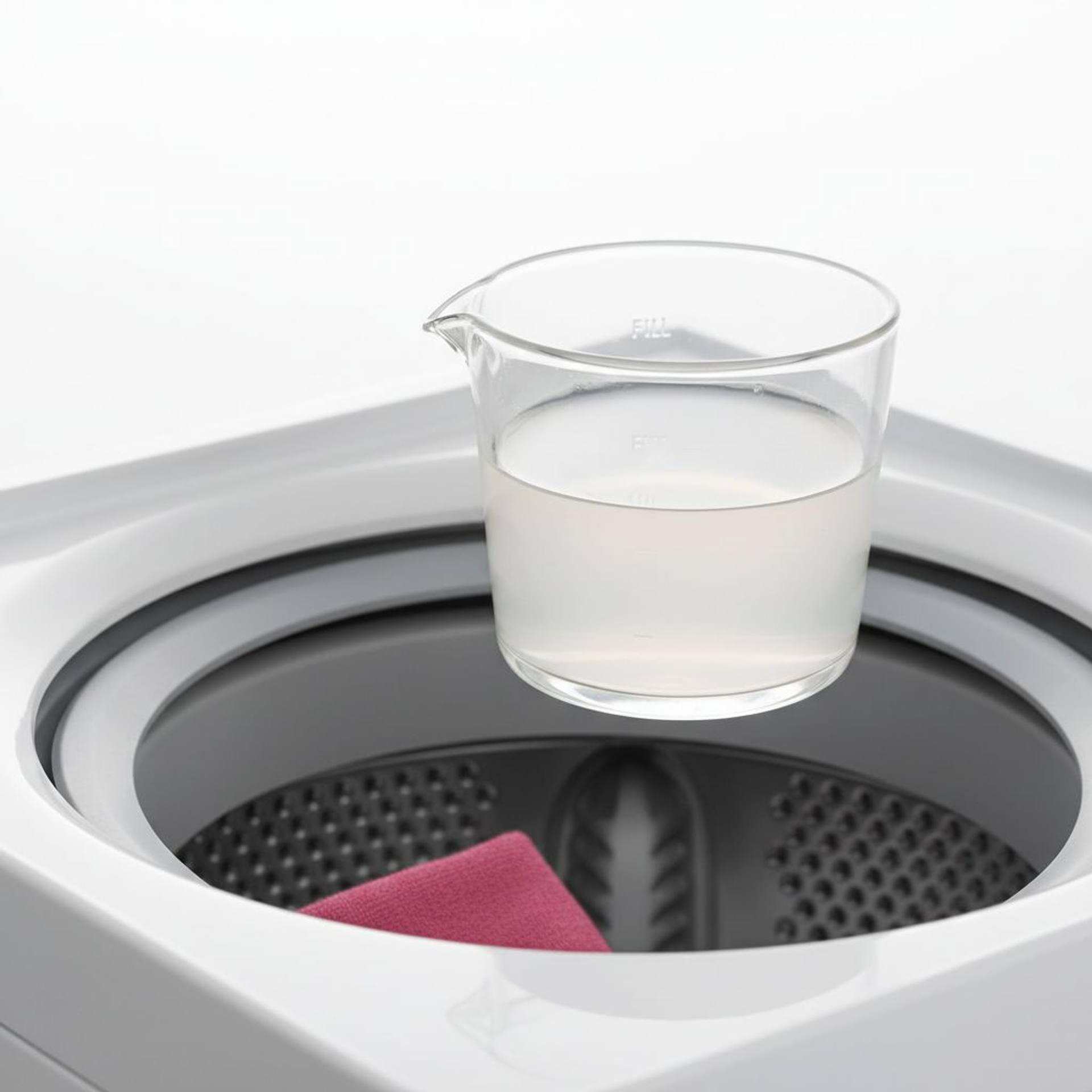
The right dose depends on three variables: water hardness, load size, and detergent form (powder, gel, capsule). The dose on the label is always a baseline for medium-hard water (1.5-2.5 mmol CaCO3/l). Other hardness classes require adjustment.
- 1
Check Your Water Hardness
Soft water is below 1.5 mmol CaCO3/l, medium is 1.5-2.5, hard is above 2.5 (or below 8.4, 8.4-14, and above 14°dH respectively). Find your class on the label and increase the dose for hard water.
- 2
Estimate Load Weight
The test reference load per EN 60456 is 5 kg of cotton. Smaller loads need smaller doses, even with the same water hardness.
- 3
Match the Unit to Detergent Form
Measure powder in grams or cup marks. Measure gel in millilitres on the cap lines (read on a flat surface). A capsule is always one per full load.
- 4
Lower Dose Below 30°C
Don't use the full dose for higher temperatures then: the risk of incomplete powder dissolving and residue on fabric rises.
Level the cup to the line, don't overfill. Hold the gel cap flat when reading the marks, or it's easy to overflow the dose.
Do
- Adjust the dose to load size and water hardness
- Read the measuring lines on a flat surface
- For children's clothes and sensitive skin, use a lower dose and add an extra rinse
Don't
- The same detergent amount regardless of load size
- Measuring cup filled to the top
- Adding detergent "to be sure" for stubborn stains instead of pre-treating with a stain remover
- Full powder dose below 30°C
The Limits of Home Detergent
what won't clean, even with the right dose
If your clothes already have grey buildup from overdosing, an extra rinse cycle with no detergent usually helps: it removes most of the un-rinsed surfactant from the fibres.
Home detergent has limits, though: delicate fabrics, heavy loads like duvets, and fabrics requiring different technology than home washing. In those cases, even the perfect dose won't give professional results.

Now you know the theory. Practice can be less forgiving.
If you would rather not risk your favourite piece, leave it to the specialists at Gorące Żelazko laundry in Lublin.


Frequently asked questions
As much as the manufacturer states on the label as the baseline dose for medium-hard water. Adjust it down for smaller loads and up for hard water. There's no universal number in grams: it depends on product concentration.
Once you exceed the saturation threshold, extra surfactant doesn't remove more dirt, it turns into foam that dampens the friction of the drum on the fabric. The result is worse washing, stiff residue, and leftover in the door seal.
Automatic systems measure the load weight and dose gel proportionally from a separate tank, so you don't set the amount manually for each wash. Just refill the tank and configure water hardness in the machine once.
That's usually redeposition described above, the result of too little detergent. Check three things: are you dosing by load size, do you account for water hardness, and is the cup level to the line, not overfilled.