Why softener ruins fleece
The aha moment: how a cationic layer clogs the nap and robs it of warmth

Fabric softeners, meaning rinse-in liquids, work by depositing cationic surfactants on the fiber surface, most often quaternary ammonium salts. On natural fibers like cotton or linen, this creates a thin, slippery layer that reduces friction between fibers and creates a softness feel to the touch.
On fleece's microfibers, this same chemical mechanism works exactly opposite, because it meets a completely different geometry of material. Fleece is a knit made from very fine polyester fibers, brushed into a fluffy pile full of microscopic air channels. It is precisely these channels, not the thickness of the yarn itself, that account for the material's warmth and lightness.
Three concrete effects of softener on the pile
channels, detergent and static, meaning exactly where the warmth escapes
The first is clogging of microscopic channels between nap fibers, meaning those same empty spaces responsible for trapping air, thermal insulation and moisture wicking. After several washes with softener, the thermal insulation properties of fleece drop noticeably, not just subjectively perceived.
Linked to this effect is a second: reduced detergent effectiveness in subsequent wash cycles, because the cationic coating makes it harder for detergent to reach fatty stains, which therefore more easily stick to the fiber.
The third, less obvious effect concerns static. Softener's antistatic effect is not permanent: after a few washes the material returns to high electrification, because the coating wears unevenly.
What fleece actually loses after softener
Drops permanently and worsens with every wash that uses softener
Gets worse, because the pile's channels are clogged with a cationic layer
Declines over subsequent washes, fat stains stick to the fiber more easily
Short lived, fades after a few washes as the coating wears off
Never do this
Never use softener on fleece. The effect of loss of thermal insulation is permanent and increases with each subsequent wash, unlike many other laundry mishaps where you can at least partially avoid the damage with a single mistake.
How to wash fleece without softener, step by step
four steps that protect the pile's thermal insulation
- 1
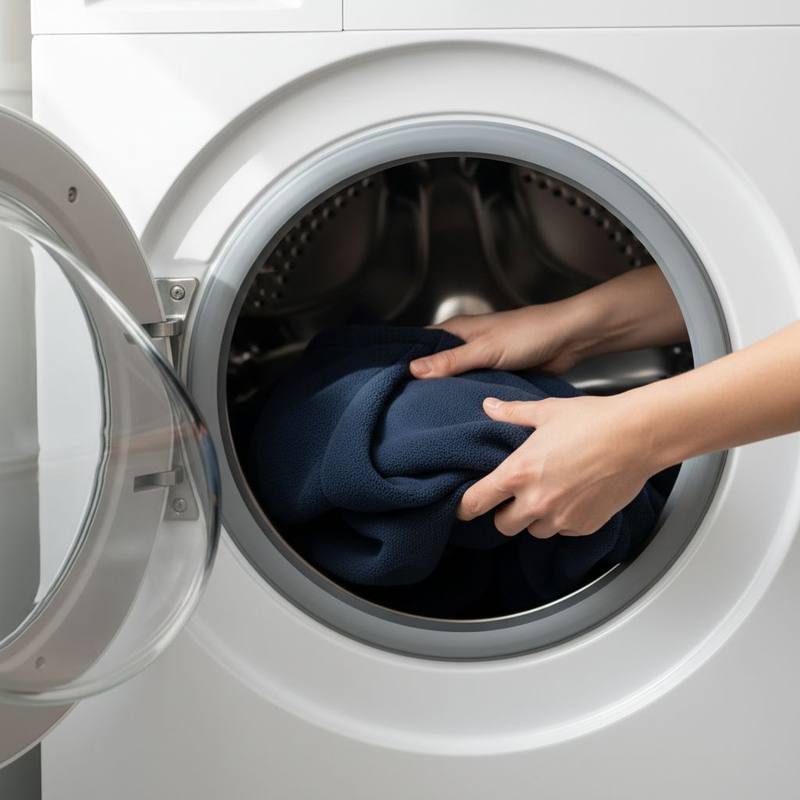
Turn fleece inside out
With the nap facing inward, it rubs less against the drum and other clothes, so it keeps its fluffiness longer and pills less.
- 2
Use less detergent than for cotton
Excess detergent settles into the pile's channels much like softener does, and partly robs it of warmth. About half the dose recommended for a similar amount of cotton is enough.
- 3
Replace softener with vinegar in the rinse compartment
Spirit vinegar neutralizes detergent residue and improves the pile's softness without creating an occlusive layer, unlike softener.
- 4
Dry on low heat and shake out the pile
High dryer heat can cause polyester fibers to mat together. Dry on low heat or air dry, then shake the garment out at the end so the pile regains its fluffiness.
A substitute for softener is about 60-100 ml, or half a cup, of 10% spirit vinegar added straight to the rinse compartment, without diluting it. Vinegar neutralizes detergent residues by lowering the fabric's pH, and improves mechanical softness without creating an occlusive layer on the fiber. Do not mix vinegar with chlorine bleach in the same cycle, as the reaction releases gaseous chlorine.
Common mistakes when washing fleece
Many people assume softener is safe, since the label promises protection against static. On top of that comes too large a detergent dose, which leaves a residue in the pile similar to softener, and drying at high heat, which further flattens and mats the fibers. A separate mistake is ironing fleece, which cannot be safely ironed at any temperature without risking melting the fiber.
Washing fleece in a nutshell
Do
- Turn fleece inside out before washing
- Use about half the usual detergent dose
- Replace softener with spirit vinegar in the rinse compartment
- Dry on low heat and shake out the pile once dry
Don't
- Don't use fabric softener for any fleece wash
- Don't dry fleece at high dryer heat
- Don't iron fleece at any temperature
- Don't mix vinegar with chlorine bleach in one cycle
Is the loss of warmth reversible
how many washes without softener it takes to regain insulation
The loss of warmth from softener does not reverse in one wash, because the cationic layer built up gradually, cycle by cycle, and it needs to be removed just as gradually. A few washes without softener, with vinegar in the rinse compartment and a moderate detergent dose, usually improves the situation noticeably, because each subsequent cycle rinses out more of the coating's residue from the pile's channels.
A full return to the state before the first use of softener is not always possible, especially if the fleece was washed with it many times. Some of the channels may have permanently matted or pilled from rubbing against the leftover coating. If after several washes without softener the pile still looks flattened and does not give back its former warmth, that is a sign home methods have reached their limit.
Worth knowing
Fleece does not naturally need softener at all. Polyester fibers are smooth and have no scales like wool or cotton, so the pile is soft to the touch right after being made, with no chemical help needed. The only effect softener really delivers on fleece is a short lived reduction in static, paid for with a permanent loss of warmth.

Now you know the theory. Practice can be less forgiving.
If you would rather not risk your favourite piece, leave it to the specialists at Gorące Żelazko laundry in Lublin.


Frequently asked questions
No. Softener deposits a cationic layer on nap fibers that clogs the microscopic channels responsible for thermal insulation and moisture wicking. The effect of lost warmth is permanent and worsens with each wash. Use 60-100 ml of 10% spirit vinegar in the rinse compartment instead.
Instead of softener, add 60 to 100 ml of 10 percent spirit vinegar to the rinse compartment. Vinegar neutralizes detergent residue, improves softness, and leaves no occlusive layer on the pile. Don't mix it with chlorine bleach in the same cycle.
Not fully. The cationic softener layer clogs the pile's microscopic channels responsible for insulation, and the effect builds with each wash. A few washes without softener, using vinegar in the rinse, partly improves it but doesn't always fully reverse it.
Softener's antistatic effect is short lived and wears off unevenly after just a few washes, so the material returns to high electrification. At the same time, the channels the softener has clogged worsen moisture wicking, which further encourages static buildup.
No. Fleece must never be ironed at any temperature, because the polyester fiber melts and flattens permanently. Fluffiness is restored by shaking the garment out after drying it on low heat, not by ironing it.
About the author
Małgorzata Małecka
Owner of the Gorące Żelazko laundry
Małgorzata Małecka runs the Gorące Żelazko laundry in Lublin. Together with her team, she makes sure customers' clothes, shoes and fabrics come back clean and in the best possible condition.