Washing fleece without losing fluffiness
Why napped fleece knit needs different spin speeds than smooth, woven polyester

Fleece, a polyester knit with a napped surface, is one of the most frequently washed synthetic materials in home washing machines. Sweatshirts, vests, blankets and the inner layers of winter jackets owe their warmth to the structure of the nap, a dense layer of loose fiber ends that trap air against the skin.
That same structure makes fleece react to washing differently than smooth, woven polyester used, for example, in rain jackets. High spin speeds and an overstuffed drum mechanically “compress” the nap much harder than flat fabric, leaving visible compression marks in the form of flattened bands.
Why fleece loses its loft
the structure of napped knit and how pilling forms
The nap is created through a brushing process, in which a machine pulls out and combs individual fibers on the surface of the knit. These fibers are not woven deep into the fabric's structure, so they are more easily damaged than the fibers of woven fabrics.
Polyester is a thermoplastic fiber. Under the influence of heat and friction inside a working drum, it partially loses elasticity, so the nap does not fully return to its original height after drying. Friction between garments is also responsible for pilling, the small balls of twisted fibers that form on the surface.
Washing parameters step by step
temperature, spin speed and detergent matched to the nap's structure
Fleece washing parameters
Temperature: 30°C, maximum 40°C
The standard temperature is 30°C on a delicate program or for synthetics. At stronger soiling, you can raise it to a maximum of 40°C. Above this temperature, the risk of permanent compression and flattening of the nap increases, because thermoplastic PET fibers begin to lose elasticity with prolonged exposure to warm water combined with drum action.
Spin speed: 600-800 rpm
Higher spin speeds intensively compress the nap and can leave permanent compression marks. Limiting spinning to 600-800 revolutions per minute is the simplest way to ensure your fleece looks just as fluffy after washing as it did before.
Drum fill: 50-60%
Fleece needs space for water to flow freely. With a full drum, friction between items increases, which intensifies pilling. Wash separately from fabrics that generate large amounts of lint, like terry towels or cotton sweats, because the nap fibers attract foreign fibers electrostatically.
Detergent: liquid
Liquid detergent is preferred over powder, because powder residue gets trapped in the dense nap and is hard to rinse out completely. Detergents with enzymes, lipases and proteases help with fatty and protein stains. The standard enzyme activation temperature of 30-40°C coincidentally matches the recommended fleece washing temperature.
Bleach: chlorine-free
Polyester is chemically resistant to chlorine at low concentrations, but chlorine bleach destroys spandex blends if the fabric contains them, and accelerates yellowing of light and white fleece.
Dryer: maximum 60°C, gentle program
Tumble dryers are permissible at low temperatures, around 60°C, on a synthetic or delicate program. However, it intensifies pilling and microfiber emissions more than air drying, so drying without a machine remains the safer choice.
Washing fleece in practice
- 1
Prepare the fleece
Fasten velcro and zippers, and turn the garment inside out. Separate fleece from towels and cotton sweats.
- 2
Set the program
Delicate or synthetics program, 30°C, maximum 40°C for stronger soiling, spin speed 600-800 rpm.
- 3
Add detergent
Pour in liquid detergent without softener. Do not overfill the drum, fleece needs space for water to flow.
- 4
Air dry
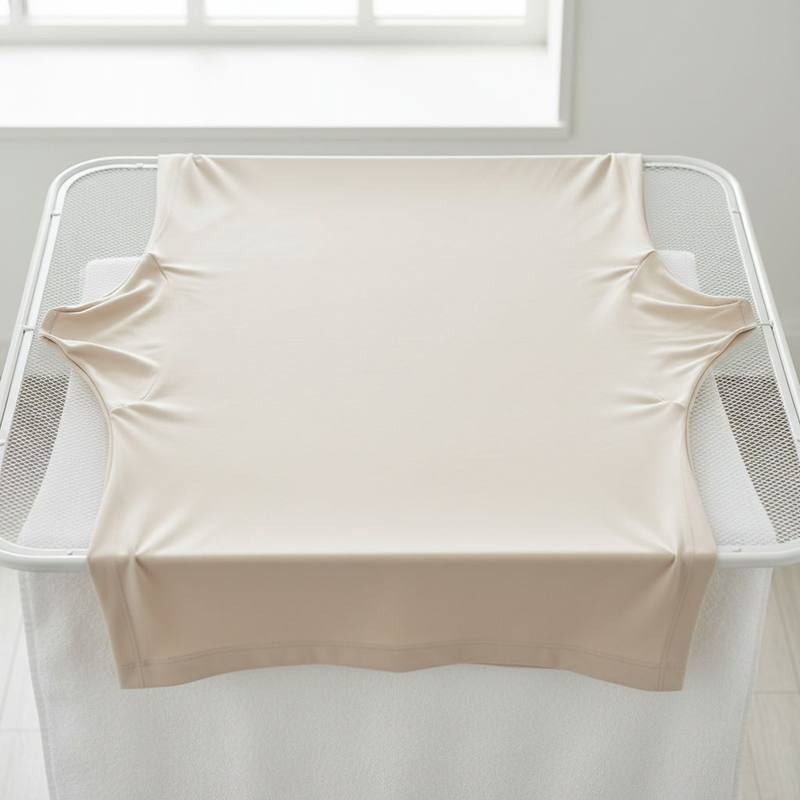
Lay flat or hang on a thick hanger, away from radiators. In a tumble dryer, use a delicate program up to 60°C.
Common mistakes when washing fleece
what to avoid so the nap does not lose its loft
Washing fleece in a nutshell
Do
- Wash at 30°C, maximum 40°C for stronger soiling
- Limit spin speed to 600-800 rpm
- Use liquid detergent, ideally with enzymes
- Air dry or use a delicate tumble dryer program up to 60°C
Don't
- Do not use fabric softener, it coats the fibers and flattens the nap
- Do not wash fleece with terry towels or velcro-fastened clothes
- Do not dry on a radiator or in direct, strong sunlight
- Do not bleach with chlorine, it accelerates yellowing of light colors
Washing fleece together with velcro-fastened jackets or backpacks mechanically “combs” and tears nap fibers, intensifying pilling exactly at contact points with the velcro. Fasten velcro before washing or wash such items separately.
Why fabric softener damages fleece
Fabric softener coats the fibers with a thin, waxy layer that glues down the loose fiber ends of the nap and permanently flattens it. It also clogs the microscopic spaces between fibers, so the fleece wicks moisture less effectively.
When to take fleece to a laundry
signs that home washing is no longer enough
If, despite following the correct temperature and spin speed, fleece looks permanently flattened, dull or covered in dense pilling after several washes, another home wash usually will not reverse it.
Professional cleaning selects agents and a program matched to the fabric's current condition, so it is better to take the item to a laundry before further attempts deepen the damage.
Refreshing instead of washing
Fleece that only smells faintly after a single day of wear does not always need a full wash. A short airing outdoors is often enough to remove the odor without an extra spin cycle.

Now you know the theory. Practice can be less forgiving.
If you would rather not risk your favourite piece, leave it to the specialists at Gorące Żelazko laundry in Lublin.


Frequently asked questions
At 30°C, on a delicate or synthetics program. For stronger soiling, you can raise the temperature to maximum 40°C, but not higher, as the risk of permanent nap flattening increases.
Choose a delicate or synthetics program, with spin speed limited to 600-800 rpm. Fill the drum to a maximum of 50-60% capacity.
It is best to wash separately from terry towels, cotton sweats, denim and velcro-fastened items. Velcro mechanically combs out the nap, while rough fabrics intensify pilling.
No. Fabric softener coats the fleece fibers with a waxy layer that glues them together and permanently flattens them, while also reducing the fleece's ability to wick moisture.
When, despite the correct temperature and spin speed, the nap stays flattened, dull or covered in dense pilling. Professional cleaning selects agents and a program matched to the fabric's condition.