Self-tanner stains: why they darken over time
Why self-tanner stains darken instead of fade: DHA reaction mechanism, first aid for fresh stains, and when to call professionals.

You applied self-tanner last night. By morning, there wasn't a trace on your favourite blouse. Three days later, after washing, you spot a brown streak exactly where the fabric touched your skin.
This isn't an ordinary stain that stubborn. With most dirt, there's a simple rule: the longer you wait, the harder it gets, but the stain itself doesn't darken over time. Self-tanner breaks that rule. A fresh mark might barely show, then it grows darker on its own, sometimes even more so after washing in warm water or pressing with an iron.
The culprit is DHA, the active ingredient in self-tanners, and a chemical reaction closer to baking bread than ordinary staining. Find out what's happening and what you can realistically do before the stain sets in.
Why stains darken over time
DHA reaction with fabric protein, accelerated by heat and time
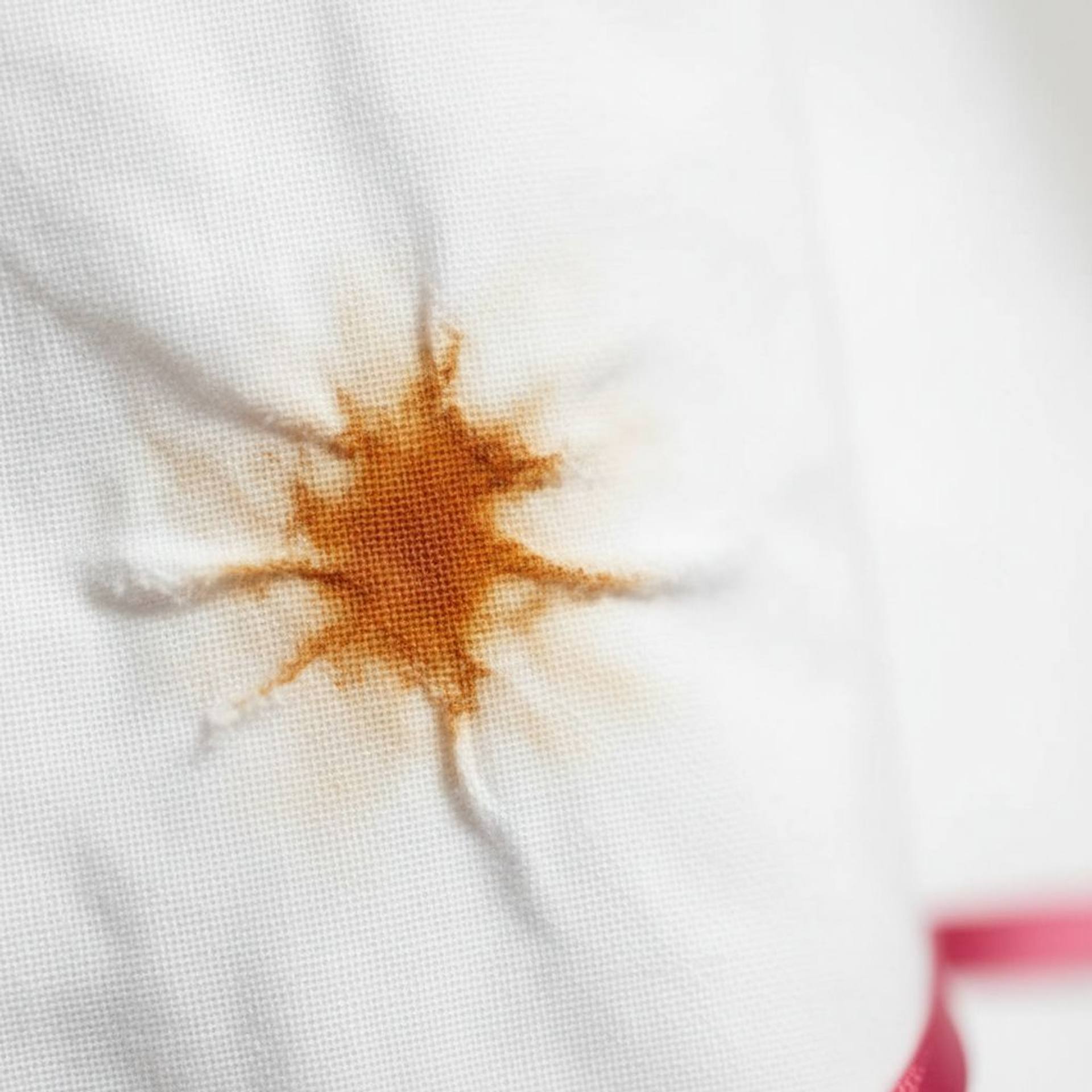
Dihydroxyacetone, or DHA, is a simple sugar used in self-tanners at concentrations from a few to twenty percent. DHA reacts with amino groups in proteins through the Maillard reaction, the same process that browns bread crust in an oven.
On wool and silk, made of protein, the reaction happens directly with the fibre. On cotton and linen, where the fibre is cellulose without amino groups, the stain comes mainly from dried product plus sweat and skin protein residue.
The reaction doesn't stop immediately. Colour deepens over hours and days, further oxidised by air. General chemistry says that each 10°C increase roughly doubles reaction speed, though nobody has directly measured this for DHA on fabric, so treat it as probable direction, not certainty. That's why an iron or clothes dryer on a fresh stain is unnecessary risk, not a solution.
Do
- Rinse stains with cold water immediately
- Wash at low temperature matching the label
- Act within hours, not days
Don't
- Iron fresh stains
- Dry in a clothes dryer before washing
- Leave laundry for several days
- Scrub stains dry
On a fresh, still-pale stain, you have a real chance before the Maillard reaction completes. The principle is simple: no heat, only cool water and a gentle oxidant matched to fabric colour and weave.
- 1
Don't dry, don't iron
Set down the iron and clothes dryer. Treat the stain as soon as possible before the reaction deepens.
- 2
Rinse with cold water
Rinse the stain from the back of the fabric under running, cold water.
- 3
Apply hydrogen peroxide
On white cotton or linen, apply 3% hydrogen peroxide for 10-15 minutes. On colours and elastane blends, skip this step as it risks bleaching.
- 4
Wash according to label
Wash at the temperature shown on the care label, never at 60°C or higher.
Hydrogen peroxide also oxidises fabric dyes, so on coloured materials and elastane blends there's a risk of bleaching. Always test on a hidden area of fabric before using any oxidant.
If the stain is already dark and set because days have passed or you've applied heat to it, the realistic outcome of home methods is lightening, not complete removal.
A baking soda paste applied for 15-20 minutes can slow further oxidation, but it doesn't remove melanoidins, which have already bonded to the weave. Dishwashing liquid with protease works only on the protein fraction from sweat and sebum, not on DHA itself, so results are often partial.
Vinegar as a "neutraliser" is a forum claim without confirmed chemical backing. Treat it as a curiosity, not a reliable method.
Sodium hypochlorite can be used only on white cotton and linen. Never on wool, silk, or elastane fabrics, as it risks fibre degradation. It can also irritate airways and skin on direct contact.
Why call a professional
Limits of home methods
Consider professional help for stains older than a few days, or ones already treated with heat, or those on delicate or coloured fabric where home oxidants are too risky.
Laundries use oxidants in controlled concentrations, matched to specific fabric: sodium percarbonate on colours resistant to oxygen bleaching, sodium hypochlorite only on white cotton and linen. They add enzymatic pre-treatment and wash at temperatures suited to the label, delivering better results than a single home product without temperature control.
Before reaching for strong oxidant on delicate or coloured fabric, ask the laundry for an initial assessment. The wrong product can be harder to fix than the self-tanner stain itself.

Now you know the theory. Practice can be less forgiving.
If you would rather not risk your favourite piece, leave it to the specialists at Gorące Żelazko laundry in Lublin.


Frequently asked questions
Usually yes, but the realistic outcome is lightening, not complete removal. It depends on the fabric, stain age, and whether heat was applied to it beforehand.
Always follow the care label and never use 60°C or higher. Hot water acts like extra heat treatment and sets the stain rather than removing it.
Sodium hypochlorite only on white cotton and linen, never on wool, silk, or elastane fabrics. On colours, sodium percarbonate works better.
Yes, thanks to controlled oxidants and enzymatic pre-treatment matched to the fabric. The exception is very old stains already heat-set, where lightening, not full removal, is the likely outcome.
About the author
Małgorzata Małecka
Owner of the Gorące Żelazko laundry
Małgorzata Małecka runs the Gorące Żelazko laundry in Lublin. Together with her team, she makes sure customers' clothes, shoes and fabrics come back clean and in the best possible condition.