Protein stains: why cold, not hot
Blood, milk, and sweat require a different approach than other stains, and the decision must be made in minutes.

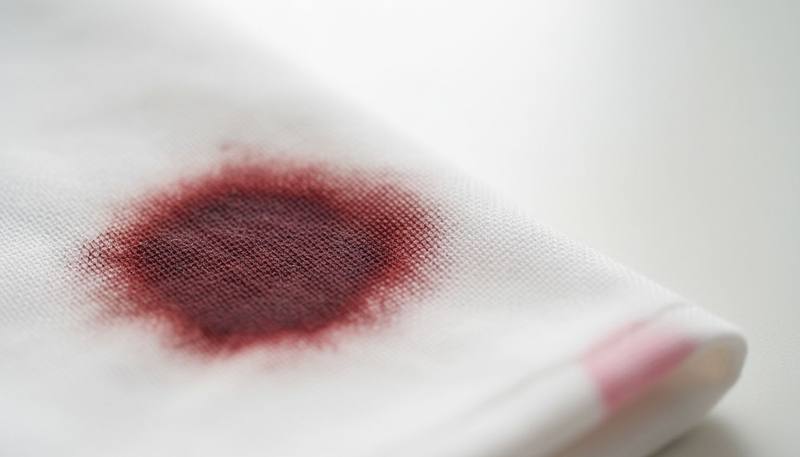
Blood, milk, egg, sweat, saliva, or vomit are all one category for a laundry: protein stains. They react differently from grease or mud and require a different approach from the very first second.
You're now in one of two situations: the stain is fresh and can still be saved in a few minutes, or you've already washed it in hot water and are wondering if anything can be done. The answer depends on the water temperature in the next step.
First aid at a glance
Do
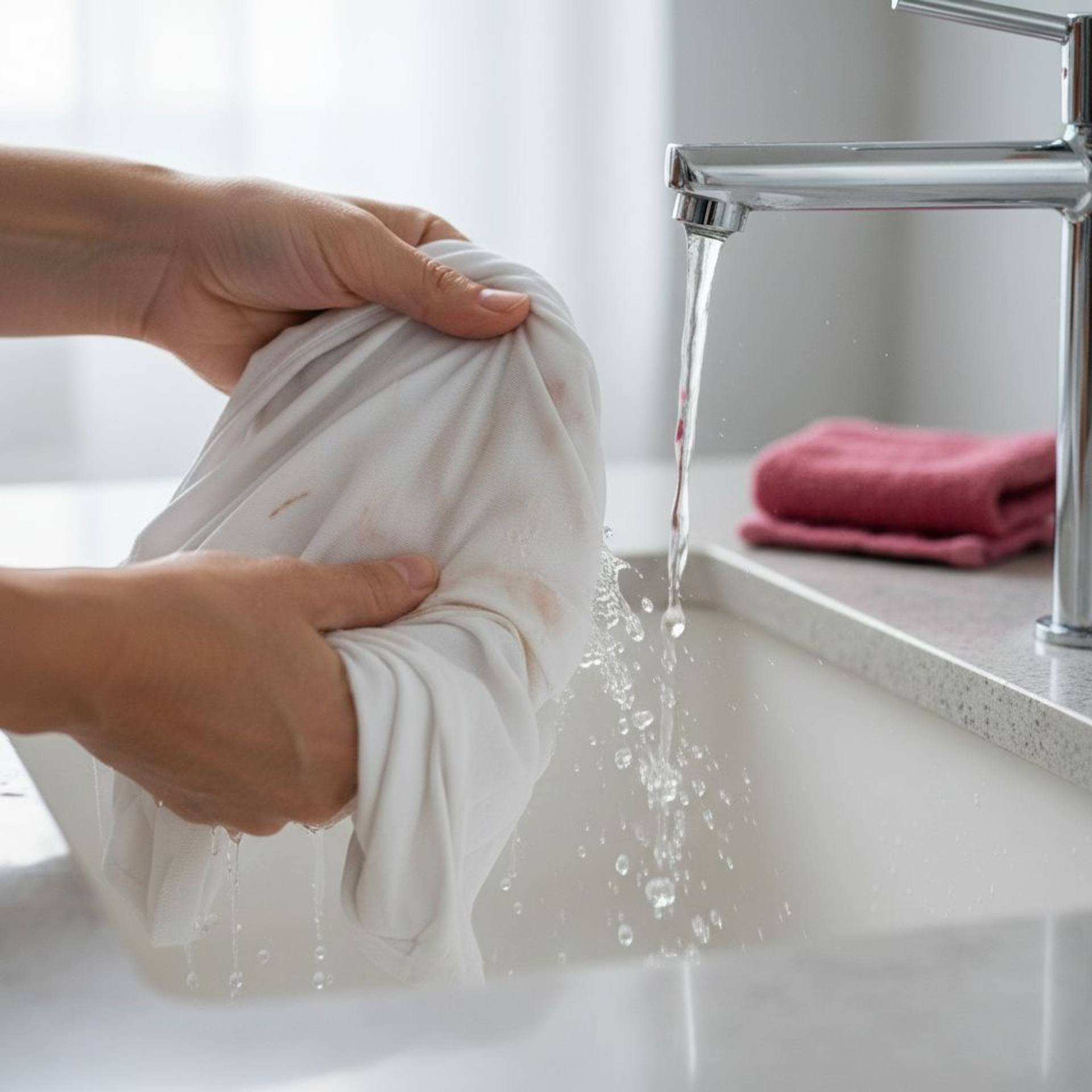
- Rinse immediately with cold water, around 20-30°C, under running water, from the left side of the fabric.
- Soak in detergent with enzymes.
- Wash at low temperature, maximum around 30°C.
Don't
- Do not use hot or warm water above approximately 30°C.
- Do not dry in a tumble dryer until the stain is completely gone.
- Do not iron the fabric before washing.
- Do not scrub the stain dry.
In its natural state, protein is soluble in water: a chain of amino acids is folded into a structure that can be rinsed away. Heat unfolds this structure, and the amino acids link into an insoluble coagulate that sinks deep into the weave.
The threshold depends on the protein: hemoglobin from blood aggregates at around 49°C and fully denatures above 65°C, albumin from egg or serum at 60-85°C, and casein from milk is most heat-resistant. That's why washing below 30°C is a safety margin, not an exact boundary.
The simplest picture is an egg in a pan: raw egg white is transparent, after heating it turns white and irreversibly insoluble, exactly like blood stain washed in hot water.
Dried protein stains
why they react differently and which home methods actually work
A fresh stain has a high chance of completely disappearing at home. If it's already been dry for a few hours, the same steps still make sense, but effectiveness drops with every hour of delay. Here are four rescue steps, in this exact order.
Four rescue steps
- 1
Soak immediately in cold water
Submerge the fabric right away, before the protein has a chance to sink deeper. Water temperature around 20-30°C, never more.
- 2
Rinse under running water from the left side
Gently rinse the stain under a stream of cold water, directing it from the inside of the material, to push the protein outward rather than into the weave.
- 3
Soak in enzymatic detergent
Dissolve detergent with proteases in cold or lukewarm water and soak the fabric for around 30-60 minutes. Enzymes break down the protein before it can set.
- 4
Wash at low temperature
Wash in the same detergent, at around 30°C. Only when there's no trace of the stain can you dry it.
Most common mistakes that lock in the stain
Drying in a tumble dryer before the stain is fully gone heats it further, because a cotton cycle reaches roughly 50-70°C. Ironing before washing works similarly, even a low synthetic setting on an iron is around 110°C, and scrubbing dry only drives the protein deeper into the weave.
Never mix these substances
Chlorine bleach must never be mixed with ammonia. The reaction produces toxic chloramine fumes, dangerous to the respiratory tract. If you use ammonia on a dried stain, apply it only in dilution and in a well-ventilated space.
Salt on fresh blood
Soaking a fresh blood stain in cold water with added salt is a common home practice. Its exact mechanism is not definitively confirmed, so treat salt as an addition to enzymatic detergent soaking, not a substitute, and only with truly fresh stains.
Limits of home methods
when professional stain removal is necessary
Home methods fail in three situations: the stain dried more than a few hours ago, it already had contact with heat (dryer, iron, hot water), or the fabric is delicate, like silk or wool, where it's easy to choose the wrong product.
A laundry has three advantages: controlled temperature and pH of the bath, professional enzymatic chemistry with higher protease concentration, and the option of dry cleaning for fabrics that cannot be soaked in water.
Even a laundry cannot guarantee removal of a stain set by heat before it arrived: the faster you get your clothes there, the greater your chance of complete success.

Now you know the theory. Practice can be less forgiving.
If you would rather not risk your favourite piece, leave it to the specialists at Gorące Żelazko laundry in Lublin.


Frequently asked questions
Heat denatures blood protein into an insoluble coagulate permanently bound to the fibre, while cold water below around 30°C keeps it soluble.
The coagulate binds to the fabric permanently and becomes virtually unremovable by home methods, because the problem lies in the protein structure, not on the surface of the material.
It's a popular home practice for fresh stains, but its mechanism is not definitively confirmed, so treat salt only as an addition to enzymatic detergent soaking.
It depends on how set it is: professional enzymatic chemistry gives a better chance than home methods, but even a laundry cannot guarantee complete removal.
About the author
Małgorzata Małecka
Owner of the Gorące Żelazko laundry
Małgorzata Małecka runs the Gorące Żelazko laundry in Lublin. Together with her team, she makes sure customers' clothes, shoes and fabrics come back clean and in the best possible condition.