Iron Scorch Marks: What You Can Still Save
The first step is asking: is it just discolouration or fibre damage?

A yellow-brown stain on a shirt you were about to put on in twenty minutes. Or on your son's school uniform, ironed the evening before the first day of school. Or worst of all, on a dress borrowed from a friend.
Your first thought: this item is ruined. Before you start looking for a replacement, check this: a 30-second test below, a safe way to rescue it at home, and the moment when you should give up.
Can it be saved or not?
30-second test: discolouration versus damaged fibre
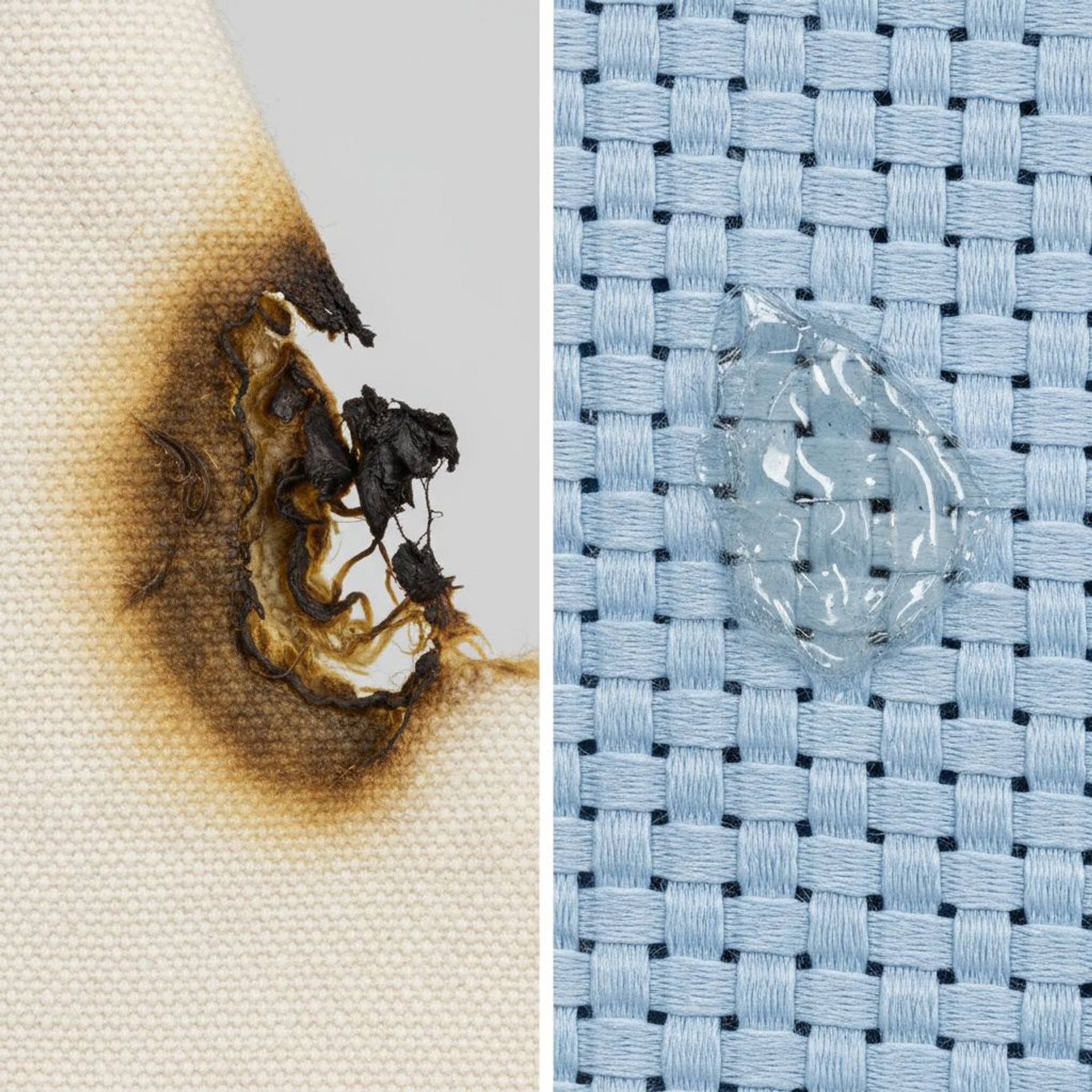
Natural fibres (cotton, linen, wool, silk) first yellow, then brown, and with prolonged heat they scorch. This is thermal decomposition of cellulose, similar to caramelisation, though strictly speaking caramelisation applies to sugars, not entire fibres.
Synthetics (polyester, acrylic, elastane, nylon) react differently: they melt and fuse into a hard, shiny stain. Cotton scorch can sometimes be partially reversed. Synthetic melting is irreversible physically. No chemistry can undo it.
Do
- The fibre remains elastic after cooling, it doesn't crumble when bent
- The yellowing is shallow, surface-level only, with no burnt smell deep in the fabric
- The stain has no shine or stiffness, the fabric feels like the original
Don't
- The fibre breaks or crumbles when gently bent
- A shiny, melted, or fused mark, typical of polyester and other synthetics
- There's a hole or missing fabric in the material
- The fabric is stiffened, rigid to the touch, with a burnt smell deep in the structure
Fabric blends inherit the threshold of their weakest component: stretch jeans scorch at lower temperatures than pure cotton. If the test above worked in your favour, here's the safe sequence of steps at home.
Only for cases that passed the test above. Begin each step by testing on a hidden area, such as an internal seam.
- 1
Test on hidden fabric
Use an internal seam or fabric reserve before touching anywhere visible. Dyes and finishes vary between fabrics.
- 2
Spot application
For white cotton or linen: 3% hydrogen peroxide diluted with water 1:1. For fresh, shallow scorch: a paste of baking soda and water. Apply only to the stain.
- 3
Neutralise odour
White vinegar diluted with water removes the burnt smell but not the discolouration itself. This is a separate step, not a substitute for step two.
- 4
Wash only after assessment
Low temperature, only after you check the effect. High temperature before removing the stain sets it permanently.
Three mistakes most often ruin the result: ironing a blend without checking the label, leaving the iron still on fabric, and ironing dark synthetics without a protective cloth. The scorch only shows when it's already deep.
When iron scorch requires professional service
Red flags where DIY is not worth trying
Do any of the signals from the list above apply to you? Then every further DIY attempt will make things worse, not better. Peroxide or baking soda won't reverse fibre melting, and they can additionally damage the colour and texture of the material around the stain.
No method, whether home or professional, can reverse charring or synthetic fibre melting. This is honest information, not encouragement to give up.
Never combine chlorine bleach with ammonia or vinegar: they produce irritating fumes. Chlorine also destroys the colour of coloured fabrics and wool. Higher concentrations of hydrogen peroxide irritate skin, so wear gloves, work at an open window, and keep away from children.
Professional service has tools unavailable at home: controlled oxidative bleaching and steam treatment that lifts fibres in shallow scorch. A test on fabric sample is always the first step. With charring or melting, darning and alteration repair remain. Honestly: with deep damage, the goal is to minimise the stain's visibility, not erase it completely.

Now you know the theory. Practice can be less forgiving.
If you would rather not risk your favourite piece, leave it to the specialists at Gorące Żelazko laundry in Lublin.


Frequently asked questions
It depends on depth: light yellowing usually disappears entirely, brown can be noticeably lightened. Charring and synthetic melting are irreversible, only alteration repair helps here.
Only after trying to remove the stain, at low temperature. High temperature before removing the stain sets it permanently.
Yes on white cotton and linen, 3% diluted with water 1:1, applied as a spot treatment. Always test it first on a hidden area.
It depends on damage depth and fabric type: shallow yellow on cotton is different work than a melted mark on synthetic that needs darning. It also depends whether spot oxidative bleaching is enough or if alteration repair is also needed. Final pricing comes only after viewing the item, not based on description alone over the phone.
About the author
Małgorzata Małecka
Owner of the Gorące Żelazko laundry
Małgorzata Małecka runs the Gorące Żelazko laundry in Lublin. Together with her team, she makes sure customers' clothes, shoes and fabrics come back clean and in the best possible condition.