Universal Homemade Stain Remover
Step-by-step recipe with precise measurements

Fresh stains race against time. You have around fifteen minutes, maybe an hour, before dirt binds to the fiber for good. Dried stains work the opposite way: they have been sitting there for days already, and you wonder if the garment can even be saved.
You know this from your own home. A child spills juice on a favorite shirt and every minute counts. Or you want to always have something reliable on hand instead of buying a new commercial stain remover each time one runs out. Or you have already tried something "by eye", the stain did not disappear or got worse, and now you are looking for exact proportions instead of another guesswork tip.
Below you get a recipe with exact measurements, clear rules for safe application, and an honest answer about where home chemistry reaches its limits.
Step-by-step recipe
Hydrogen peroxide, baking soda and dish soap: precise proportions
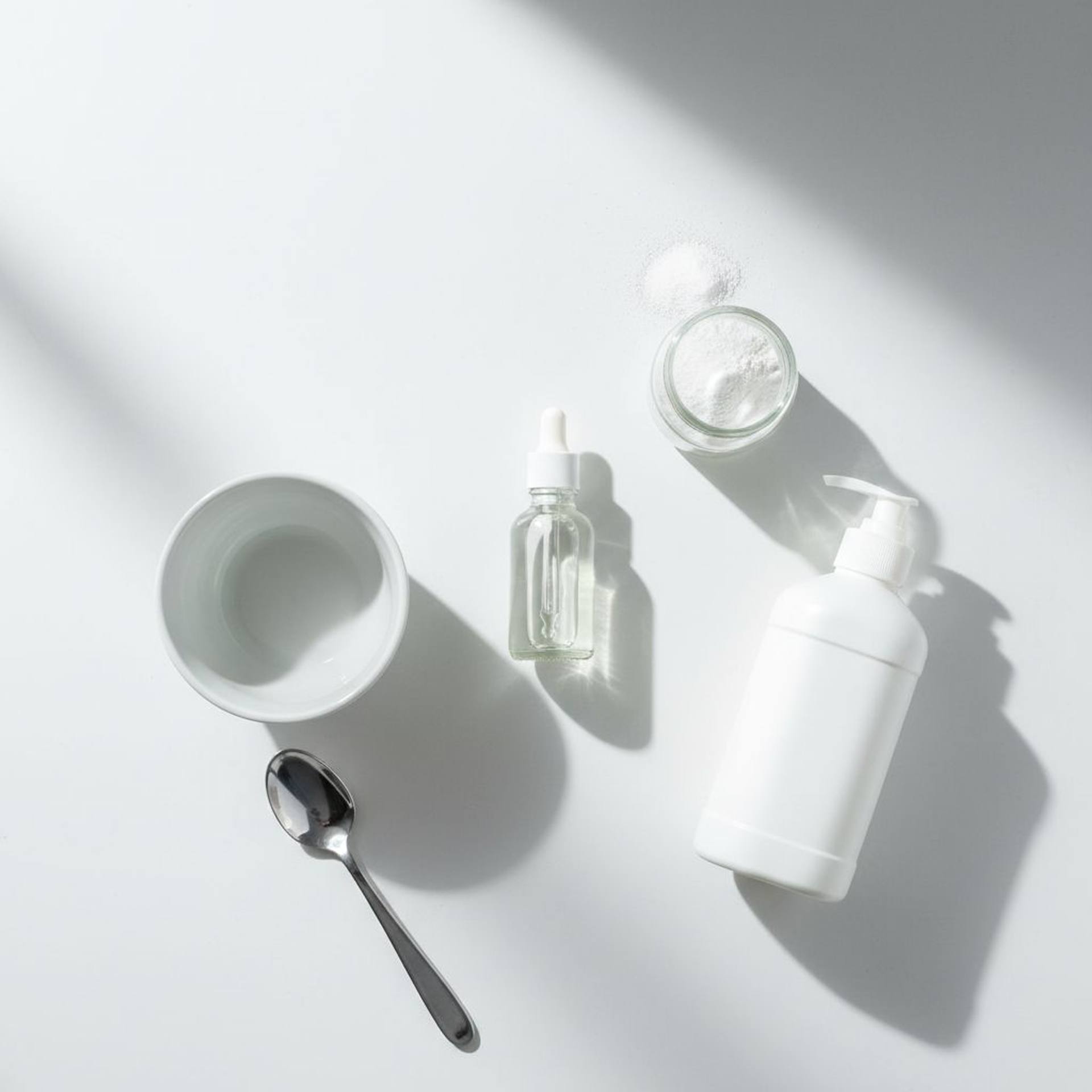
This recipe works on a 3-in-1 principle. Dish soap is a surfactant that breaks surface tension and emulsifies grease. Hydrogen peroxide oxidizes and breaks down the pigments of the stain. Baking soda raises the pH of the solution to around 8.0 to 8.5, which additionally aids in removing grease and neutralizes acidic soiling.
Prepare the solution immediately before use. Do not store it in a sealed container: hydrogen peroxide decomposition produces oxygen, and pressure in an airtight container builds up.
Tools needed: measuring cup, mixing bowl and a tablespoon.
Universal base for fresh stains
Ingredients
- 500 ml lukewarm water (30-40°C)
- 1 teaspoon (5 ml) dish soap
- 1 tablespoon (approx. 15 g) baking soda
- 2 tablespoons (30 ml) 3% hydrogen peroxide (pharmacy grade)
Instructions
- 1
Mix lukewarm water with dish soap.
- 2
Add baking soda and dissolve it thoroughly.
- 3
Finally, add hydrogen peroxide.
- 4
Use the solution immediately, do not store the prepared mixture for later use.
The universal base works well for mixed, fresh soiling. Some stains, however, need modification: different contact time, different temperature, sometimes without oxidizing agent at all.
Below are the most common cases in brief. For each of them in the laundry's knowledge base you will find a separate, detailed guide.
Blood (fresh)
Soak in cold water with salt only, without hydrogen peroxide on wool and silk because it oxidizes keratin.
Never in hot water: protein denatures and the stain sets permanently.
Red wine
Cover the stain with salt on wet fabric, brush off the excess, then apply the universal base with hydrogen peroxide.
Always do a tolerance test first, wine pigments fade easily on weaker fabrics.
Grease and oil
Pre-treat with talc or potato starch to absorb, then use base with double the amount of dish soap.
Cold water does not dissolve solid grease, without heat the stain will remain.
Pen ink
Soak a cotton swab in 70% rubbing alcohol and rub the stain from edges to center, without water at first.
Water used before alcohol spreads the ink over a larger area.
When stain remover can damage fabric
Colors, wool and silk need caution
Tolerance testing is mandatory. Apply 1 drop of solution to a hidden area, for example an inside seam. Wait 10 minutes and check if the color and texture have not changed.
Apply from underneath the stain. Place the fabric with the stain facing down on a white towel, and apply the solution from the back side. This way you push the dirt out of the fiber instead of pushing it deeper in.
Contact time is 10-30 minutes, depending on the type of stain. Beyond 30 minutes with hydrogen peroxide, the risk of over-drying and water marks increases, especially on silk and viscose.
Finally, rinse the fabric in lukewarm water (approx. 30°C) before proceeding to regular washing. This removes remaining oxidizer and surfactant residue.
Homemade stain remover in practice
Do
- Do tolerance testing with every new fabric: 1 drop, 10 minutes observation
- Use cold water on protein stains (blood, milk, sweat), hot water sets them
- Apply solution from underneath the stain on a white towel
- Rinse thoroughly with lukewarm water before drying
- On wool and silk limit yourself to cold water with salt or consult with the laundry
Don't
- Do not use on fabrics labeled "dry clean only" (circle symbol, ISO 3758)
- Do not dry in a dryer or iron if the stain has not disappeared completely
- Do not soak for longer than 30 minutes in hydrogen peroxide solution
- Do not use on natural leather, suede, fur, sequins and glued applications
All the rules above protect the fabric. One of them, however, concerns something more important than any stain: your safety, and applies to all home laundry chemistry, not just this recipe.
Never mix these
Do not mix this or any other stain remover with chlorine bleach (sodium hypochlorite) or ammonia. The reaction releases toxic chloramine gas which irritates the respiratory tract. This is the most common mistake when "boosting" a homemade stain remover.
A homemade stain remover is first aid for fresh stains, up to 24-48 hours, on resistant fabrics: cotton, linen, polyester, acrylic.
However, its effectiveness has limits.
Fresh protein stains, with correct handling, disappear in 70-85% of cases. Grease set for more than a week drops to only 30-50% effectiveness. Old tannin stains, like coffee or wine, typically are 20-40%, and often only lightening, not complete removal.
After 7-14 days some pigments bind to the fiber chemically. Home methods then genuinely do not work. It is not a matter of "you did not scrub hard enough", it is just physical chemistry that cannot be overcome in your kitchen.

Now you know the theory. Practice can be less forgiving.
If you would rather not risk your favourite piece, leave it to the specialists at Gorące Żelazko laundry in Lublin.


Frequently asked questions
10-30 minutes, depending on the type of stain. For the hydrogen peroxide version, maximum 30 minutes, longer soaking weakens the fiber.
Yes, provided you do a tolerance test. 3% hydrogen peroxide rarely bleaches permanent reactive dyes on cotton, but natural dyes, for example indigo in lighter denim, can fade locally after just 10-15 minutes.
Stop any further home attempts, do not dry or iron the damaged area. Leave the assessment and possible repair or color matching to a professional laundry.
For stains older than 7-14 days, on silk, wool and cashmere, on fabrics with sequins or labeled "dry clean only", and when your own attempt has already made the stain worse.
About the author
Małgorzata Małecka
Owner of the Gorące Żelazko laundry
Małgorzata Małecka runs the Gorące Żelazko laundry in Lublin. Together with her team, she makes sure customers' clothes, shoes and fabrics come back clean and in the best possible condition.