Homemade fabric refresher without washing: recipe
Recipe for a spray that neutralizes sweat odor: exact proportions of alcohol, baking soda, and water, plus why refreshing works instead of washing.

You spray your shirt with a store-bought refresher, the smell disappears, then a few hours later it's back, sometimes stronger than before. Sound familiar? It's not coincidence and it's not your nose's fault.
Most commercial fabric sprays, including those based on strong perfume, don't neutralize odour. They mask it with another scent that fades faster than what it was supposed to cover. Laundry customers often confuse the intensity of a product's smell with its effectiveness, but they're two different things.
True neutralization works differently: it either encapsulates the odour molecule (like cyclodextrins do in commercial products) or neutralizes it chemically by changing pH. Below you'll find a homemade recipe based on the second mechanism, with exact proportions.
Homemade fabric refresher spray
Ingredients
- 500 ml distilled water (not tap water)
- 2 tablespoons (approx. 30 ml) 70% isopropyl alcohol
- 1 teaspoon (approx. 5 g) baking soda
- 10-15 drops (max approx. 5 ml) essential oil, optional
Instructions
- 1
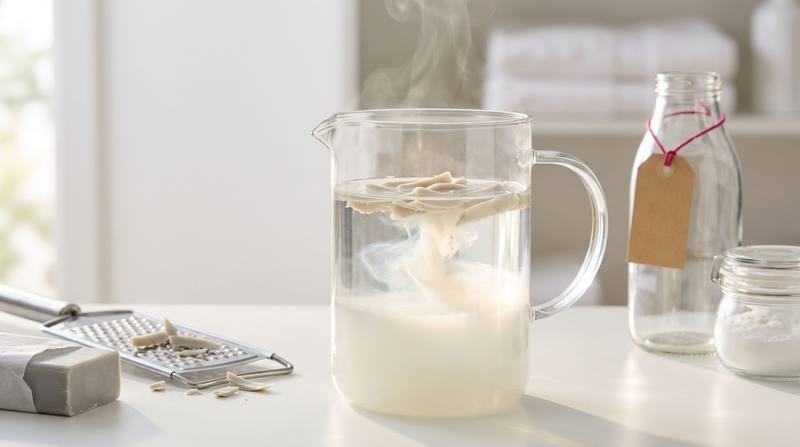
Dissolve the baking soda thoroughly in distilled water. Undissolved crystals can scratch delicate fibres or leave a white residue.
- 2
Add 70% isopropyl alcohol and mix.
- 3
If you want a scent, add 10-15 drops of essential oil. Do not exceed 1% of the volume.
- 4
Pour into a spray bottle. Shake before each use.
The proportions of baking soda, alcohol, and water in this recipe are not arbitrary. Each ingredient has strict chemical reasoning.
- Baking soda (NaHCO3) in solution has a pH of about 8.3, so it neutralizes the acids in sweat. The main culprit is isovaleric acid (pKa about 4.78), which is characteristic of 'old sweat' smell on synthetics. Above pH 7, the acid shifts to anionic form, which is non-volatile, so it stops smelling.
- 70% isopropyl alcohol has documented antibacterial action. Standard EN 1276 confirms a reduction of bacterial numbers by at least 5 orders of magnitude after 5 minutes of contact. It also speeds up water evaporation, limiting the risk of streaks.
- Essential oil in this recipe is purely for scent, not an active ingredient. That's why the limit is 1% of volume: higher amounts increase the risk of oil stains and skin allergic reactions.
For comparison, the cyclodextrin mechanism in commercial products encapsulates the odour molecule odourlessly and works better than even the strongest homemade perfumed recipe. This difference explains why an expensive spray sometimes smells more subtle yet works better than a cheap one.
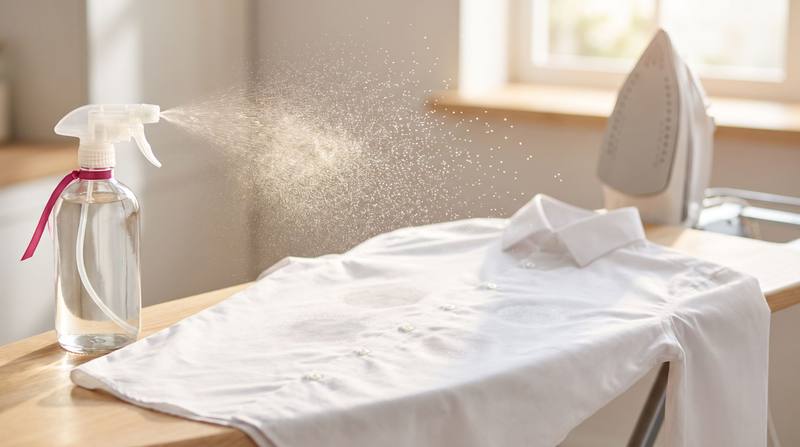
Spray from 20-30 cm away in a fine mist, maximum 2-3 passes. Over-soaking the fabric leads to streaks: mineral salts from the water migrate to the edge of the droplet as it dries (the so-called coffee-ring effect). After spraying, dry the fabric flat in a well-ventilated place for at least 2-4 hours before putting it away. Damp fabric in a closed space with humidity above 70% can develop mildew in just 24-48 hours.
A test on an invisible area is mandatory, especially on silk, naturally dyed wool, and fabrics with water-repellent finishes.
- 1
Choose an invisible spot
An inner seam, sleeve hem, or bottom edge are safe places to test.
- 2
Spray and wait 24 hours
Apply the spray exactly as you intend to use it on the rest of the garment. Watch for colour loss, streaks, or fibre stiffening.
- 3
Now you can use it on the whole thing
Test successful? You can spray the entire surface. If there's any change in colour or texture, do not use this recipe on that fabric.
Baking soda and essential oil are easy to blame for fabric damage, but check the third ingredient in the recipe first. Isopropyl alcohol dissolves some fabric coatings and finishes.
This is especially true for materials you can't simply throw in a washing machine. A mistake on such fabric is difficult or impossible to undo, which is why the 24-hour test from the block above is not just a formality.
Do not use this recipe on these materials
Leather, suede, nubuck: collagen reacts with alcohol, risking stiffening or irreversible hardening of fibres. Jackets and technical fabrics with DWR coating (outdoor, breathable membranes): alcohol dissolves the fluorocarbon or silicone layer responsible for waterproofing. Silk and naturally dyed wool: higher risk of colour loss, which is why the 24-hour test is especially important here.
Down jackets, wool sweaters, and delicate fabrics
When refreshing is enough instead of washing, and when it's not
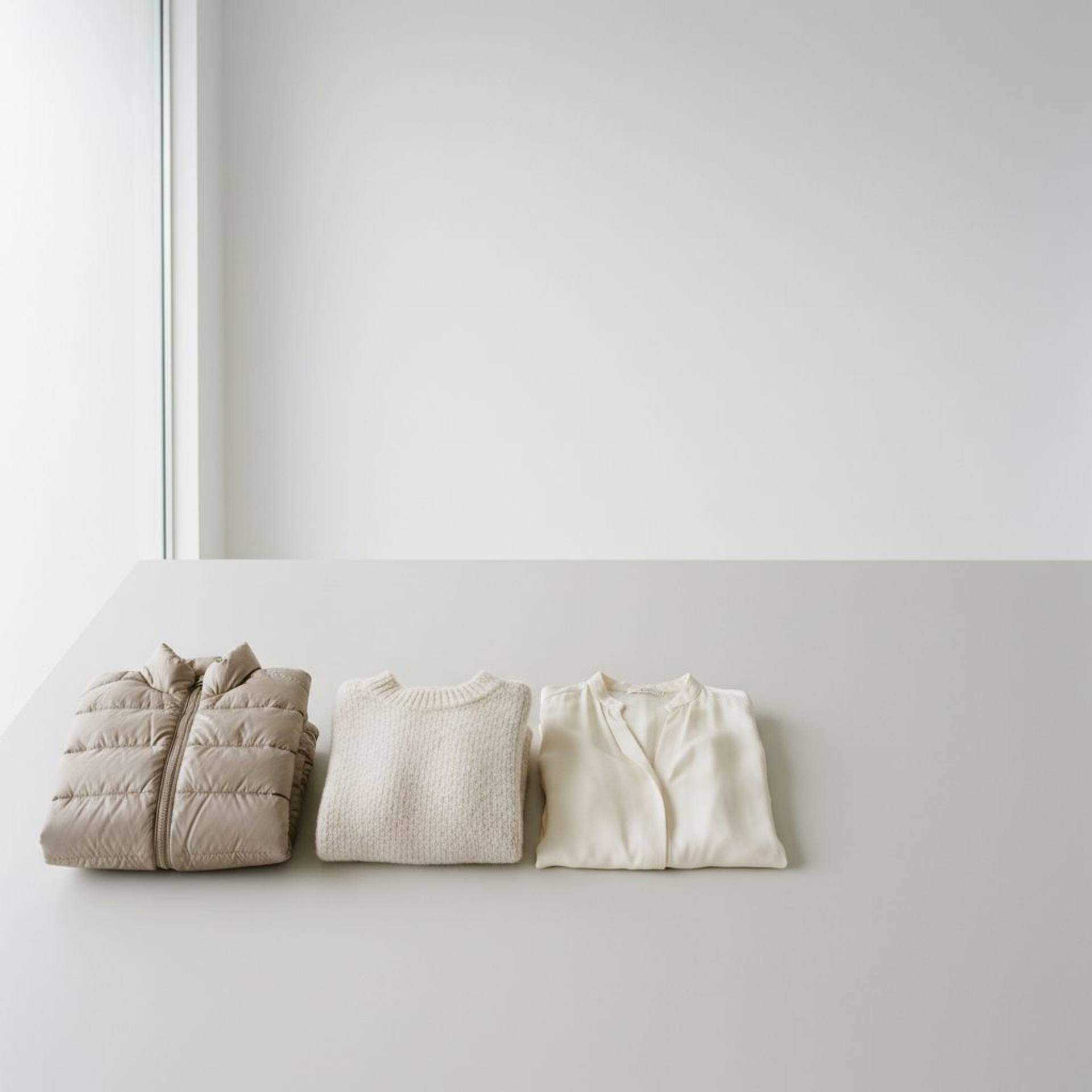
The key question before reaching for the spray is: does the smell or stain sit on the surface of the fibre, or is it already in it.
Fresh sweat from one wear or light 'closet smell' is a surface problem: spray really does neutralize it. Smoke settled over weeks, suspected mildew, or DWR coating on a jacket that's these are beyond what a mist can reach.
Below is the same set of cases spelled out one by one, so you can check in seconds which side yours is on.
Do
- Light sweat smell on sportswear between washes
- Wool coat or jacket refreshed after one wear
- Closet smell before going out, with no visible stains
Don't
- Tobacco smoke smell embedded over weeks: tar and nicotine bind to the fibre irreversibly at the spray level
- Suspected mildew: stale smell and discoloration, because spores penetrate into the fibre core, where spray cannot reach
- Jackets and coats with DWR membrane or Gore-Tex, see warning above
You're only reaching the smell that sits physically on the surface of the fibre, not compounds chemically bonded to it.
Water vapour at 75-100°C in a washing machine penetrates deeper and denatures surface bacteria. This works when the temperature stays above 70°C for more than 3 minutes.
Professional cleaning additionally removes stains, which no spray ever will.

Now you know the theory. Practice can be less forgiving.
If you would rather not risk your favourite piece, leave it to the specialists at Gorące Żelazko laundry in Lublin.


Frequently asked questions
This recipe does both, but in a different sense than perfumed store sprays. Baking soda neutralizes the pH of acids responsible for sweat odour, and alcohol helps them evaporate along with other volatile compounds. That's real neutralization, not just masking with scent. It won't replace washing for organic soiling or stains though.
10-15 drops per 500 ml of water, meaning a maximum of around 1% of the volume (about 5 ml per 500 ml). More means greater risk of oil stains on the fabric and skin allergic reactions. Common oils like lavender and citrus contain linalool and limonene, which are known contact allergens.
Yes, if there's too much oil or you use tap water instead of distilled. Hard water contains calcium and magnesium ions that leave a white residue when dry, especially visible on dark fabrics. That's why the recipe requires distilled water and a 24-hour test before your first use on the whole garment.
It's a sign that the smell has seeped deeper than a surface mist can reach, such as tobacco smoke or mildew. In that case, professional steam refreshing or dry cleaning helps, not another stronger homemade mix.
About the author
Małgorzata Małecka
Owner of the Gorące Żelazko laundry
Małgorzata Małecka runs the Gorące Żelazko laundry in Lublin. Together with her team, she makes sure customers' clothes, shoes and fabrics come back clean and in the best possible condition.