Homemade Laundry Liquid
Recipe, proportions, and safety limits

Before you start mixing soap and soda in your kitchen, you're asking yourself one question: will this actually work? Your concerns are real. You worry about clogging the washing machine or irritating your child's skin.
That caution is justified. You make homemade detergent for three reasons: the raw materials cost pennies, you avoid SLS, parabens and synthetic fragrances, and you're supporting a zero-waste lifestyle. All these motivations make sense, but none of them get you out of chemistry.
Below you'll find exact proportions in grams and liters, plus a clear boundary beyond which DIY stops being worth it.
Recipe Step by Step
Gray soap, washing soda: exact proportions
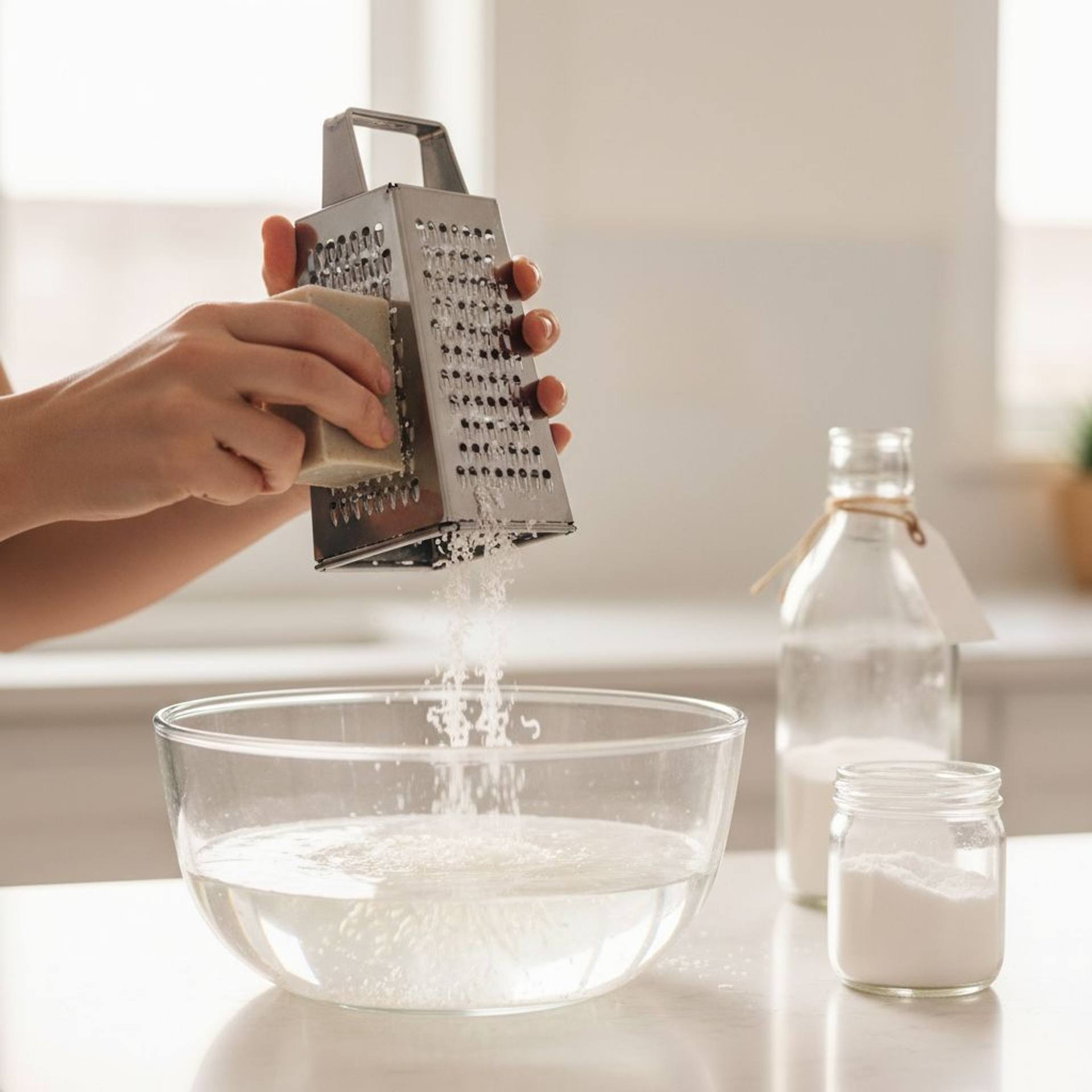
You need just a vegetable grater, a pot, and a labeled jar or bottle.
One condition determines the effectiveness of the entire recipe: the soap must completely dissolve in hot water at a temperature between 60 and 80 degrees Celsius. Undissolved lumps won't disappear on their own in the washer; they'll stay in the fabric.
The base is around 100 grams of gray or Marseille soap per 3 to 4 liters of finished liquid.
Base: Soap and Washing Soda
Ingredients
- 100 g gray or Marseille soap, grated on a grater
- 1 l hot water (60 to 80°C)
- 60-80 g washing soda
- 20-30 g borax decahydrate (optional, strengthens cleaning power)
- 2-3 l cold water to top up
Instructions
- 1
Grate the soap on a vegetable grater.
- 2
Dissolve it completely in hot water, stirring for 5 to 10 minutes until you get a uniform, cloudy liquid with no lumps.
- 3
Add washing soda (and borax if using it), stirring until fully dissolved.
- 4
Top up with cold water to 3 to 4 liters and set aside to cool. Thickening as it cools is normal.
- 5
Pour into labeled bottles. Shake well before each use.
Dosage: approximately 100 to 150 ml per wash for 5 to 7 kg of laundry at medium soil level, more for harder water.
Soap is made from the sodium or potassium salts of fatty acids. In hard water, calcium and magnesium ions react with them and form an insoluble precipitate, commonly called soap scum.
This single mechanism explains several symptoms you read about on forums. Lack of suds, graying and stiffness of clothes, residue on fabrics, and buildup in the washing machine drum and hoses: it's all the same problem.
This is why washing soda or borax isn't just an "extra boost" in this recipe. It's a requirement, without which soap simply won't work in tap water.
Water hardness in Lublin is high
Tap water in Lublin has an average hardness of about 352 mg CaCO3/l, or 19.7 degrees dH. That's the range from hard to very hard water, so the risk of residue and graying without a water softener is real for you, not just theoretical. Don't skimp on washing soda in the recipe, and once in a while run your washer empty at 90 degrees to flush out buildup from the drum and hoses.
Washing soda (sodium carbonate) softens water and in reasonable amounts is fairly safe. Concentrated, it can irritate eyes, so it's a good idea to wear gloves when preparing the concentrate.
Borax (sodium tetraborate decahydrate) works more strongly, but has reproductive hazard classification starting at 8.5% concentration in the mixture. Don't use it during pregnancy and keep it out of children's reach, in a tightly sealed, labeled container.
For sensitive skin and eczema, thorough rinsing is key. Also watch out for essential oils added "for scent": lavender oil contains linalol, one of the fragrance allergens. In the EU it must be listed on cosmetic labels. This is a common cause of irritation in infants.
Soda and Borax in a Nutshell
Do
- Dissolve soap completely before pouring the liquid into bottles
- Adjust the amount of soda to match your tap water hardness
- Store borax in a sealed, labeled container out of children's reach
- Rinse infant clothing an extra time
Don't
- Don't use borax during pregnancy without consultation
- Don't mix vinegar or citric acid with chlorine bleach in one wash (risk of chlorine gas)
- Don't store finished liquid longer than 2 weeks at room temperature
- Don't add essential oils to infant laundry
Homemade liquid works well on lightly soiled everyday cotton and linen in moderate hardness water.
It won't replace professional washing for wool, silk and cashmere because its high pH (10.0 to 11.5) damages the cuticles of keratin and weakens the fiber. It won't handle stubborn protein and fat stains either, because it lacks enzymes, nor laundry requiring bleaching or thermal disinfection.
Handing tougher items to specialists is a conscious choice, not a failure of DIY.

Now you know the theory. Practice can be less forgiving.
If you would rather not risk your favourite piece, leave it to the specialists at Gorące Żelazko laundry in Lublin.


Frequently asked questions
No, if the soap is properly dissolved and you dose the liquid sensibly. The real risk is undissolved soap lumps and residue, which in hard water builds up without the addition of soda.
About 100 to 150 ml per 5 to 7 kg of laundry at medium soil level. Use more for harder water.
Washing soda, yes, in reasonable amounts. Borax requires more care: a sealed, labeled container out of children's reach and avoid it during pregnancy.
Not recommended. Its pH (10.0 to 11.5) damages the cuticles of wool keratin and weakens silk fiber.
About the author
Małgorzata Małecka
Owner of the Gorące Żelazko laundry
Małgorzata Małecka runs the Gorące Żelazko laundry in Lublin. Together with her team, she makes sure customers' clothes, shoes and fabrics come back clean and in the best possible condition.