Homemade Scent Boosters for Laundry
Safe proportions of essential oil and three tested methods step by step

You dry laundry on the balcony and after two days the scent vanishes. So you buy scent beads at the drugstore, like the popular Lenor Unstoppables. But you have to keep buying them because homemade substitutes with essential oil smell noticeably shorter than store-bought products.
The difference lies in technology: commercial microcapsules release scent gradually over weeks, while homemade oil is volatile and disappears almost immediately.
Homemade methods work, but only when you follow dosing rules and match the method to the fabric. Below you'll find the exact proportions and three tested approaches.
Safe Essential Oil Dosage
Drops per ball, sachets and baking soda for laundry, with no risk of stains or irritation
Safe Essential Oil Proportions
3-5 drops per ball, 3-6 balls per dryer load
4-6 drops of oil per 100 g carrier
2-4 tablespoons of baking soda + 8-10 drops of oil
2-3% oil in carrier, approx. 20-30 drops per 100 ml
30-40°C retains more scent on fiber than 60°C
Essential oils are volatile: their vapor pressure reaches 0.1-1 mmHg. Most of the scent substance evaporates during washing or drying before the clothing even goes into the closet.
That's why homemade methods keep scent for 3-7 days, not 4-6 weeks like commercial beads with microcapsules embedded on a polyethylene glycol carrier.
Three Approaches Step by Step
Felt balls for the dryer, sachets with salt or rice, and baking soda with oil in the drum
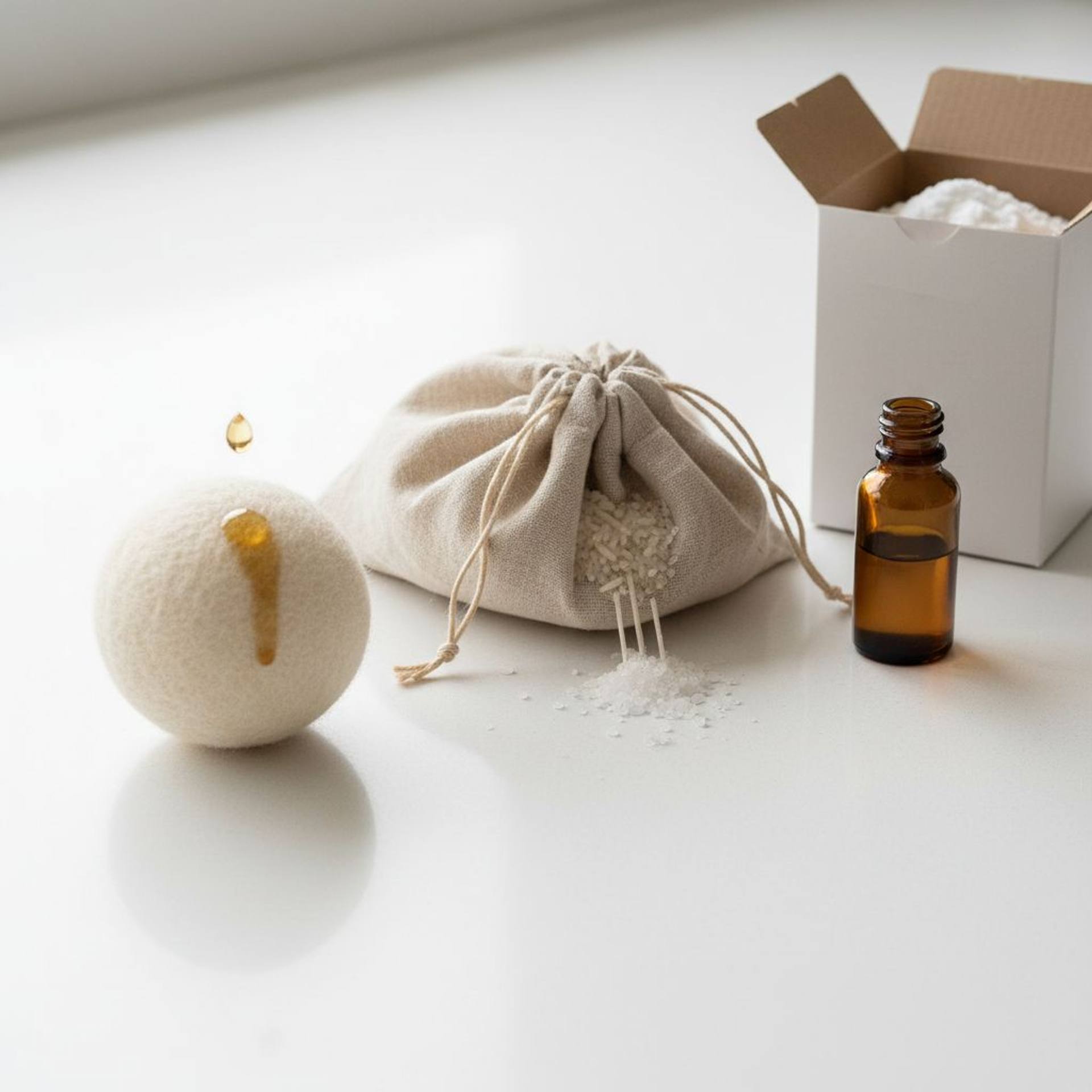
In the photo you can see three methods side by side: wool balls go into the dryer drum, while linen sachets stay in the drawer with clothes. Baking soda with oil goes straight into the washing machine drum, even before washing starts.
Each carrier releases scent at a different stage of the wash cycle. Your choice of method depends on where you want the scent to last longest: in the closet, in the dryer, or just during the wash itself.
Three homemade variations differ in carrier and point of action: dryer, closet, or washing machine drum.
- 1
Wool or Felt Balls for the Dryer
Saturate each ball with 3-5 drops of oil and toss 3-6 balls per load. Scent lasts 1-3 dryer cycles, then you'll need to add oil again.
- 2
Sachets with Rice or Coarse Salt
Pour 4-6 drops of oil over 100 g of rice or salt in a linen bag. Keep sachets in the drawer with clothes, not in the washing machine. They hold scent from several days to several weeks.
- 3
Baking Soda with Oil Straight into the Drum
Pour 2-4 tablespoons of baking soda and add 8-10 drops of oil directly into the drum, never in the powder drawer. You mainly smell it while wet; once dry, the scent barely binds to the fiber.
None of these methods reproduce microencapsulation with delayed release from friction; it's simply a different mechanism with different trade-offs.
A few simple rules will protect you from the most common mistakes that customers later bring to our laundry.
Safe Dosing Rules
Do
- Dilute the oil in a carrier (salt, rice, baking soda, water) rather than applying it directly to fabric
- Test new oil on an inconspicuous fabric area
- Pour baking soda with oil directly into the drum, not the powder drawer
Don't
- Don't pour oil directly on a collar or other fabric area: this risks oily stains and discoloration on light and delicate materials
- Don't mix citrus or pine oils with chlorine bleach: limonene and pinene then oxidize into more allergenic peroxides
- Don't use strong oils (eucalyptus, tea tree, cinnamon) on breathable membranes and softshell: they permanently clog DWR impregnation pores
Other Things to Watch For
Wax or oil residue not dissolved at low temperature (20-30°C) can clog the pump filter and drain hose of your washing machine. In children, people with allergies, and those with atopic dermatitis, excess oil risks irritation: redness, itching, sometimes blistering. Changes most often appear in friction areas like armpits or neck at the collar. Essential oils are also toxic to cats because their livers lack enough enzyme to break down phenols and terpenes. Poisoning can occur even with indirect contact with washed fabric.
Homemade balls and sachets work well on everyday fabrics in reasonable concentration as a cosmetic scent addition.
Professional laundry makes sense when odor is a sign of a hygiene problem, smoke, mustiness, or old sweat, not just missing perfume. It also makes sense when the fabric is delicate or technical: membranes, silk, softshell.

Now you know the theory. Practice can be less forgiving.
If you would rather not risk your favourite piece, leave it to the specialists at Gorące Żelazko laundry in Lublin.


Frequently Asked Questions
The safe upper limit is 2-3% concentration in the carrier, or about 20-30 drops per 100 ml. Pour it into the drum, not the powder drawer.
Not in pure form. Dilute it first in a carrier, such as baking soda, salt, or water. Undiluted oil leaves greasy stains and irritates skin.
From 3 to 7 days in a sachet or ball, and it fades almost immediately after the first wash. Commercial beads with microcapsules keep scent for 4-6 weeks.
Yes. Essential oils are a common contact allergen: Fragrance Mix I/II sensitizes 1.9-2.6% of the population. Be especially cautious with children and people with atopic dermatitis.
About the author
Małgorzata Małecka
Owner of the Gorące Żelazko laundry
Małgorzata Małecka runs the Gorące Żelazko laundry in Lublin. Together with her team, she makes sure customers' clothes, shoes and fabrics come back clean and in the best possible condition.