Homemade ironing spray
Recipe, proportions and honest safety limits

Before you spray your shirt with homemade fluid, you're probably asking one thing: does it even work, or will it just ruin the fabric and end up being a laundry visit anyway?
The answer is yes: homemade ironing spray works, as long as you stick to the proportions. It's a simple water solution, 95 to 99% water and 1 to 25% active ingredient (vinegar, alcohol, starch, or essential oil), which softens hydrogen bonds in the fiber and makes it easier to press wrinkles out under the iron plate.
There's one condition: proportions and fabric type matter. First the exact recipe, then the safety limits you ask about most.
Water and vinegar proportions
How much vinegar per liter of water to avoid damaging fabric or the iron plate
Water acts as a plasticizer here. Molecules penetrate between cellulose chains in cotton or linen and keratin in wool, temporarily breaking hydrogen bonds, which makes fibers easier to press flat under the heat of the iron plate.
Vinegar and alcohol additionally lower water's surface tension from around 72 mN/m (pure water, 20°C) to 35 to 45 mN/m at 10 to 20% by volume. The result: the iron glides better, fabric dries faster, fewer water marks.
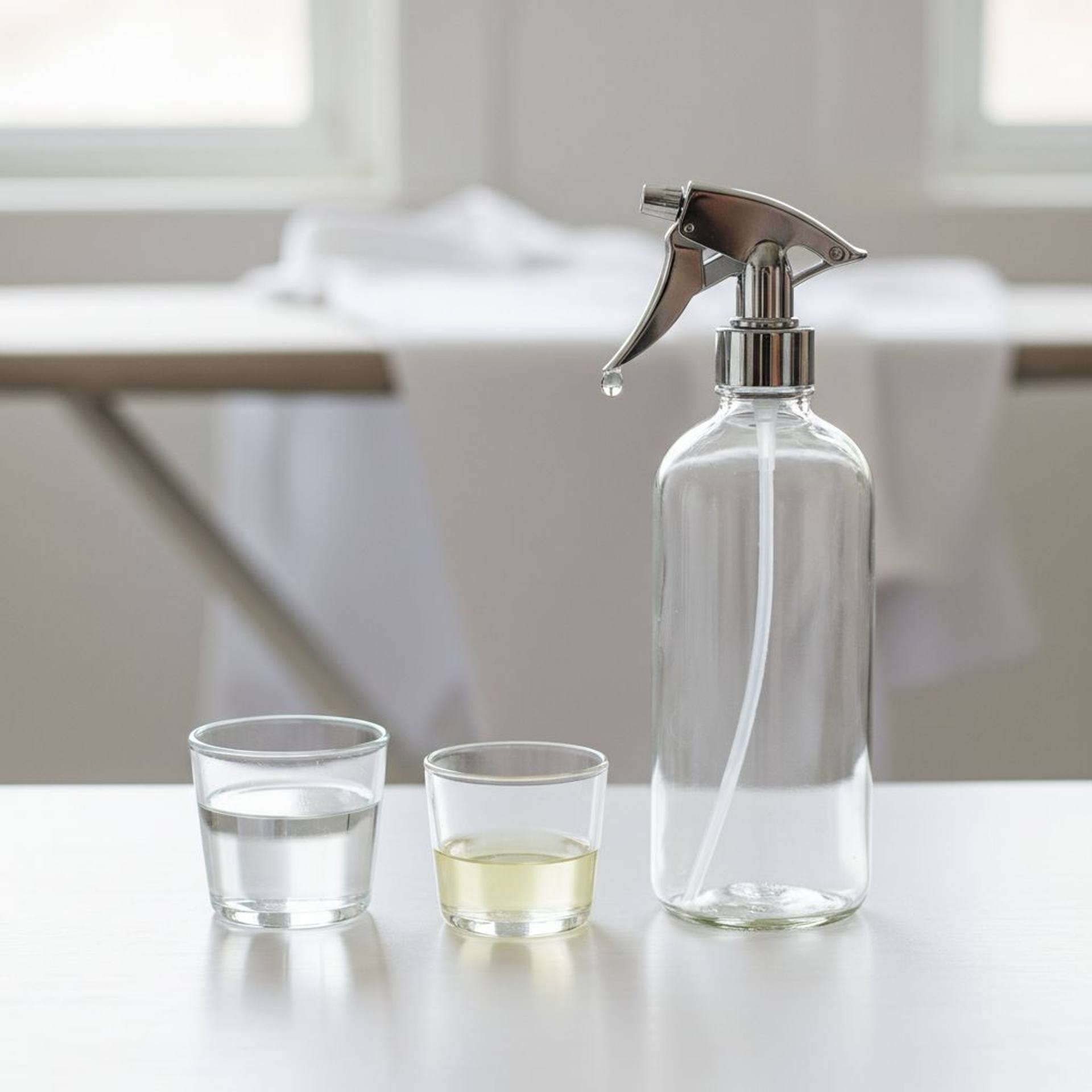
Homemade ironing spray with vinegar
Ingredients
- 400 ml distilled water
- 100 ml spirit vinegar 5-10%
- 1 teaspoon alcohol (ethanol or isopropanol), optional as emulsifier
- 5-10 drops essential oil, optional for scent
Instructions
- 1
Pour distilled water and vinegar into the spray bottle in a 3:1 ratio, final vinegar concentration is around 1.25 to 2.5%.
- 2
If you want scent, add a teaspoon of alcohol and 5 to 10 drops of essential oil. Without alcohol, the oil won't dissolve in water.
- 3
Shake the bottle before each use.
- 4
Test the spray on a hidden area of fabric, like an inner seam, and wait for it to dry.
- 5
Spray from at least 15 cm away.
- 6
Use distilled water, not tap water: in Lublin, water hardness averages around 352 mg CaCO3/l, and in some areas up to 393 mg CaCO3/l, and mineral deposits clog steam vents.
Never do this
Never mix vinegar (acetic acid, CAS 64-19-7) with chlorine bleach (sodium hypochlorite, CAS 7681-52-9), even when trying to boost your homemade prep. The reaction releases toxic chlorine gas (Cl2, CAS 7782-50-5). Polish safety limits are NDS 0.7 mg/m3 and NDSCh 1.5 mg/m3 (regulation MRPiPS from 12.06.2018). Store vinegar and bleach separately, ideally in different cabinets.
Safe vinegar concentration in spray is around 1.25 to 2.5%, or a 3:1 ratio of water to 5 to 10% vinegar. Higher concentrations increase the risk of odor and irritation, and the threshold for classification as corrosive starts only at 25%. Always test the spray on a hidden area before spraying the whole garment. Temperature matters just as much as concentration. Per ISO 3758 standard: one dot on the label is around 110°C (synthetics, spandex), two dots around 150°C (wool, silk, polyamide), three dots around 200°C (cotton, linen). Exceeding that limit after spraying water results in scorch marks or shiny residue (shine marks). Pure essential oil without an emulsifier doesn't dissolve in water: it stays in droplets and when it contacts the hot iron plate, it leaves greasy stains on light fabrics.
When home ironing causes damage
Delicate materials that home irons shouldn't handle: when DIY ironing risks damage
Do
- Test spray on a hidden area and wait for it to dry before assessing the result
- Use distilled water, especially in irons with steam generators
- Make the starch variant in small batches, around 250 ml, and use within 24 to 48 hours, keep in the fridge
- For blended fabrics, match temperature to the most delicate fiber, for example spandex around 110 to 130°C
Don't
- Don't spray silk, worsted wool, and fabrics with factory finishes without testing first
- Don't use spray on garments marked with a crossed-out iron symbol
- Don't apply alcohol to acetate fabrics, it can dissolve them or dull them
- Don't keep starch spray for longer than a few days, it's food for mold and bacteria
Even with correct proportions, accidents happen: white marks after water evaporates, the so-called coffee ring effect, greasy stains from oil without an emulsifier, scorches from too high a temperature.
But that's no reason to skip homemade spray for everyday use. Some cases, though, are already a job for the laundry, not another try at home.
Homemade spray or laundry
Homemade spray
3zl
cost of ingredients for about 500 ml from the recipe above, for comparison a store-bought spray of similar size usually costs fifteen zloty or more
Ironing at the laundry
16zl
price for PLN, Lublin, ul. Wronska 2, steam ironing with no risk of water marks or scorches
Verdict: For shirts, bedding, and linen, homemade spray pays off. For suits, silk, and fabrics with finishes, the risk of damage outweighs the savings.
Fresh water mark: dampen the entire surface evenly, not spot-by-spot, and dry with a warm iron through a cotton cloth, that prevents the ring effect. Lingering vinegar smell? Air out the garment, and if that doesn't help, a quick rinse will be needed.

Now you know the theory. Practice can be less forgiving.
If you would rather not risk your favourite piece, leave it to the specialists at Gorące Żelazko laundry in Lublin.


Frequently asked questions
The spray itself doesn't, but hard tap water does. In Lublin, water hardness averages around 352 mg CaCO3/l, and mineral deposits in steam vents can reduce their output by 30 to 50% after a few months. That's why always use distilled water.
Yes, but only with an emulsifier, for example a teaspoon of alcohol per 500 ml of solution. Without it, the oil doesn't dissolve in water and leaves greasy stains when it touches the hot iron plate.
The vinegar variant without starch lasts a long time, because it's just a simple water solution with no food for bacteria. If you add starch for collar stiffening, keep it in the fridge and use it in around 2 to 3 days, longer than that cloudiness and sour smell appear.
For suits and blazers needing form pressing, for silk, velvet, and taffeta sensitive to water marks, and for fabrics with finishes hard to recreate at home. The laundry will match the method and temperature to the specific material.