Baking Soda Stain Paste
When It Really Works

You've already mixed baking soda and water into a paste, spread it on the stain, and now you're waiting to see if it disappears or leaves a white mark behind. This is the moment when most people start to doubt the method.
Let's be honest from the start: baking soda only works on a narrow range of stains, mainly fresh sweat and light food grease. It's not a bleach or a universal stain remover. Sodium bicarbonate is a simple ionic compound without the amphiphilic structure of a surfactant in detergent, so it doesn't emulsify grease.
Below, you'll learn when attempting the method makes sense, when it's a waste of time, and how to fix a failed treatment.
How to Make Baking Soda Paste
Ratios, water temperature, and contact time before washing
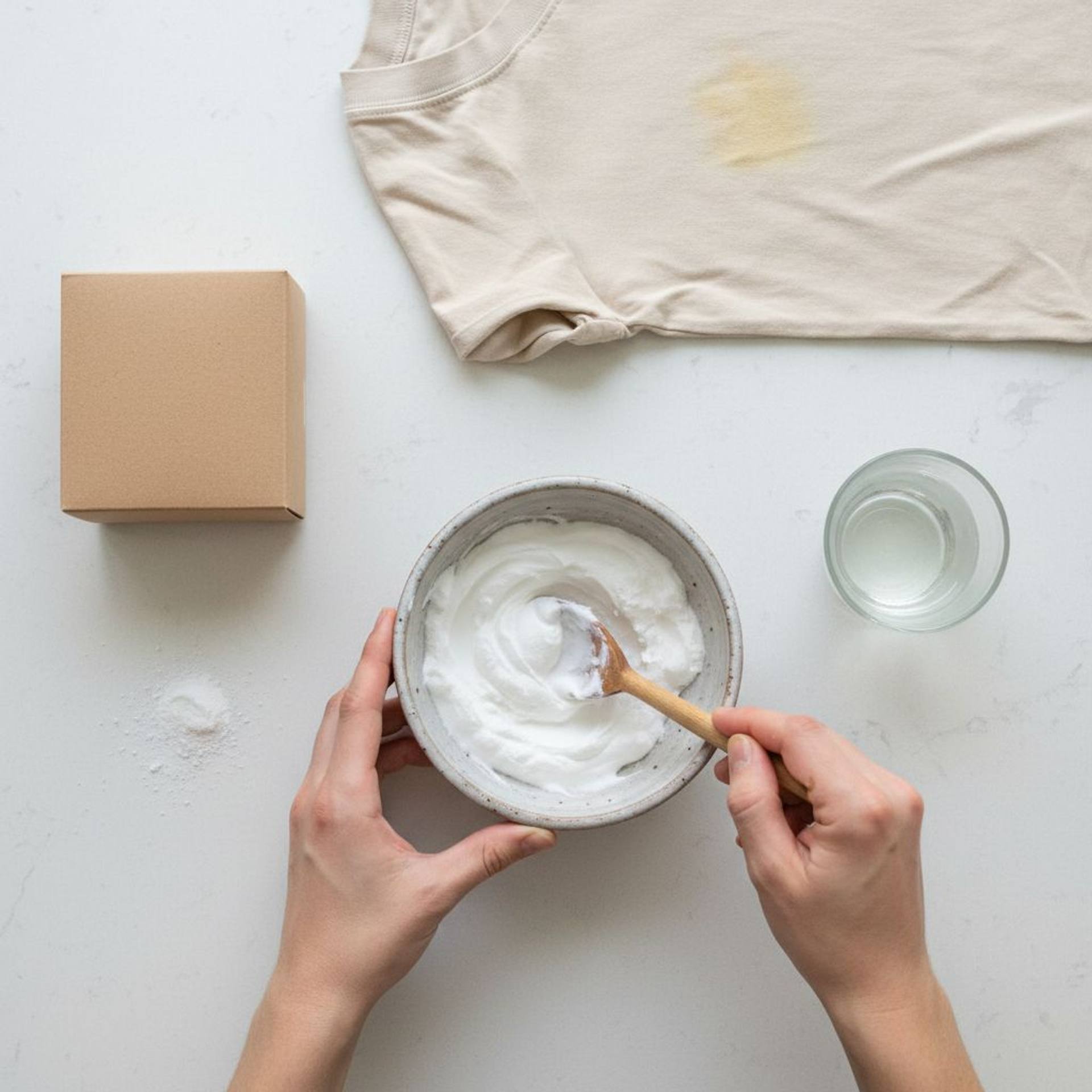
Baking soda solution has a pH of about 8.3, which makes it slightly alkaline. This is enough to neutralize organic acids from sweat, but it's nowhere near enough to break down grease. You need pH above 11-12 for fat hydrolysis, which is the level of washing soda, not baking soda.
Baking soda doesn't form micelles like a surfactant does. It works through physical adsorption on crystal surfaces, not emulsification. So the "fizzing" when the paste touches an acidic stain is just CO2 being released, not a cleaning mechanism, contrary to popular belief.
- 1
Ratio 3:1
Three parts baking soda to one part water, mixed to a thick, smooth paste.
- 2
Lukewarm water, 30-40°C
Cold water makes the paste grittier and more abrasive. Above 50°C, baking soda starts to break down into washing soda, which is more aggressive on dyes.
- 3
Test on hidden fabric
Before applying the paste to the stain, test how the fabric reacts on an inner seam or hem.
- 4
10-15 minutes of contact time
Apply the paste to the stain and wait. Beyond 20-30 minutes when drying, the risk of white residue increases, especially on dark and synthetic fabrics.
- 5
Rinse without rubbing dry paste
Rinse with lukewarm water, then wash normally in the machine. Scrubbing dried paste pushes particles deeper into the weave.
When Home Remedies Fail
Old stains, delicate fabrics, and chemical marks that baking soda cannot handle
Baking soda paste effectiveness by stain type
Fresh sweat
Neutralizes lactic acid (pH 4.5-6) and physical adsorption. Best results within 1-2 hours of soiling.
Fresh food grease (oil, butter)
Only physical adsorption, effective only while grease hasn't penetrated the weave.
Grass
No chemical mechanism against chlorophyll, needs solvent or enzyme.
Red wine
Baking soda doesn't work on tannins and anthocyanins.
Popular internet myth. Salt and hydrogen peroxide are more effective.
Fresh blood
Cold water with protease enzyme works much better than baking soda alone.
Never do this
Mixing baking soda with chlorine bleach alone is not dangerous: baking soda acts as a buffer and doesn't release toxic gases. The real risk appears when you confuse baking soda with an acidic cleaner, like a scale remover or toilet bowl cleaner. Mixing such a cleaner with chlorine bleach releases toxic chlorine gas, one of the most dangerous mistakes in home stain removal. Don't confuse baking soda (NaHCO3, pH 8.3) with washing soda, also called soda ash (Na2CO3, pH about 11.6, marked as GHS irritant to eyes). Using washing soda on a stain instead of baking soda increases the risk of fabric discoloration. Never use this method on wool, silk, cashmere, alpaca, or viscose: an alkaline environment weakens the dye bond to protein fibre. Besides, the hair scale on wool swells and loses its smoothness.
If you already tried and the result is white residue, streaks, or a stain still showing, in most cases it can be fixed.
The most common cause of residue is hard tap water. In Lublin, this is usually 300-400 mg CaCO3/L, or 16-22°dH: calcium ions react with baking soda and settle as lime scale, most visible on dark fabrics.
- 1
Soak, don't rub dry
Soak the white residue in lukewarm water. Rubbing on dry residue pushes particles deeper into the weave and deepens micro-damage.
- 2
Wash normally
After soaking, wash the fabric in a regular cycle, with no extra treatments on wet fabric.
- 3
For next time: boiled water
Next time, make the paste with boiled and cooled water or demineralised water instead of tap water. This eliminates lime scale buildup.
- 4
One retry, then stop
If the stain is still visible, you can try once more, without extending contact time beyond 15 minutes. If the second attempt also fails or the fabric has changed texture or colour, stop experimenting.
A stain older than 24-48 hours or fabric that changed colour or texture after treatment is a signal that further experiments only increase the risk of permanent damage.
Try it yourself or take it to a professional
Do
- The stain is fresh, no more than 2-4 hours old
- The fabric is resilient: cotton, linen, polyester with stable colour
- The soiling is light: sweat or delicate food grease
- You tested the paste on a hidden part of the fabric
Don't
- The stain is more than 24-48 hours old
- The fabric is wool, silk, cashmere, alpaca, or viscose
- The stain comes from mineral oil, ink, paint, glue, resin, wine, grass, or dried blood
- The care label shows dry-clean only
- You already tried unsuccessfully and the fabric has changed colour or texture

Now you know the theory. Practice can be less forgiving.
If you would rather not risk your favourite piece, leave it to the specialists at Gorące Żelazko laundry in Lublin.


Frequently Asked Questions
Three parts baking soda to one part water makes a thick paste. Use lukewarm water, 30-40°C, because cold water makes a grittier paste, and hot water above 50°C changes baking soda into a more aggressive washing soda.
Mineral oil, ink, paint, glue, set-in wine, grass, and dried blood. Baking soda has no surfactant structure, so it doesn't emulsify grease or break down dyes.
Soak the fabric in lukewarm water and wash normally, without rubbing on dry residue. Next time, make the paste with boiled and cooled water or demineralised water instead of tap water, because residue is usually lime scale from hard water.
When the stain is more than 24-48 hours old, the fabric is delicate (wool, silk, cashmere), or one retry at home didn't work. In these cases, further home attempts usually cause more damage than stain removal, and professional cleaning gives a better chance of success.
About the author
Małgorzata Małecka
Owner of the Gorące Żelazko laundry
Małgorzata Małecka runs the Gorące Żelazko laundry in Lublin. Together with her team, she makes sure customers' clothes, shoes and fabrics come back clean and in the best possible condition.