Glycerin for old stains
How a home method softens a dried stain before proper washing.

You have a garment in your wardrobe with a stain from weeks or months ago. Tucked away for laundry someday, or inherited from someone else, found at a vintage market. Now you wonder if it can even be saved at all.
Two concerns come back most often: that rubbing will only spread the stain wider (the halo effect) and that glycerin itself will leave a greasy mark, which you'll then have to remove separately.
Glycerin is one of the gentler home methods for old, dried stains, but it has its rules and limits. Below we show how it works and where its effectiveness ends.
Disclaimer upfront: glycerin alone does not remove stains. It is a preparation step before proper washing, not a standalone stain remover.
How glycerin works on old stains
A hygroscopic humectant softens dried residue before washing
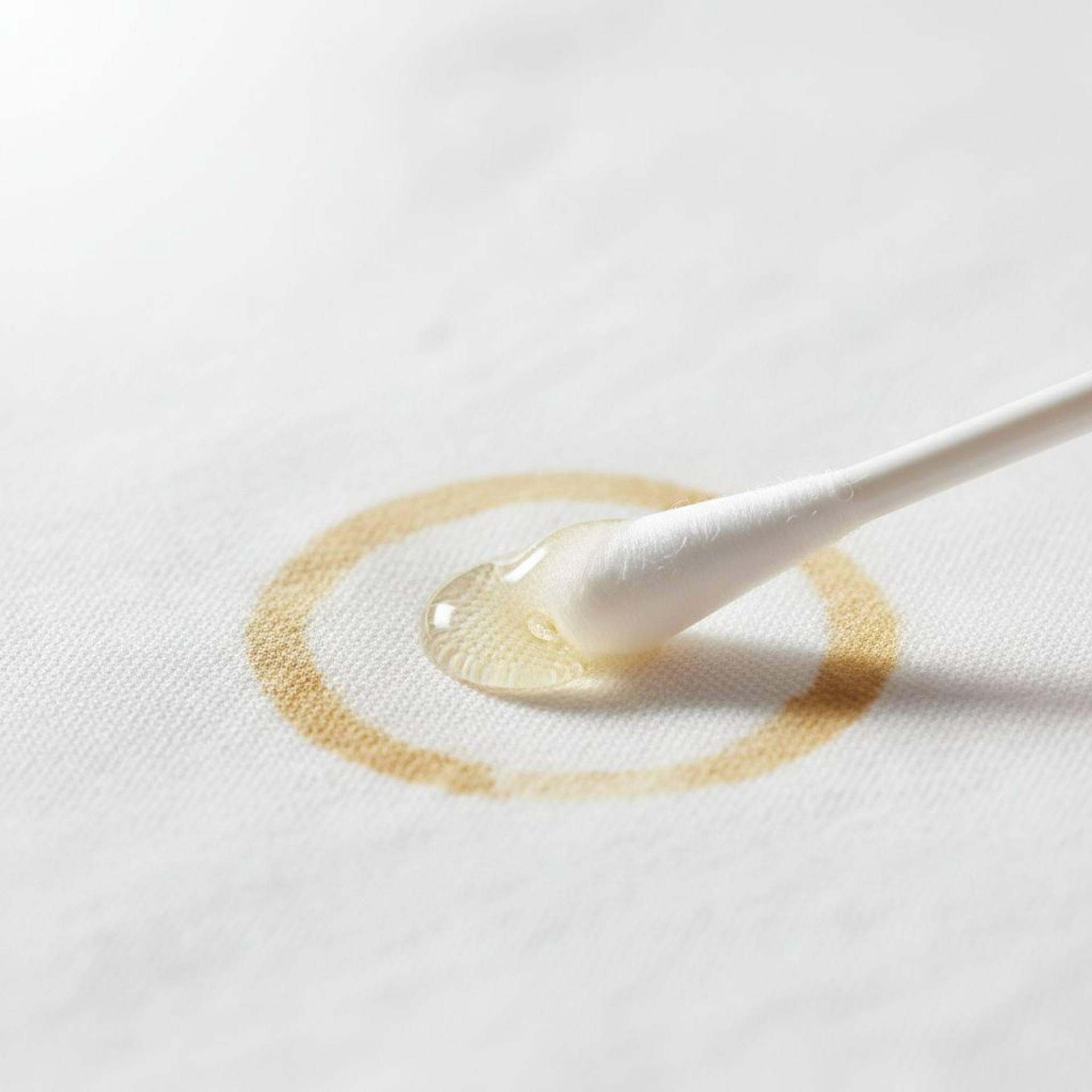
Glycerin (glycerol, propane-1,2,3-triol) is a colourless, viscous liquid with strong hygroscopic properties. It binds water and releases it into dried, hardened soil structure.
An old stain differs from a fresh one. The staining substance has bonded to the fibre, and the solvent, usually water, has evaporated. A hard layer remains on the fabric that is insoluble in cold water. Glycerin moisturises this layer and softens it, allowing detergent or enzyme to reach the actual staining substance later.
The mechanism works particularly well on protein stains (blood, egg, milk, sweat), starch stains, and some grease stains. On tannin stains like coffee, tea, or red wine, effectiveness is less clear-cut. Enzymatic solutions or hydrogen peroxide work better there.
Glycerin (glycerol, propane-1,2,3-triol)
CAS 56-81-5Colourless, viscous, hygroscopic liquid used as a pre-treatment agent for dried protein and starch stains before washing.
- Pre-treatment of protein and starch stains
- Cosmetics
- Food industry
- No mandatory GHS classification at typical commercial concentration
- Low acute toxicity
- Risk mainly with products combined with irritant substances
The protocol takes five to six simple steps, with no specialist equipment needed.
You only need glycerin, warm water, and patience, so you can start right away without a visit to a professional chemical supply shop.
Before you start: test on a hidden part of the fabric, for example on a seam or hem. This step cannot be skipped, especially with dyed or delicate materials. Only after a positive test do you proceed to applying glycerin to the stain.
- 1
Test on a scrap
Apply glycerin to a hidden area (seam, hem). Wait a few minutes, check for discolouration.
- 2
Warm the glycerin
To lukewarm temperature, around 40C. Never hotter: damages protein fibres and sets the stain.
- 3
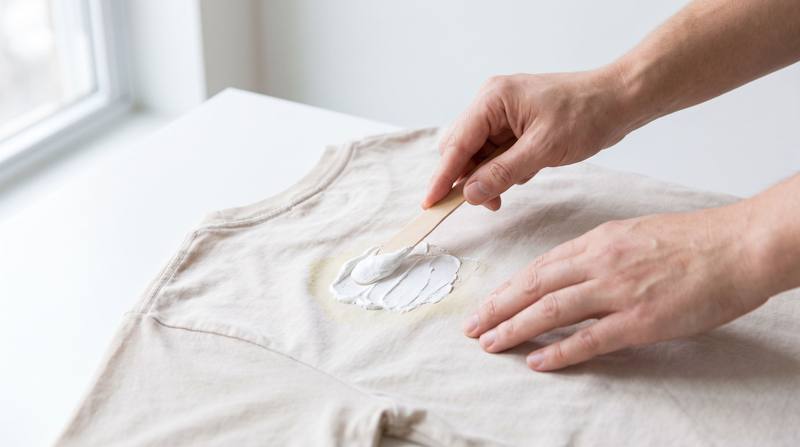
Apply to the stain
Rub gently, without scrubbing across the grain.
- 4
Wait the right amount of time
30-60 minutes for stains from days ago, several hours or overnight for older ones.
- 5
Rinse with lukewarm water
Around 30C. Never hot before identifying and removing the type of stain.
- 6
Wash properly
Protein stain: cold water and enzymatic detergent. Grease stain: warm water and surfactants.
Never use hot water on protein stains
Before you fully remove a protein stain, such as blood, do not use hot water or an iron. Protein coagulates (denatures) from around 60C onwards, this is an established biochemical fact, not forum advice. The effect is irreversible: the stain becomes permanent, and even professional stain removal may no longer help.
Glycerin on old stains: good practices and mistakes
Do
- Test on a hidden area before treating dyed or delicate materials
- Lukewarm water when applying and rinsing, as per the steps above, patience with old stains
- Treat glycerin as preparation for washing, not a standalone stain remover
Don't
- Hot water or an iron before removing a protein stain: it sets the stain permanently
- Vigorous rubbing across the grain: damages the surface, especially of wool and silk
- Combining glycerin with other agents, such as bleach, without checking interactions
- Relying on glycerin for tannin stains: coffee, tea, wine
Glycerin handles many protein and starch stains well, but it is not a universal solution.
Honestly: if a protein or tannin stain was already set by high temperature, neither glycerin nor professional stain removal offers a guarantee of complete removal. High temperature causes irreversible changes in protein or dye structure that no cleaning method can reverse. In such a case, the realistic aim is to reduce the stain's visibility rather than make it disappear completely. Before you give up on a garment, however, it is worth checking whether the stain really has gone through high temperature or just looks old and dried. Not every old stain is thermally set.
When glycerin fails
which dried stains resist treatment
The home method has its limits. It will not handle stains containing synthetic dyes strongly bonded to the fibre, such as from ink, grass, or paint. These types of dyes penetrate deep into the fibre structure and do not respond to moisturising or softening, which is what glycerin relies on. Attempting to remove them by home methods usually only blurs the stain's outline, without real effect. In such cases, a different chemical mechanism than hygroscopic water binding is required.
Similarly with fabrics requiring dry cleaning: silk, some wools, and viscose blends. These fibres react poorly to water immersion, even lukewarm, and may distort, shrink, or lose lustre. And with stains already set thermally, as we discussed above: home glycerin will not reverse them. High temperature permanently changes the soil structure, so moisturising and softening have nothing left to dissolve. In both cases, the risk of damaging the fabric in a home attempt outweighs the potential benefit.
In such cases, professional stain removal at a laundry is the direction, not another home attempt. With an unknown stain composition, each further attempt raises the risk of permanent fabric damage. A specialist identifies the type of soil and selects a chemical agent matched to the specific fibre, which cannot be done by eye at home. A laundry also has methods and temperatures unavailable in home conditions, which increases the chance of recovering the fabric without further harm. Before you throw away a garment, it is worth giving it that one chance.

Now you know the theory. Practice can be less forgiving.
If you would rather not risk your favourite piece, leave it to the specialists at Gorące Żelazko laundry in Lublin.


Frequently asked questions
30-60 minutes is enough for stains from a few days ago, when the dried layer is still relatively thin. For older ones, from weeks or months ago, several hours or overnight is needed for glycerin to moisturise and soften the hardened residue. Time is not fixed: it depends on layer thickness and stain type, so better to check the fabric after the first hour than stick to one rigid deadline.
With proper use it has a low damage profile, but always test on a hidden area. Risk mainly concerns products combined with irritant substances.
Both have low toxicity at typical concentration (CAS 56-81-5, no mandatory GHS classification). What counts is product purity, not where you bought it.
It has higher effectiveness thanks to choosing the agent for the fibre and controlled temperature, but without guarantee on stains already chemically set.
About the author
Małgorzata Małecka
Owner of the Gorące Żelazko laundry
Małgorzata Małecka runs the Gorące Żelazko laundry in Lublin. Together with her team, she makes sure customers' clothes, shoes and fabrics come back clean and in the best possible condition.