Powder, gel, or capsule
Same function, different chemical composition. Learn the difference to choose the right detergent for your needs.

You pour powder into the drum, and after washing your black sweatshirt has a white coating, as if the fabric passed through a sandbox. Another time, gel leaves a greasy streak exactly where you poured it before washing. Or a capsule: you open the washing machine after the cycle and spot an undissolved piece of film stuck to your sleeve.
This isn't a washing machine malfunction or a packaging defect. Powder, gel, and capsule are all the same product type: laundry detergent. Each form has a different chemical composition, though. Some ingredients stay stable only in an anhydrous environment, others work only in water, and capsules add one more element: a soluble coating.
Below we explain the chemical reason behind each of these issues and help you pick the right form for your laundry needs.
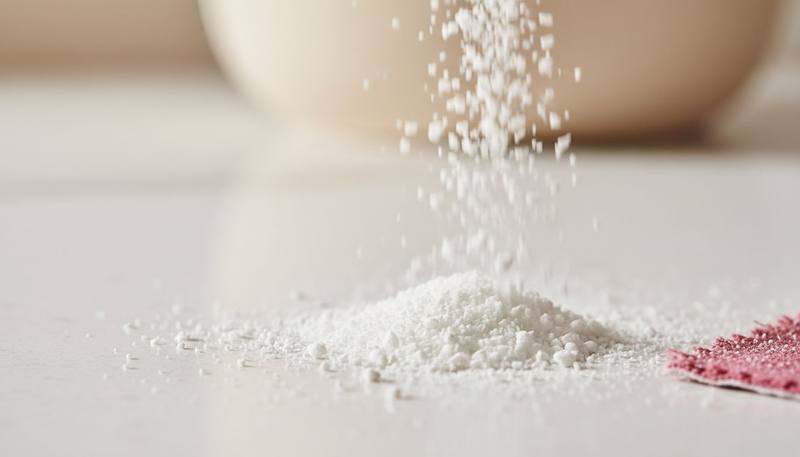
Deposits of sodium carbonate (CAS 497-19-8) and sodium silicate (CAS 1344-09-8) from builders. Common in hard water and incomplete dissolution.
Programme too short or cold: PVA film (CAS 9002-89-5) didn't have enough time and water to fully dissolve.
Gel applied directly to fabric instead of dispersed in water at the start of the cycle.
Powder granule solubility drops as water temperature decreases.
Solubility in temperature
when gel suspends in cold water
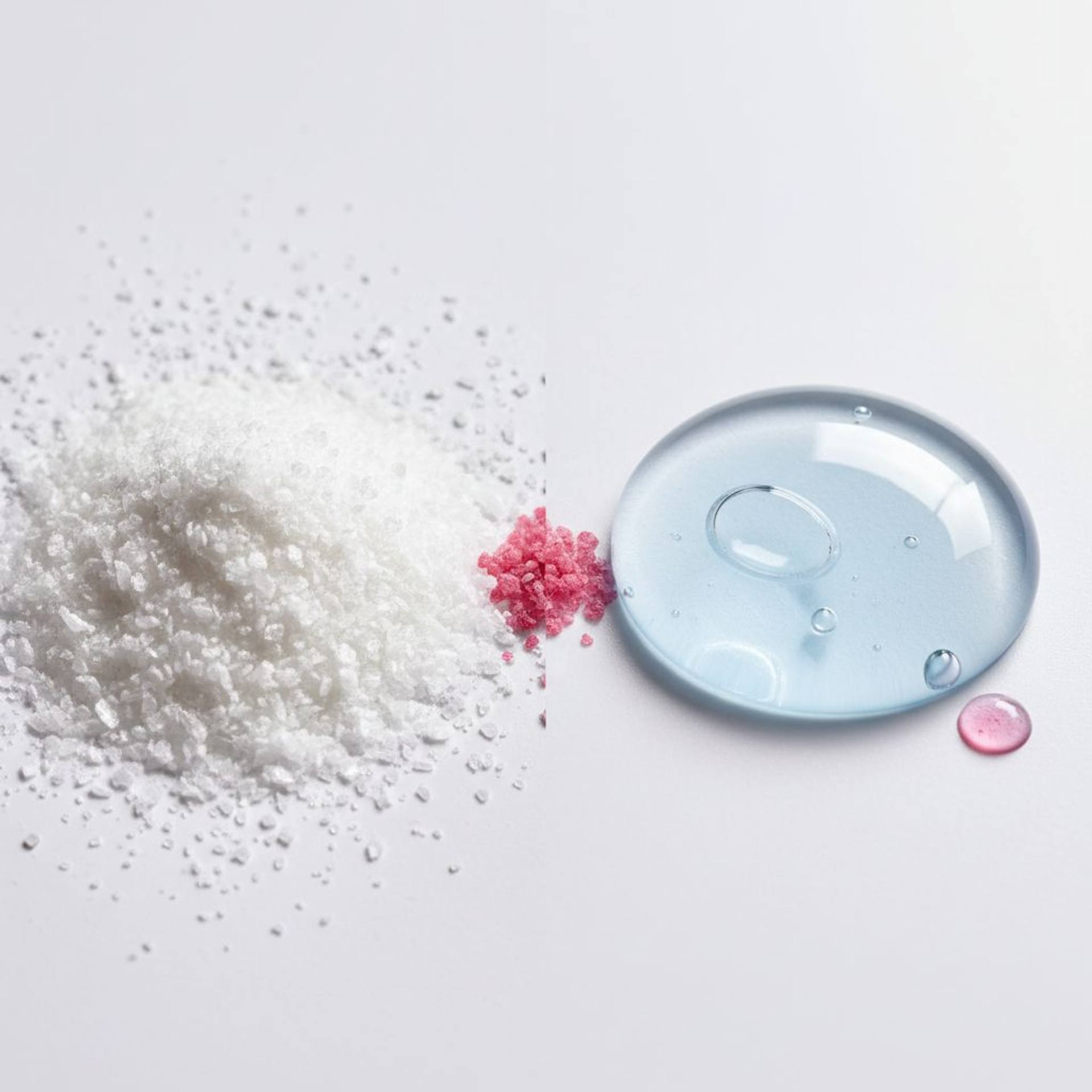
Powder is anhydrous base. It can contain solid mineral boosters, such as sodium carbonate (CAS 497-19-8), sodium silicate (CAS 1344-09-8), or zeolite A (CAS 1318-02-1), which dissolve better in warmer water. Below a certain temperature threshold, they simply don't fully dissolve in a short cycle.
Gel and capsules rely on nonionic surfactants, including fatty alcohol ethoxylates (CAS 68439-46-3), which dissolve well even at low temperatures. That's why gel suspends in cold water much less often than powder.
The capsule coating, a polyvinyl alcohol (PVA) film (CAS 9002-89-5), dissolves on contact with water in seconds. It needs enough water and drum movement at the start of the cycle, though.
The most common capsule mistake
Don't put the capsule directly on the fabric. Place it at the bottom of the drum, before the laundry. Avoid the shortest and coldest cycles: PVA film may not fully dissolve, and residue will stick to your clothes.
Enzymes in gel
why they're less active than in powder at the same dose
Enzymes in detergents (proteases, amylases, lipases, cellulases) break down protein, starch, and grease stains. In powder, they come as coated granules, stable in an anhydrous environment. In gel and capsules they must be dissolved in liquid formula from the start, which requires extra stabilisers to protect them from self-degradation in contact with water and surfactants.
In aqueous systems, enzymes typically lose activity faster than in dry form, so liquid formulas need additional stabilisers during production. There's no confirmed data, though, proving that gel at the same dose carries lower actual enzyme activity than powder. This needs verification from the manufacturer of each specific formula.
Enzymes help break down specific stain types: protein, starch, and grease. Not every fabric tolerates them equally well, though. See the warning below.
Wool and silk: proteolytic enzymes damage the fibre
Proteolytic enzymes break down proteins, and wool and silk are protein fibres. A formula with strong protease, especially gel or capsule with high enzyme concentration per dose, can weaken these fibres during extended contact or at higher temperatures. For wool and silk, choose detergent without proteolytic enzymes. If in doubt, take your laundry to a professional laundry instead of experimenting at home.
How to check that everything went right
After the cycle ends, inspect the fabric: no visible film pieces means the capsule fully dissolved. Gel has an advantage: you control the dose proportionally to load size, whereas capsules always deliver the same fixed amount of detergent.
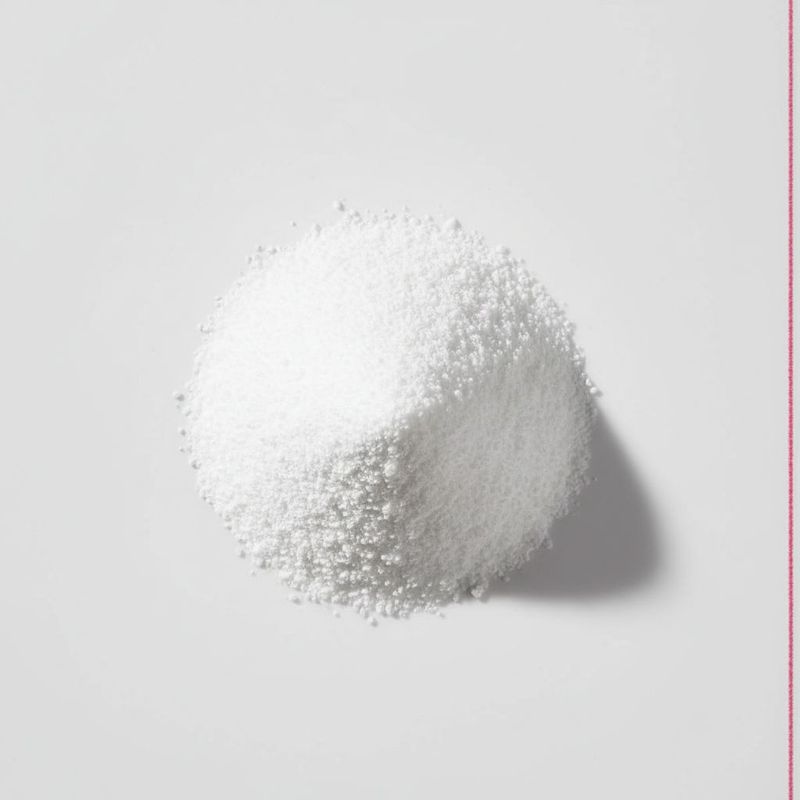
Powder
dry base, mineral
Best for whites and fabrics that tolerate oxygen bleach.
Gel
water base
Good choice for delicate fabrics and colours.
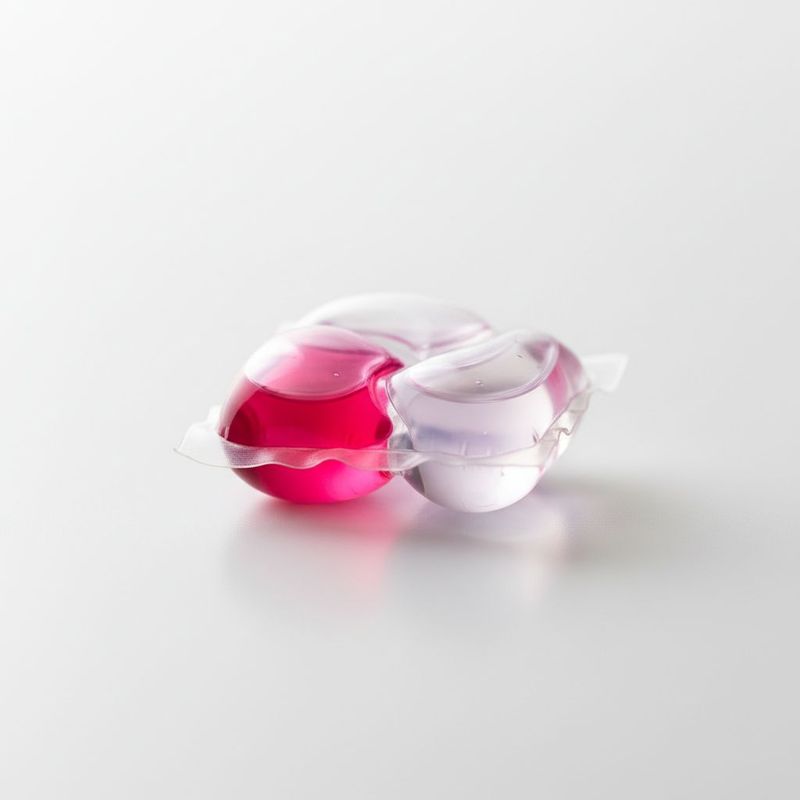
Capsule
concentrated, in PVA coating
Convenient for standard or long cycles.
No form is universally better. Choice depends on water hardness, programme temperature, and fabric type: powder works for whites and bleaching, gel for delicate fabrics and colours, capsules for the convenience of a fixed dose in standard or long cycles.
Home chemistry has limits, though. Bleach discolouration on wool won't vanish after a simple detergent switch in the next wash. Fibre damage from prolonged contact with strong proteolytic enzyme won't reverse either. The same goes for detergent stains fixed during another wash at the wrong temperature.
At that point, it's worth moving from experiments to a professional laundry.

Now you know the theory. Practice can be less forgiving.
If you would rather not risk your favourite piece, leave it to the specialists at Gorące Żelazko laundry in Lublin.


Frequently asked questions
Depends on cycle duration and agitation. In a very short, cold cycle the PVA coating may not fully dissolve, leaving film residue on the fabric.
It's undissolved powder builders, mainly sodium carbonate and sodium silicate. They settle on fibres more often at low water temperature or in hard water.
Not in open or concentrated form. Store them in the original packaging, out of reach of children: accidental contact with concentrated contents is documented in toxicology literature as a source of serious poisoning.
It's mainly the convenience of precise, fixed dosing, not automatic effectiveness superiority. Powder keeps exclusive oxygen bleaching in many formulas.
About the author
Małgorzata Małecka
Owner of the Gorące Żelazko laundry
Małgorzata Małecka runs the Gorące Żelazko laundry in Lublin. Together with her team, she makes sure customers' clothes, shoes and fabrics come back clean and in the best possible condition.