Drying tulle without losing shape
Flat, away from heaters and sun: why hangers are the wrong choice.

Tulle is one of the most heat-sensitive materials in the care of evening and wedding wear. The thin mesh has minimal thermal mass, so it heats up to a critical temperature faster than intuition suggests, both when drying and under an iron. Below are the rules for safe drying and ironing, matched to the fiber your tulle is made from.
Drying tulle without losing shape
flat position, distance from heat sources and the real drying time
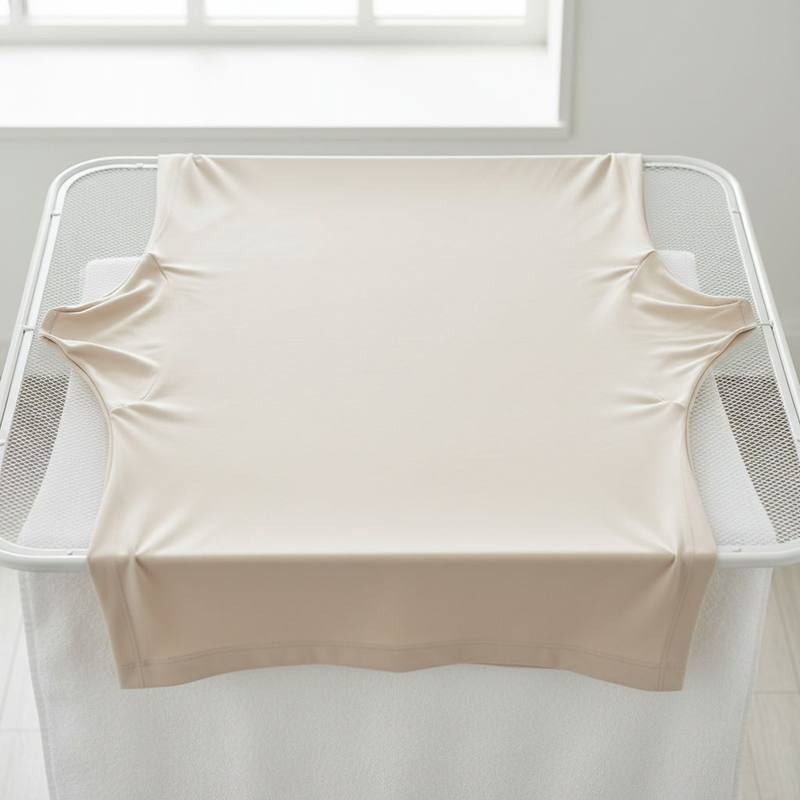
Dry tulle in a flat position, on a towel or mesh drying rack. A hanger seems more convenient, but for heavy, multilayered tulle skirts it's a bad choice. The material stretches under its own weight while still wet and most prone to permanent distortion.
Keep drying tulle away from direct sunlight and heat sources, such as radiators or hot air vents: these speed up aging of the sizing and can cause yellowing of white tulle before it even fully dries.
Under room conditions, at temperature 20 to 22°C and relative humidity around 50%, a single layer of tulle typically dries in 2 to 4 hours, as the material is very light and low weight per unit area.
Never do this
Tumble dryer is contraindicated even on a delicate program at temperatures around 40 to 50°C. The combination of heat with mechanical drum movement permanently crushes the mesh and accelerates sizing degradation, and the effect can no longer be fixed by any ironing.
A common mistake with multilayer tulle
Don't stack wet tulle layers on top of each other. The bottom layers get pressed down by the weight of the upper ones and dry into a distorted shape. Dry each layer separately, laid out flat, even if it takes up more space.
Ironing tulle without scorching
Temperature thresholds for nylon, polyester and silk and the rule of safe contact.
Safe iron temperature depends on what material your tulle is made from, and in each case is much lower than the fiber melting temperature measured in laboratory conditions. Before reaching for the iron, check the threshold breakdown below for each material.
Ironing tulle by material
Ironing by material
Nylon, about 110°C
One dot in the ISO 3758 system, the lowest temperature threshold on the iron scale. Nylon is prone to melting even with slight overheating.
Polyester, about 150°C
Two dots in the ISO 3758 system. The standard clearly assigns this level to polyester, not a broader range including one dot.
Silk, about 130 to 150°C
Only through a damp cotton cloth, never directly. Silk doesn't melt like synthetic fibers, but loses strength and yellows around 150°C.
The difference between fiber melting temperature and the temperature at which synthetic tulle shows visible damage under an iron sole is in practice much smaller than the melting temperature alone would suggest.
The reason is physical. Direct, concentrated contact of a heated iron sole with thin tulle mesh very often leads to local melting of loops within 1 to 2 seconds. The thinness of the fiber and the low heat capacity of the material means it heats to critical temperature much faster than intuition suggests.
Safe ironing, step by step
- 1
Lay a dry cotton cloth over the fabric
Cover the tulle section you want to iron with a dry cotton cloth. This is the only safe barrier between the hot iron sole and the delicate mesh.
- 2
Test on a hidden section first
Check the chosen temperature on a piece hidden in a seam or lining before moving to the visible part. A few seconds of contact is enough to judge the fiber's reaction.
- 3
Iron in spots, lifting the iron each time
Touch the iron through the cloth briefly and pointwise, lifting it each time instead of sliding it across. A sliding motion extends contact time and raises the risk of melting the loops.
- 4
When in doubt, reach for steam
A handheld steamer from 10 to 15 cm away gives a similar smoothing effect without the risk of direct contact with a hot surface.
Never do this
Never place the iron sole directly on synthetic tulle, even at the setting appropriate for nylon or silk. Always iron through a dry cotton cloth, pointwise and briefly, lifting the iron instead of sliding it across the material.
Remove stains before ironing
Never iron tulle over a visible stain: heat sets most staining permanently into the mesh loops. First remove the stain and let the material dry completely, only then reach for the iron or the steamer.
When to hand tulle to a laundry
Multilayered wedding or evening gowns made of tulle, especially ones decorated with sequins, beads or lace, are better left to a professional laundry. Smoothing a large surface of mesh without creases requires steam equipment and experience that a home iron can't replace. The same applies to tulle already showing signs of overheating, such as slightly stiffened patches: further home handling usually only deepens the damage.

Now you know the theory. Practice can be less forgiving.
If you would rather not risk your favourite piece, leave it to the specialists at Gorące Żelazko laundry in Lublin.


Frequently asked questions
Yes, but never directly with the iron sole on the material. Iron through a dry cotton cloth, pointwise and briefly, at temperature chosen for the material: about 110°C for nylon, about 150°C for polyester, 130 to 150°C for silk through a damp cloth.
A handheld steamer from 10 to 15 cm away is the safest method, eliminating direct contact with a hot surface. Hanging on a hanger with air circulation for 12 to 24 hours works slower but works for light transport wrinkles.
The temperature depends on the fiber and is always lower than the lab melting point suggests, because point contact between a hot plate and thin netting melts it in a second. Never place the iron directly on synthetic tulle, even on a nylon setting. Iron through a dry cotton cloth, briefly and in spots, lifting the iron instead of gliding.
No. Even a delicate program at 40 to 50°C combines heat with the drum's mechanical movement, which permanently crushes the mesh and speeds up degradation of the stiffening sizing. Always dry tulle flat, in the air.
Thermal damage, meaning stiffened or fused mesh loops, can't be undone by any home method. If the mark is visible on an exposed part of the garment, it's worth asking a laundry whether it can be masked or the section repaired.