White streaks from powder on black clothes
In most cases, it's undissolved powder or hard water deposits, not damaged dye.

You pulled a black blouse out of the washing machine and saw white, grainy streaks or grey film on the sleeves. First thought: I've ruined the clothes.
Relax. In the vast majority of cases, it's not faded dye, just incompletely dissolved powder or hard water deposits. The fabric hasn't lost its colour, it just has something on it that can be washed off.
From this text, you'll learn where that film comes from, how to remove it from clothes you have now, and how to make sure it doesn't come back with every wash.
How to tell deposits from damaged dye
Powder or mineral deposits are grainy or matte. Most often, they come off when you rub them with a wet hand or put the clothes through an extra rinse. Real dye damage looks different: it's a stain, not a streak, and it doesn't disappear from touch or another wash. If the film doesn't fade after two attempts described below, you're probably dealing with something more serious than deposits.
White powder streaks on black clothes: why it doesn't dissolve completely
Three mechanisms: zeolites, hard water, optical brighteners
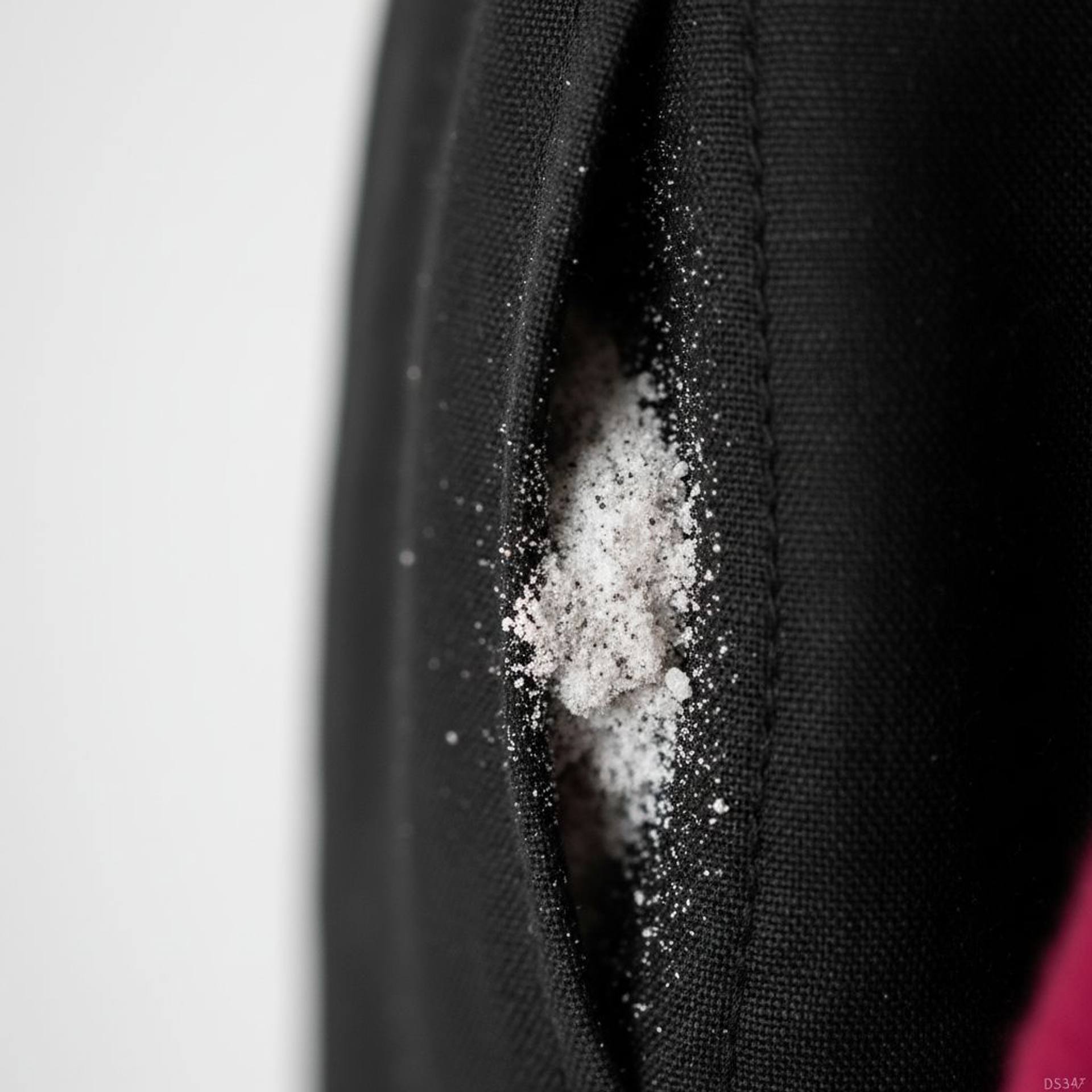
The first culprit is zeolites, the powder ingredients responsible for water softening. They dissolve worse at low temperatures, so cold water washing increases the risk that some powder will stay on the fabric instead of rinsing away.
The second mechanism is hard water. Calcium carbonate from the tap water settles together with detergent residue, most readily in cuffs, pockets, and folds where rinsing water has the hardest time reaching.
The third culprit is optical brightener, present in most universal powders. It has nothing to do with dissolution: it's a substance that deliberately settles on the fibre and optically brightens it. On black fabric, it creates a greyish, matte film, even when the powder has dissolved perfectly.
Undissolved powder
Shake the film off dry, then do an extra rinse without adding more powder.
Mineral deposits from hard water
Second rinse with a smaller drum load. If the problem keeps coming back, water softener or professional washing helps.
Optical brightener (FWA)
Switch to detergent designed for dark and black fabrics, without optical brightener.
Rinsing alone won't remove an already settled layer. You need to change the powder.
Fabric softener residue
Rinse without fabric softener added. Next wash, use less rinse fluid.
Now that you know what you're dealing with, it's time for rescue. Whether the clothes are still wet makes a difference: on damp fabric, deposits come off easier than after a full drying cycle.
The order of steps matters too. More powder or hotter water "to be sure" usually makes things worse, not better.
- 1
Check if the clothes are dry or wet
On damp fabric, deposits come off more easily, without needing a full rewash.
- 2
Shake and brush the excess film off dry
Do this before any contact with water, so you don't rub the deposit deeper into the fabric.
- 3
Run an extra rinse in cold or lukewarm water
Use the "extra rinse" setting on your machine, without adding more powder.
- 4
If the deposit doesn't come off, rewash with a smaller load
Adjust the powder dose to your water hardness and dissolve it first in warm water, rather than pouring it dry into the drawer.
What not to do
Adding more powder "to be sure" increases the risk that the next layer also won't rinse out completely. Spirit vinegar in the fabric softener compartment is often recommended on forums for mineral deposits and makes chemical sense, as acetic acid dissolves calcium carbonate. But regular use can damage rubber seals on your washing machine, so use it only occasionally, not with every wash.
Minerals from hard water on black clothes: how to avoid matte stains
Dosing, temperature, and load size going forward
Do
- Choose detergent designed for dark and black fabrics, without optical brightener
- Dose powder according to the manufacturer's table based on water hardness, not by guessing
- Wash black clothes with less than a full drum load so water rinses the fabric better
- Turn clothes inside out before washing
- Regularly clean your washing machine with a cleaning cycle or empty wash with descaler
Don't
- Don't pour powder directly onto clothes in the drum, only into the drawer
- Don't wash universal powder at very low temperatures if the manufacturer recommends higher
- Don't overload the drum beyond about two-thirds capacity with dark clothes
Water in Lublin and the surrounding area is often rated as moderately hard to hard. In practice, this means one thing: when in doubt, dose powder closer to the upper limit on the box than the lower one.
There are still questions that usually come up after reading this text.
If the problem keeps coming back despite better dosing and temperature, or affects fabric where you don't want to risk another failed attempt (a suit, an elegant dress), that's a signal.
Stop experimenting on your own then.
A laundry doses detergent proportionally to load size and measured water hardness, uses products without optical brighteners, and rinses fabric in multiple stages with residue monitoring. This solution makes sense for recurring problems or delicate fabrics, not for a single everyday shirt wash.

Now you know the theory. Practice can be less forgiving.
If you would rather not risk your favourite piece, leave it to the specialists at Gorące Żelazko laundry in Lublin.


Frequently asked questions
Usually not. It's powder or mineral deposits, not faded dye. Check the rule from the box above: real damage is a stain that doesn't disappear from touch or another wash.
As much as the manufacturer recommends for the "hard water" threshold in the dosing table on the box. That's the highest dose from the table, not a guess.
Gel carries lower risk of grainy deposits because it doesn't contain insoluble zeolites in the same form as powder. It's worse at handling mineral stains, though.
Chemically, yes, acetic acid reacts with calcium carbonate. Keep this solution for rare situations, not for regular machine descaling.
About the author
Małgorzata Małecka
Owner of the Gorące Żelazko laundry
Małgorzata Małecka runs the Gorące Żelazko laundry in Lublin. Together with her team, she makes sure customers' clothes, shoes and fabrics come back clean and in the best possible condition.