Powder stays in pockets: why and how to prevent it
Powder residue in pockets and creases isn't a washing machine fault, but a predictable effect of the physics and chemistry of washing.

White streaks in pockets, hard deposits in the crease of a cuff, powdery residue right by the collar. You see it most clearly on dark clothes, just after they've dried.
It's not a washing machine fault and not a coincidence. Powder residue (that's what we'll call it here) is a predictable effect of the physics and chemistry of washing. You can remove it, and even more easily, you can prevent it.
Why powder doesn't dissolve in water
Chemistry of solubility in pockets and creases
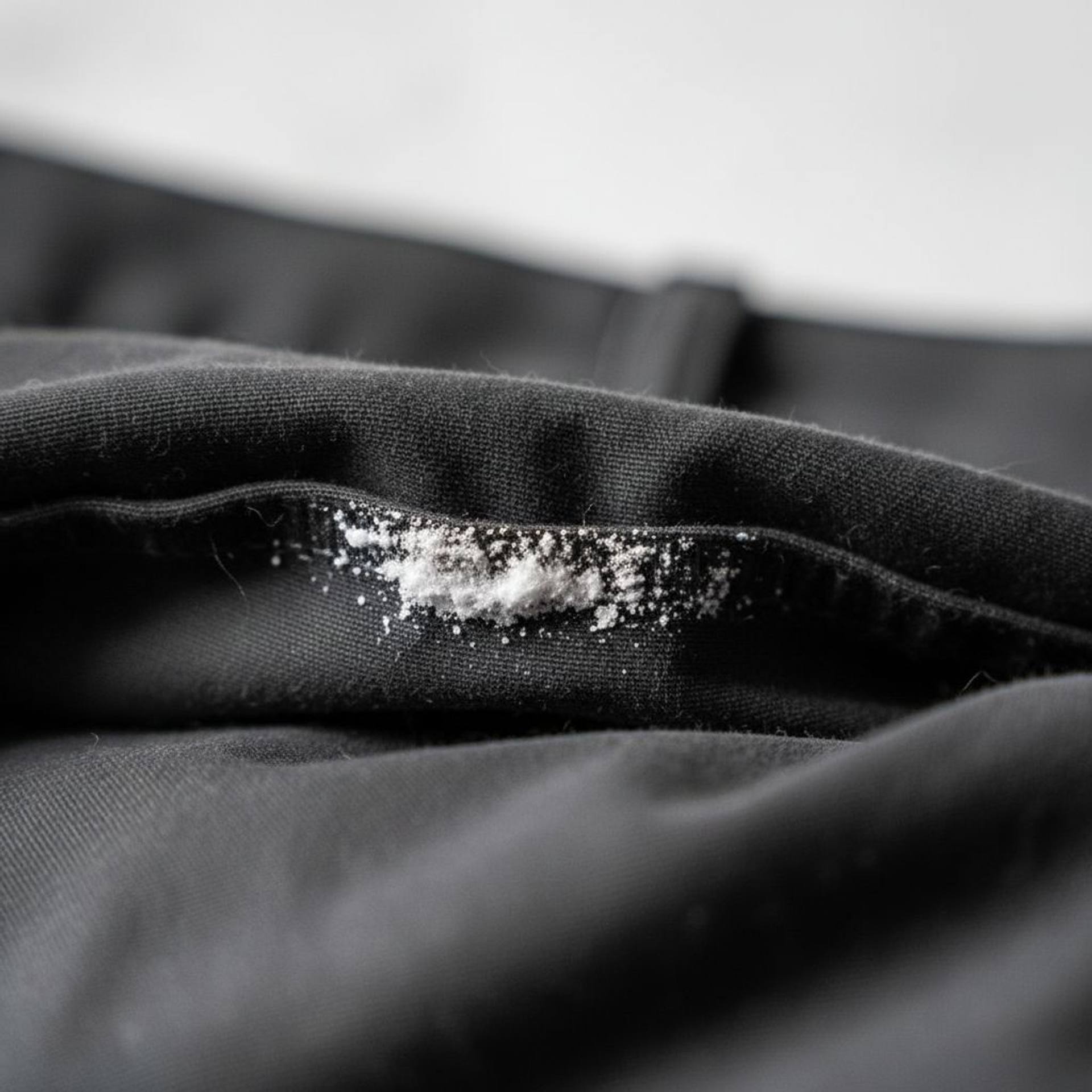
Laundry detergent is a mixture. Anionic surfactants (LAS) do the cleaning, and builders (sodium carbonate and zeolites) soften the water and help remove dirt. Surfactants dissolve faster than builders, especially in hard water. A pocket turned inside out creates an air pocket that water can't fully penetrate, so undissolved granules settle at the bottom of the fabric.
In hard water, roughly above 180 mg CaCO3/l, calcium and magnesium ions react with LAS and builders, forming insoluble calcium salts visible as white deposits in seams and creases. Full powder dissolution typically happens at 40-60 degrees Celsius, and below 30 degrees, builder solubility is clearly limited.
The most common mistakes when washing with powder
Do
- Measure powder with the scoop from the packaging, matched to water hardness and load size
- Turn pockets inside out before washing
- Always put powder in the dispenser drawer, never directly on clothes
- Wash with a full, unoverloaded drum at 40-60 degrees Celsius
Don't
- Dose powder by eye, without a scoop matched to water hardness
- Wash with pockets turned inside out
- Put powder directly in the drum instead of the dispenser
- Overload the drum beyond recommended capacity
If the residue has already dried and you see white streaks, you don't need to re-wash everything from scratch. The steps below work both on a single item and on a full load where the problem keeps recurring.
- 1
Shake off the dry residue
Before putting the garment back in the washer, brush or shake off the dry residue from the pockets and creases. The fewer granules go into the drum, the lower the risk of it happening again.
- 2
Soak the spot
Turn the pocket inside out and soak the area with residue in warm water before putting the garment in the washer. This dissolves what brushing didn't remove.
- 3
Wash again with extra rinsing
Run a full, unoverloaded load at 40-60 degrees Celsius with an extra rinse cycle. With thicker fabrics, the extra rinse isn't optional, it's necessary.
- 4
Check the result after drying
If the deposit comes back despite correct washing, check your local water hardness and powder dosage. That's usually the cause of recurring problems.
Dissolve the powder in warm water prepared beforehand and only then pour it into the dispenser drawer. This single habit eliminates the risk of undissolved granules even at lower washing temperatures.
With hard water, liquid detergent or capsules limit residue risk better than powder, because they contain no insoluble builder granules. If the problem persists despite correct washing, consider a water softener or switching to powder with a built-in builder.

Now you know the theory. Practice can be less forgiving.
If you would rather not risk your favourite piece, leave it to the specialists at Gorące Żelazko laundry in Lublin.


Frequently asked questions
A pocket turned inside out creates an air pocket that water can't fully penetrate. Undissolved builder granules, especially at too low a temperature or in hard water, settle at the bottom of the fabric and become visible as white deposits when dry.
Yes. Overdosing beyond the solubility of the wash water at that temperature and hardness is one of the most common causes of deposits. Measuring with a scoop matched to load size and water hardness solves the problem in most cases.
Yes, directly. Calcium and magnesium ions react with surfactants and builders, forming insoluble calcium salts visible as white deposits. Risk rises above roughly 180 mg CaCO3/l, classified as very hard water.
With premium and wool fabrics, where the risk of permanent damage is higher than with regular washing, and when the problem persists despite correct dosage and temperature.
About the author
Małgorzata Małecka
Owner of the Gorące Żelazko laundry
Małgorzata Małecka runs the Gorące Żelazko laundry in Lublin. Together with her team, she makes sure customers' clothes, shoes and fabrics come back clean and in the best possible condition.