Ammonia in laundry: uses and risks
Ammonia is powerful, but it requires careful handling, proper dilution, and good ventilation to stay safe.

Pet urine smell returns despite washing at 60 degrees. Sweat stains remain on the collar even though you used the best detergent available. Naturally, you reach for the ammonia from under the sink, because grandma did it that way and it worked.
But here's the problem: ammonia only works with proper dilution and ventilation, and a mistake or bad combination with another product ends worse than a persistent stain. Here you'll find what ammonia actually does in laundry, where the safety line is, and when it's cheaper to take your clothes to a professional laundry.
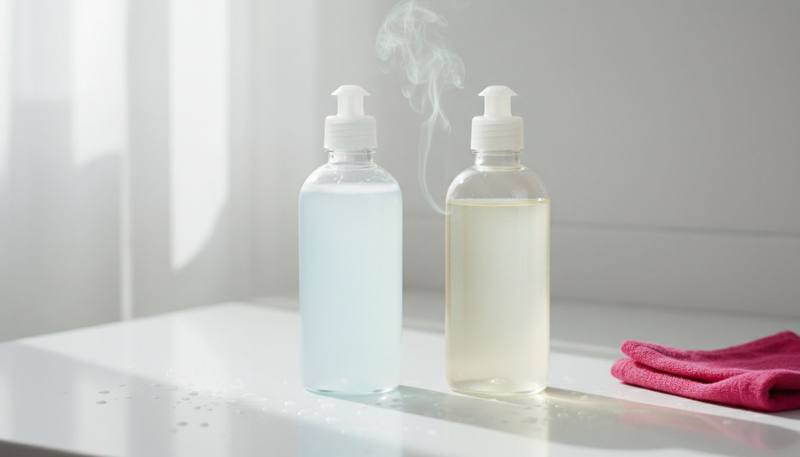
The ammonia you buy in a pharmacy is always a water solution, never pure gas. It has a basic pH, so it dissolves grease and softens dried protein stains like sweat, blood, and milk. You apply it to a stain before proper washing, not instead of washing.
The second use is neutralising odours, like urine, and refreshing white fabrics. It works where high temperatures are forbidden, such as with wool and silk, because it works without heating water.
Ammonia, aqueous solution (ammonium hydroxide)
CAS 1336-21-6 (anhydrous ammonia has a separate number, 7664-41-7, so safety data sheets differ). Commercial solutions in Poland typically have a concentration of roughly 5-10% NH3; check the exact range on the label. GHS classification: eye irritation category 2, respiratory STOT SE 3, aquatic hazard category 1: H319, H335, H400.
- Protein and grease stains
- Fabric refreshing
- Odour neutralisation
Is ammonia safe: how it works, exposure, and when to avoid
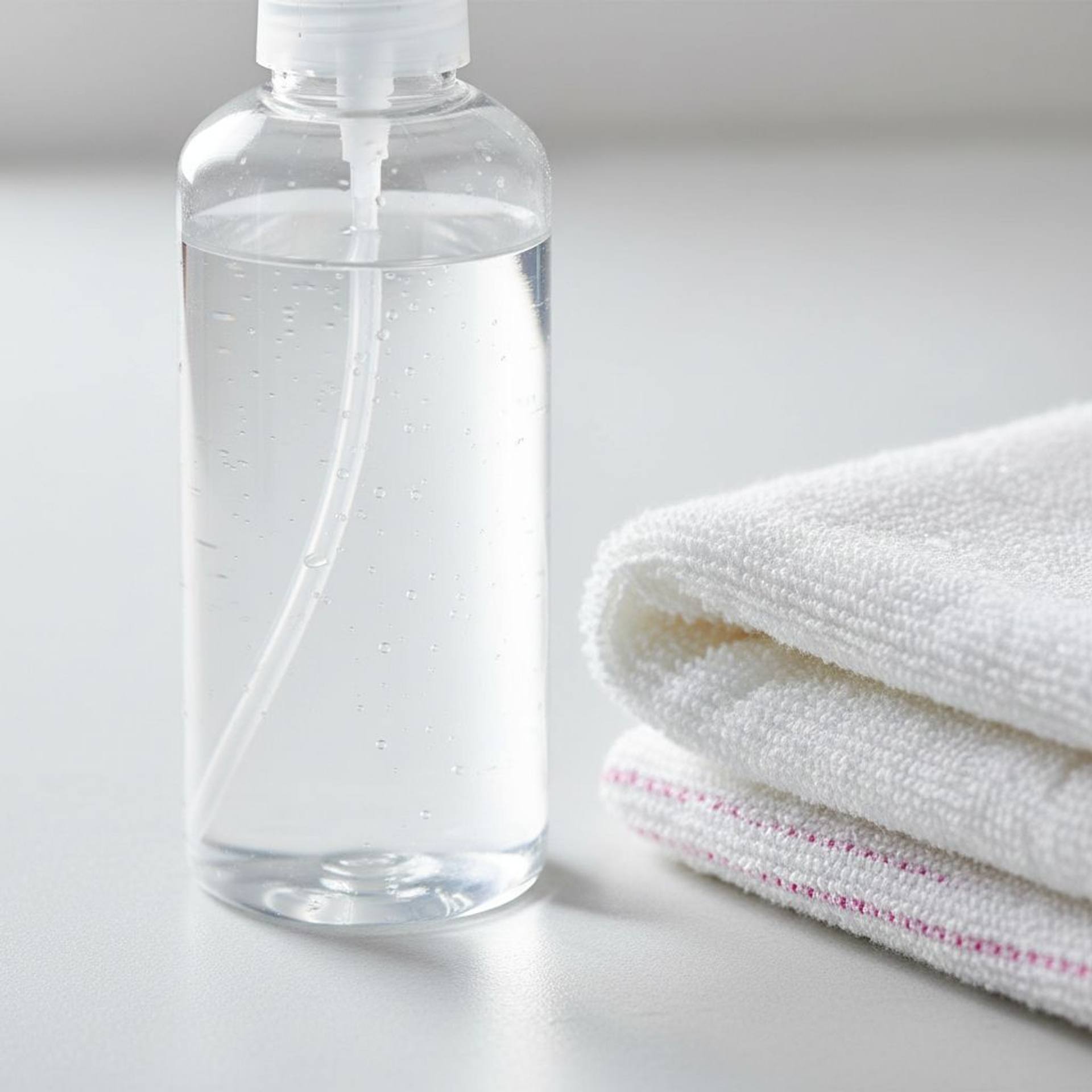
Never mix ammonia with chlorine bleach, also known as sodium hypochlorite (CAS 7681-52-9). The reaction produces toxic chloramines, which strongly irritate the respiratory tract and eyes. This is one of the most commonly cited dangerous combinations of household cleaning products: keep both products separate.
Working in an unventilated room irritates the respiratory tract within minutes at higher concentrations. A solution that's too concentrated on silk, wool, or dyed fabrics, left for longer than about fifteen minutes, can cause discolouration or fibre damage.
Ammonia is not a classic allergen, but it irritates strongly. In people with atopic dermatitis, asthma, or respiratory hypersensitivity, symptoms can worsen from simply inhaling the fumes. Mixing with vinegar is not dangerous like mixing with chlorine, just useless: the acid neutralises the ammonia's pH and neither product cleans.
Do
- Dilute ammonia with water before use, never apply it pure
- Test the solution on a hidden part of the fabric
- For concentrations above roughly 5%, use nitrile or neoprene gloves; this is general guidance, not an industry standard
Don't
- Don't mix ammonia with chlorine bleach (sodium hypochlorite)
- Don't use on silk, wool, or dyed fabrics without testing
- Don't work in a closed, unventilated room
Home ammonia safety limits: where the line is
- 1
Dilute the solution
Roughly one tablespoon of ammonia per cup of water; this comes from home guides, not an industry standard. A stronger solution doesn't work faster, it just increases the risk of fabric damage.
- 2
Test on a hidden area
Apply a drop to an inner seam, wait a few minutes, and check whether the fabric has changed colour or texture.
- 3
Apply with ventilation and gloves
Work with an open window, wearing nitrile or neoprene gloves. Leave the solution on the stain for roughly 10-15 minutes, then wash normally.
Home ammonia use is cheap and always available, but without control over how a specific fabric reacts, the risk of permanent damage is higher than with professional treatment. A laundry selects the concentration and duration according to fabric care symbols under ISO 3758 standard, not by guesswork.
Take valuable or delicate items like silk, wool, or coats to professionals. Do the same if a home attempt has already set the stain, or if the odour returns despite repeated washing.

Now you know the theory. Practice can be less forgiving.
If you would rather not risk your favourite piece, leave it to the specialists at Gorące Żelazko laundry in Lublin.


Frequently asked questions
It depends on the fabric and concentration. On silk, wool, and dyed fabrics, the risk of discolouration grows with longer contact, so always test the solution on a hidden part.
No, never. Ammonia and chlorine bleach react, producing toxic chloramines that irritate the respiratory tract and eyes. Learn more about this reaction in our guide to mixing chlorine and ammonia.
They work differently: ammonia acts alkaline on grease and protein, vinegar acts acidic on limescale and odours. Don't mix them because they neutralise each other. For sensitive fabrics, vinegar is milder.
In pharmacies and household chemical shops. Before buying, check the NH3 concentration on the label and, if the product provides it, the SDS safety data sheet.
About the author
Małgorzata Małecka
Owner of the Gorące Żelazko laundry
Małgorzata Małecka runs the Gorące Żelazko laundry in Lublin. Together with her team, she makes sure customers' clothes, shoes and fabrics come back clean and in the best possible condition.