Why Aluminium Deodorant Stains Are Hard to Remove
Aluminium salts from antiperspirant form a durable complex with sweat proteins. We explain the mechanism and effective stain removal methods.

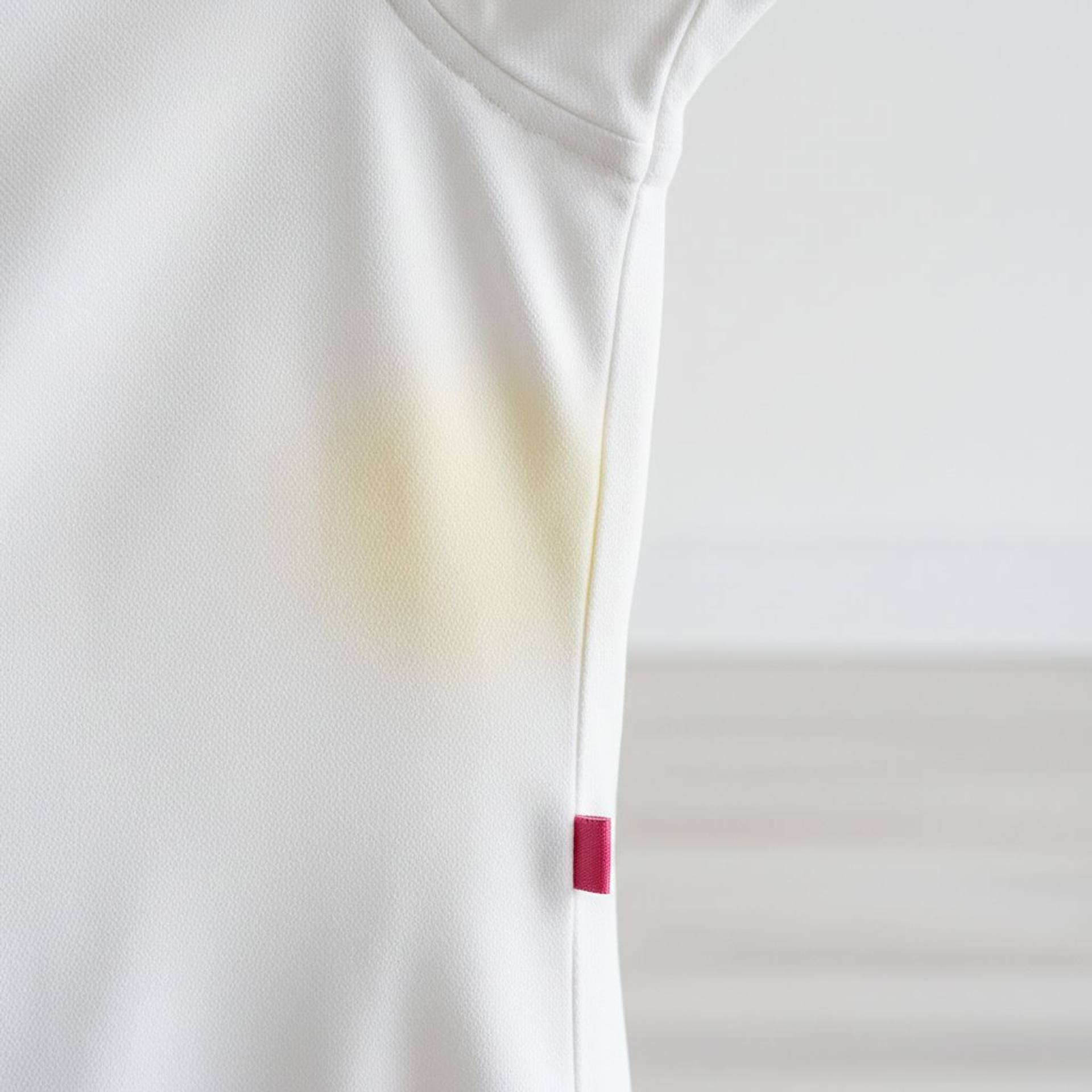
You know the feeling: your shirt comes out of the wash clean, but after drying or after running an iron under the arm, you spot a yellowish or grayish discolouration you didn't see before. It's not ordinary sweat stain.
It's an aluminium deodorant stain. The product of a chemical reaction between aluminium salts from your antiperspirant and sweat residues on the fabric. That's exactly why regular washing, even at high temperatures, often won't remove it. In this article, we explain what happens on the fibres and why you need a different approach than you'd use for a typical stain.
Why Aluminium Binds to Fabric
What's in an aluminium deodorant that stains your clothes
Aluminium salt from antiperspirant, when it comes into contact with skin moisture, forms an aluminium hydroxide gel residue, Al(OH)3. This is a well-documented mechanism of how antiperspirant works: the residue mechanically blocks the openings of sweat glands. This same residue transfers onto fabric with every contact with the material.
The yellow discolouration isn't aluminium alone. It's a complex of aluminium with several sweat components at once: proteins from apocrine secretions and shed skin, plus fine-molecular sweat compounds, mainly urea and lactic acid. These fine molecules aren't proteins, but they also bind aluminium ions.
Heat from a tumble dryer or iron further denatures these proteins and locks the complex onto the fibre. This is a practical principle adopted by the laundry industry, though still without a single definitive scientific source. But the consequence is simple: don't iron or heat-dry a stain before you remove it.
Aluminium Chlorohydrate (ACH)
CAS 1327-41-9The most common aluminium salt in roll-on and stick antiperspirants. Solid forms lack harmonised GHS classification; aqueous solutions may be marked as eye irritants depending on the manufacturer.
- roll-on antiperspirants
- stick antiperspirants
- everyday formulas
- classification depends on manufacturer and product form
Why Regular Washing Won't Remove the Stain
The armpit stain doesn't come out after washing, even at high temperature
Ordinary laundry powder or gel does an excellent job with grease and everyday organic dirt. It breaks down these soils and rinses them from the fibres. The problem is that it doesn't break the bond between aluminium salt and protein, because that's a completely different type of chemical bond.
That's why aluminium deodorant stains can come back after multiple washes, or build up in layers, even when washing at high temperatures. It doesn't mean you're washing poorly or doing something wrong. It's simply a different type of soil that requires a different mechanism of action than standard detergent.
Don't heat-set the stain
Don't iron or heat-dry a stain before it's removed. Heat denatures protein and locks the aluminium-protein complex onto the fibre, and after setting, home methods stop working.
The solution isn't higher temperature or more detergent. It's breaking the protein bond with a protease enzyme before the fabric goes into regular washing.
What actually works
Do
- Soak the stain with an enzymatic stain remover containing protease before washing, at a temperature below the enzyme's deactivation threshold (usually around 40°C, exact value depends on the specific product)
- Remove the stain straight away after you spot it, before heat locks it in
- Test on an invisible part of the fabric before using vinegar on silk or wool
Don't
- Don't use chlorine bleach on coloured or wool fabrics, as it destroys dye and weakens wool's protein fibres
- Don't apply antiperspirant directly onto your clothes instead of dry skin
Silk and wool are protein fibres (keratin and fibroin) that bind aluminium ions more strongly than cotton or linen. This aligns with general knowledge about aluminium's affinity for protein structures, though precise data from textile literature still needs confirmation. In practice, this means the stain holds tighter on delicate fabrics.
Polyester collects residue mostly on the fibre surface and in theory is easier to clean. In practice it's harder to notice until it sets so much it becomes permanently visible.
Never mix vinegar with bleach
Never mix vinegar or other acids with bleach-containing products like chlorine bleach. The reaction of acid with sodium hypochlorite releases chlorine gas, which is harmful to health.

Now you know the theory. Practice can be less forgiving.
If you would rather not risk your favourite piece, leave it to the specialists at Gorące Żelazko laundry in Lublin.


Frequently asked questions
Below the protease enzyme's deactivation threshold, usually around 40°C. The exact value depends on your specific stain remover, so check the label. Higher temperature won't speed things up, it will just disable the enzyme.
It depends on how much heat-set the stain is and what fabric it's on. Fresh stains respond well to protease enzyme. Older or already heat-set stains from an iron or dryer are much harder to remove at home.
Vinegar works moderately well on fresh stains but can be risky for silk and some dyes, so test on a hidden area first. Baking soda works mainly by scrubbing and abrasion, not by breaking down the aluminium-protein complex.
When the stain is old, the fabric feels stiffened, it's silk or wool, or the stain has already been heat-set by an iron or dryer. Then acid or abrasive home methods usually just lighten the stain on the surface.
About the author
Małgorzata Małecka
Owner of the Gorące Żelazko laundry
Małgorzata Małecka runs the Gorące Żelazko laundry in Lublin. Together with her team, she makes sure customers' clothes, shoes and fabrics come back clean and in the best possible condition.