When wool needs special treatment
warning signs that point to a garment's value, delicacy and risk of felting

Not every wool item can go in a home washing machine. Sometimes the fiber decides, more often the garment's construction: linings and stiffeners. Recognizing this early saves money and nerves, because a mistake with wool is often irreversible: a felted fabric cannot be brought back to its original state.
Below is a simple criterion for when to take an item to a laundry, and when it is safe to wash it yourself at home, plus an explanation of why wool reacts to washing differently than cotton or synthetic fabrics.
Why wool felts
keratin scales, moisture and friction: the mechanism behind every other rule
Wool is a protein fiber made of keratin, the same material as human hair. The surface of every fiber is covered in microscopic scales, arranged like roof tiles, all pointing the same way. In a dry state the scales lie flat, so fibers slide past each other freely.
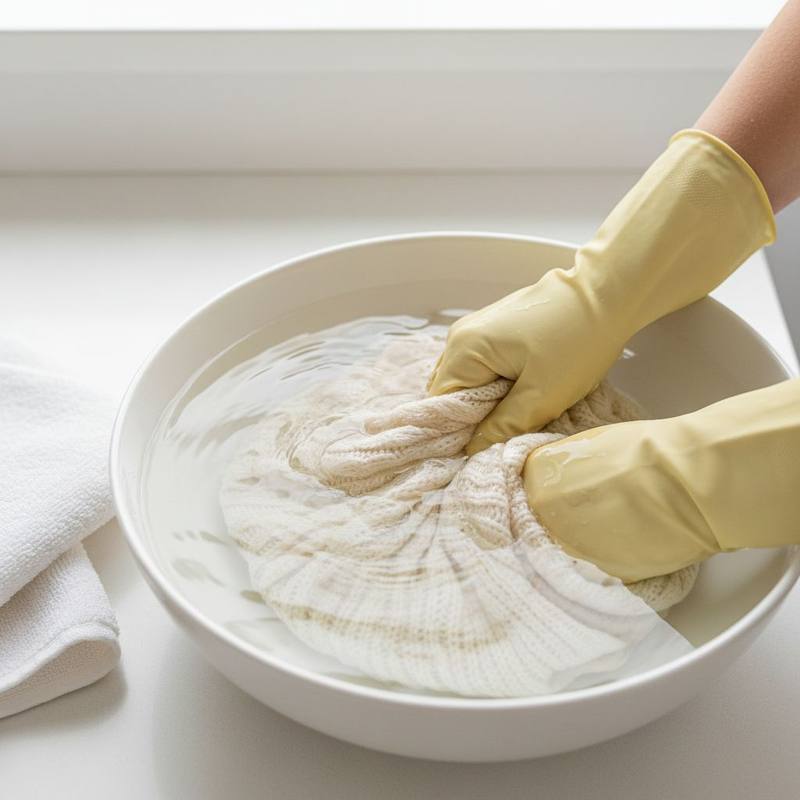
The problem starts when three factors act on wool at once: heat, moisture and friction. High temperature and water loosen the fiber's structure, and motion, such as a washing machine's spin cycle or heavy rubbing during hand washing, makes the scales of neighboring fibers hook onto each other and never let go. That is how felt forms: the fabric shrinks irreversibly, thickens and loses its original texture. That is why a single too-hot wash can ruin a wool item beyond any hope of returning to its previous size.
Fiber or construction: a simple criterion
a few seconds is enough to assess the risk
Ultrafine merino wool (15-17.5 µm), cashmere, and any fabric with a label ruling out water washing should go to professional cleaning, not the home washing machine. The finer the fiber, the worse it tolerates friction and moisture at the same time, so the risk of felting rises.
Just as often, though, the deciding factor isn't the fiber itself but the garment's construction. Linings, stiffeners and bonded elements won't survive a water wash, even if the wool itself would come through fine. That's why a coat may need dry cleaning even though a single sweater made of the very same wool can safely be washed at home.
Warning signs: when not to risk washing at home
Ultrafine merino 15-17.5 µm and cashmere need professional cleaning, not a washing machine
A “dry clean only” symbol rules out any water washing at home
Lining, stiffeners and bonded elements won't survive a water wash
Visible felting or “boiled wool” from a previous wash is a sign to stop trying
Dry cleaning versus wet cleaning
two professional methods that work on a different principle than a home washing machine
Professional wool cleaning methods
Dry cleaning (symbol P)
a solvent instead of water
The solvent doesn't swell the keratin fiber, so felting risk is close to zero. It is the method for the most demanding wool fabrics and lined garments.
Controlled wet cleaning (symbol W)
water washing under full control
This is water washing with precise temperature control and heavily limited spin speed. That way the fiber never experiences heat, moisture and friction at the same time, the exact combination that causes felting.
DIY or a professional laundry
Do
- Wash everyday sweaters and scarves without lining yourself, sticking to the 30°C, pH 5.5-8.0 and limited-spin regime from the washing section
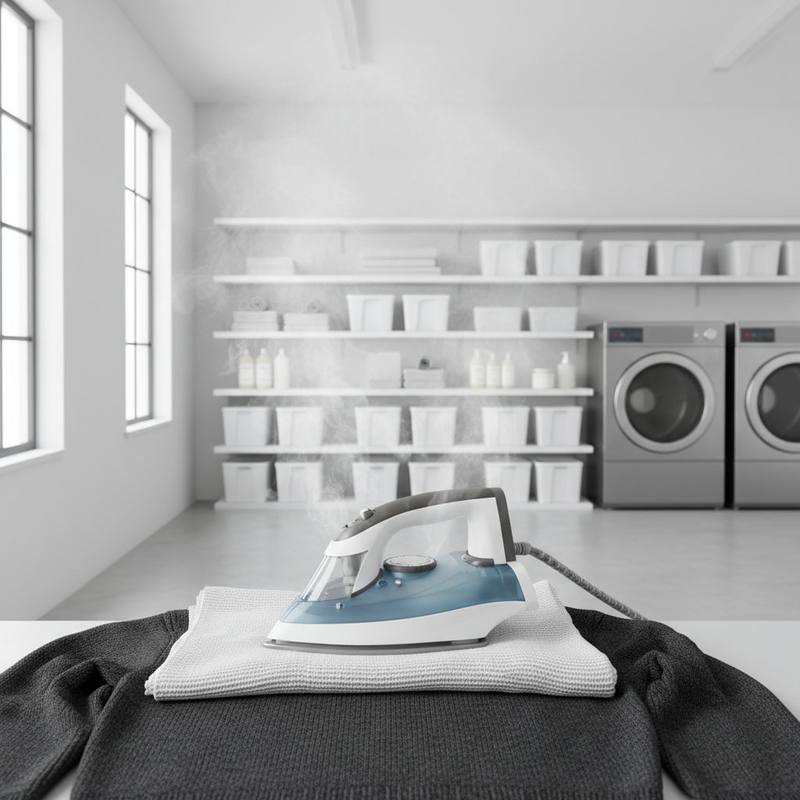
- Dry flat and iron through a cloth yourself for simple knits without stiffening
Don't
- Don't wash lined or stiffened coats and suits yourself, take them to a laundry
- Don't risk washing ultrafine merino wool or cashmere at home, or anything labeled “dry clean only”
- Don't try to rescue heavily felted “boiled wool” with another home wash, go back to the felting section above
When home attempts do more harm than good
Don't try to rescue a heavily felted sweater with another home wash. Repeating the same mistake, hot water, spinning and friction, only deepens the felting instead of reversing it. Once the fiber has already shrunk and thickened, no home wash will bring back its original size or texture.
Before you put wool in the washing machine
Check the label and test on a hidden spot, such as an inside seam, before washing the whole item. You can wash simple sweaters and scarves without lining yourself at a low temperature, drying them flat and ironing through a damp cloth to avoid shining the fiber.
How much wool cleaning costs at a laundry in Lublin
approximate prices for the most common services
In Lublin, washing a wool sweater at Gorące Żelazko laundry starts from 40 PLN, and cleaning a wool coat starts from 70 PLN. The laundry is open 9:00–17:00.
Before you try to rescue a felted sweater yourself with yet another home wash, it's worth simply asking whether anything can still be saved. Answers to the most frequently repeated questions about washing, drying and rescuing wool are below.

Now you know the theory. Practice can be less forgiving.
If you would rather not risk your favourite piece, leave it to the specialists at Gorące Żelazko laundry in Lublin.


Frequently asked questions
For ultrafine merino wool, cashmere, lined or stiffened fabrics, and anything labeled “dry clean only”. In these cases, the garment's construction or the fiber's delicacy exceeds what a home washing machine can handle.
At Gorące Żelazko laundry in Lublin, washing a wool sweater starts from 40 PLN, and cleaning a wool coat from 70 PLN.
When the label bans water washing, when the garment has a lining or stiffeners, or when it's ultrafine merino or cashmere. In these cases the risk of home washing is too high.
At home, usually not. Felting is an irreversible tangling of keratin scales, so another wash only deepens the problem instead of reversing it. Rather than trying again, it's worth asking a laundry right away whether anything can still be recovered.
Dry cleaning (symbol P) uses a solvent instead of water, so the keratin fiber doesn't swell and felting risk is close to zero. Wet cleaning (symbol W) is water washing with temperature control at 15-30°C and heavily limited spin speed.
About the author
Małgorzata Małecka
Owner of the Gorące Żelazko laundry
Małgorzata Małecka runs the Gorące Żelazko laundry in Lublin. Together with her team, she makes sure customers' clothes, shoes and fabrics come back clean and in the best possible condition.