When to take velvet to the laundry
Instead of washing at home, decision framework and how we work at Gorące Żelazko in Lublin

We have gathered a lot of knowledge in this article: fabric construction, types, washing parameters, rescuing crushed pile, stain types. Time to put this into one practical decision framework: washing it yourself, or handing it to a laundry.
The fastest way to apply it is to check the symbol on your item's label. Below you will also find a short evaluation procedure for when the label does not give a clear answer, a list of common home washing mistakes, and a description of how dry cleaning works in a professional laundry.
How to read velvet and velour labels
Washing and cleaning
Crossed-out basin
No water washing, dry cleaning only. Typical for silk and viscose woven velvet.
Basin with “30” and one line
Gentle washing at 30°C. Typical for cotton and dressy velour.
Crossed-out iron or iron with one dot
No direct ironing, or low temperature through steaming only, never touching iron sole to pile.
Circle in square with letter “P”
Dry cleaning with perchloroethylene and related solvents.
Crossed-out triangle
No bleaching. Especially important for dark, saturated velvet colors where bleach irreversibly destroys dye.
What really decides how it is washed
Protein and cellulose fibers lose strength in contact with water, so manufacturers almost always recommend dry cleaning only.
These fibers tolerate water and moderate friction far better, so machine washing on a gentle program is usually safe.
Elastane loses elasticity at high temperature, so the washing regime depends on the base fabric, always at a lower temperature than without this addition.
Densely set, vertical fibers reflect light in one direction. Crushed into random directions, they lose sheen even though the color has not changed at all.
The label alone is not always enough to make a decision. When the item is valuable or sentimental, when you are dealing with a large stain, or the pile is badly crushed, something more than one symbol helps.
Below you will find a step-by-step evaluation procedure, followed right after by the full decision framework: what you can safely do yourself and what is better left to specialists.
Step by step: how to evaluate an item before deciding
four questions that settle doubts when the label does not give a clear answer
- 1
Check the label
Start with the washing symbols. A crossed-out basin or a circle with the letter “P” mean the decision is already made: dry cleaning only.
- 2
Identify the base fabric
If there is no label, judge the base fabric by touch and look. A cooler-to-touch material with uneven, shifting sheen is usually silk or viscose, a warmer and more uniform one is usually polyester or cotton.
- 3
Assess the scale of the problem
A fresh, small stain and slightly flattened pile can often be rescued at home with steam and brushing. A large, dried stain or permanent crushing already needs professional treatment.
- 4
Weigh the risk and value of the item
An evening dress, a blazer with lining and stiffening, or a sentimental item are not a good field for experiments. When doubts remain, the safer choice is always the laundry.
Decision framework: yourself or the laundry
a quick-check summary in list form
Yourself or professional laundry
Do
- Cotton or polyester velour (tracksuits, towels, pajamas) with label allowing 30-40°C washing
- Refreshing slightly flattened pile with hand steam and brushing
- Vacuuming upholstery and minor fresh soiling with dry method (talc, cornstarch)
Don't
- Silk and viscose velvet with label saying “dry cleaning only”
- Evening dresses and blazers with lining and stiffening
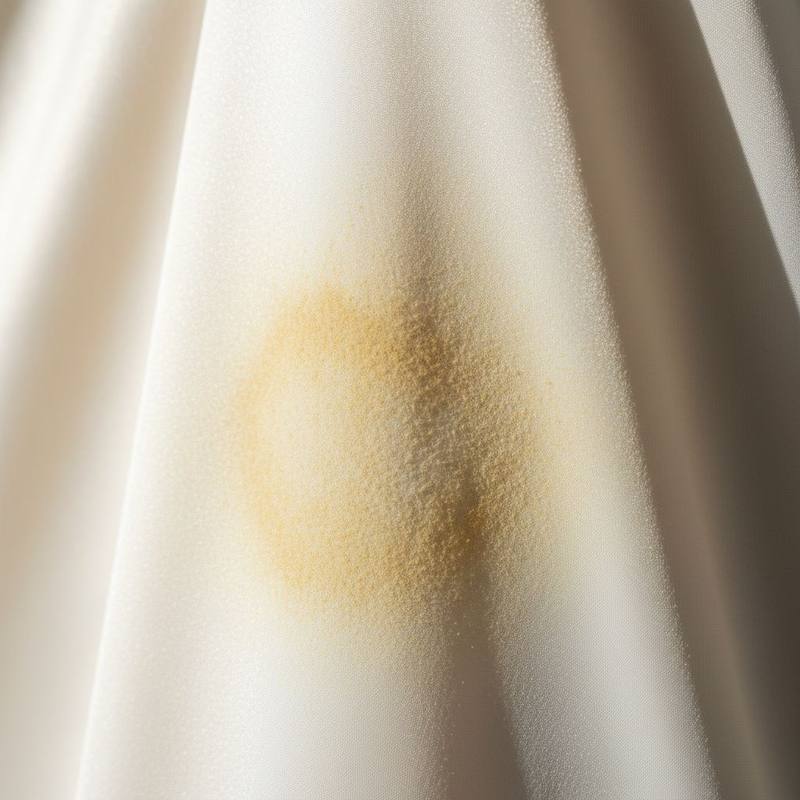
- Halo effect or water marks on large surface and permanent pile crushing after improper ironing
- Furniture velvet upholstery: professional on-site cleaning or cover removal for dry cleaning
Most common mistakes when washing velvet at home
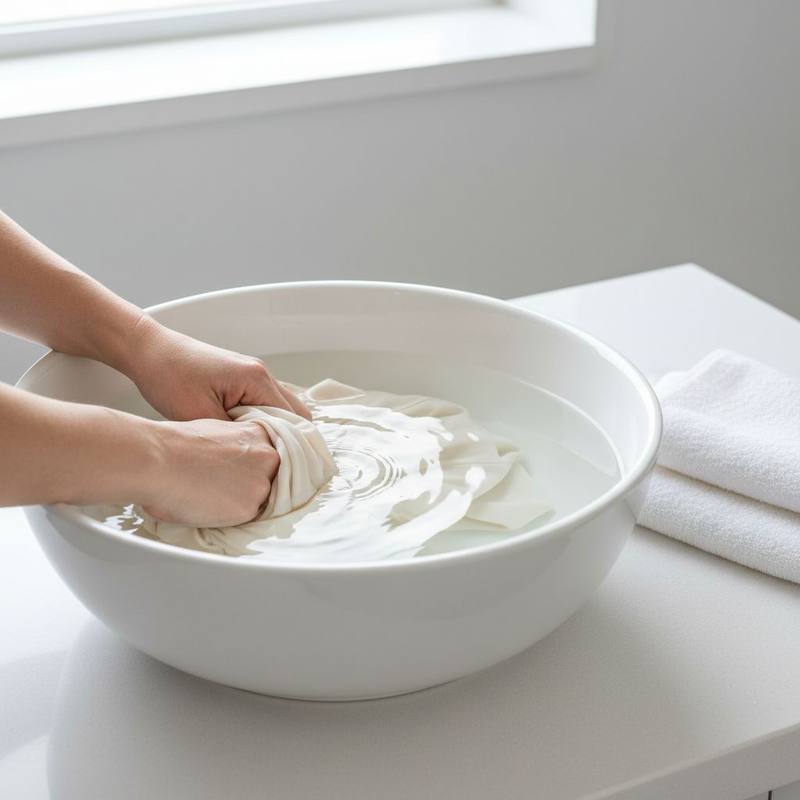
Most damage is not caused by the water itself, but by mishandling the wet fabric. Four mistakes come up most often: wringing and twisting wet velvet instead of rolling it in a towel, washing without a protective bag so the pile rubs against zippers and buttons of other items in the load, tumble drying with heat which permanently flattens the fibers, and ironing directly on the pile instead of from the wrong side through a backing. A separate mistake is skipping the test on a hidden patch before the first contact of silk or viscose with water. Without that test you do not know whether the fabric will safely tolerate moisture until it is already too late.
How professional dry cleaning works
what happens to velvet at the laundry so the pile comes out without crushing
Professional dry cleaning of velvet is based on perchloroethylene (PERC) maintained at 25-30°C process temperature. Drum rotations are reduced and cycle time shortened, protecting pile from crushing. Post-cleaning drying happens below 40°C, in short time, with an additional pile “fluffing” step (tumbling finish). Finishing is done with a needle board or steaming on a form and mannequin, never direct flat iron sole pressure.
Why it is worth vacuuming velvet upholstery more often
Dense velvet and velour pile holds household dust and dust mites similar to a carpet, because vertically set fibers have far more surface area than a flat fabric. If someone in the household has allergies, reach for the upholstery vacuum nozzle more often than for regular furniture, and you will also refresh the sheen of the pile itself.

Now you know the theory. Practice can be less forgiving.
If you would rather not risk your favourite piece, leave it to the specialists at Gorące Żelazko laundry in Lublin.


Frequently asked questions
Velvet is a woven fabric with a separate pile warp cut over rods. Velour is a knit with an additional loop yarn. This construction difference determines elasticity and washing response.
No. Despite similar appearance, they are two different constructions: woven versus knit. Velour is naturally more elastic and reacts differently to water and pressure than velvet.
Natural (silk, viscose) has uneven sheen changing with viewing angle and is cooler to touch. Synthetic (polyester, microfiber) has uniform sheen, is warmer and more static-prone.
Take it to the laundry when the label says dry cleaning only. The same goes for items with lining and stiffening. Large halo effect or water marks and permanent pile crushing after bad ironing are also better left to professionals instead of home experiments.
The price depends on the type of item and the condition of the fabric. Dress cleaning starts at 50 PLN, and coat cleaning starts at 70 PLN. The laundry always gives a final quote after seeing the specific item.
About the author
Małgorzata Małecka
Owner of the Gorące Żelazko laundry
Małgorzata Małecka runs the Gorące Żelazko laundry in Lublin. Together with her team, she makes sure customers' clothes, shoes and fabrics come back clean and in the best possible condition.