Milk and dairy stains: how to remove them
Milk, cheese, butter, or yogurt stain is three problems at once: protein, fat, and odor. Learn the cold water principle and when to take the item to a laundry.

Milk is not one stain. It's three stains at once in one drop.
This emulsion of water, protein (approx. 3.2-3.4%), fat (3.5-4%) and lactose (4.6-4.8%) leaves three separate traces on fabric: protein, fat, and odor. Smell arrives after a few days. The same applies to yogurt, sour cream, cheese, and buttermilk, each of these products carries the same three.
Most common mistake: wash out the visible color and consider it done. Protein remains embedded in the fiber, and the smell returns after a week in the closet.
Protein, fat, and odor all at once
why milk stains are not one problem, but three
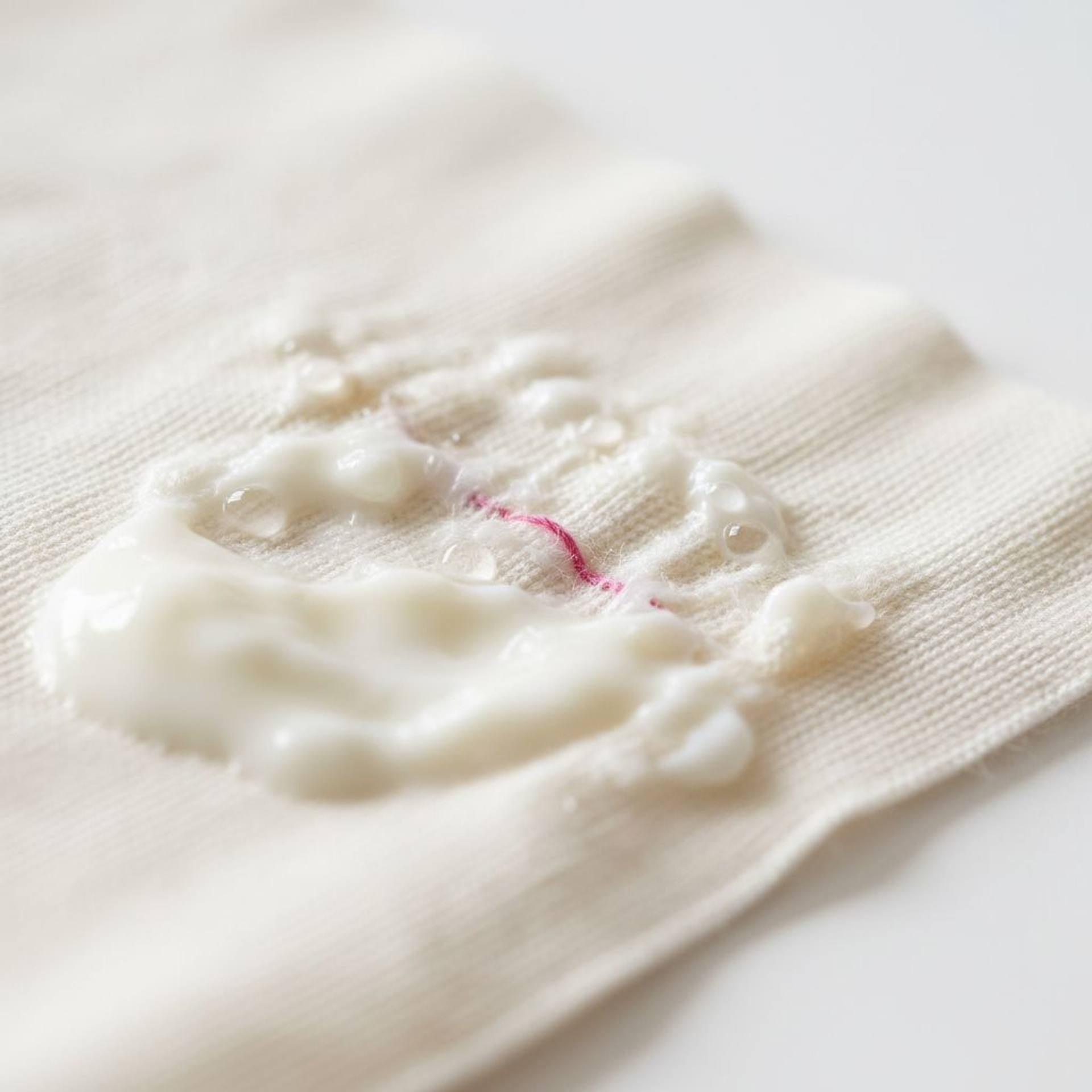
Casein is about 80% of milk proteins, the rest is whey proteins. Whey denatures easily with heat, casein responds mainly to acid, not to heat alone. That's why one rule matters: cold water at every preliminary stage.
Milk fat penetrates deep into the fiber (especially synthetic) and without surfactant stays there. Smell is the result of fermentation: bacteria break down lactose and protein remnants, the longer the stain sits, the worse it smells.
Before you do anything
Do
- Rinse with cold water from the back of the fabric before reaching for anything else
- Soak in enzymatic detergent before proper washing
Don't
- Don't toss stained item straight into high-temperature wash
- Don't dry stained item before stain is gone
- Don't iron the stain before washing, hot iron sets protein permanently
- Don't rely solely on bleach, it doesn't remove protein or the cause of smell
Cold, warm, or hot
why milk stains behave differently at different temperatures
One hard rule for protein stains (milk, blood, egg, sweat): no first contact with hot water. High temperature from the start permanently sets the protein on fabric, the stain stops dissolving in water.
In practice, order usually fails: a shirt with milk stain goes straight into hot wash before anyone uses cold water. The right place for higher temperature is only step 3 of the protocol below, after removing the protein trace.
Two enzymes, two jobs
Breaks down protein (casein and whey proteins), active at 30-50°C, loses activity above about 60°C.
Breaks down milk fat at 30-40°C, slower than protease, needs longer contact time with stain.
Both enzymes need time: fifteen to thirty minutes, neither works instantly.
Look for detergent with both protease and lipase, not just stain remover for colored stains. With milk, soaking time matters, not scrubbing force.
Step-by-step protocol
This protocol handles protein, fat, and odor one by one, in exactly that order.
- 1
Cold water rinse
Rinse excess milk or dairy with cold water (below about 30°C) from the back of the fabric before doing anything else.
- 2
Enzymatic soak
Soak stain in cold water with enzymatic detergent for about 15-30 minutes, depending on stain freshness and product.
- 3
Proper washing
Now wash at temperature suited to the fabric: for cotton, higher temperature dissolves fat, for delicate fabrics temperature stays low without exception.
- 4
Check before drying
Check and smell the fabric before drying it: trace or smell still noticeable? Repeat soaking, don't dry by force, as that sets both permanently.
Delicate fabrics
Wool and silk don't tolerate high temperature or strong proteolytic enzymes in high concentration. Risk: wool felting (irreversible fiber matting) and silk weakening. With these fabrics, professional cleaning is often safer than home washing with enzymes.
A stain that washes out visually is not the same as removed smell. The sour odor from sour milk comes from bacterial breakdown: bacteria break down lactose and protein remnants, not from milk itself.
The solution is the same as with the stain: enzymatic detergent plus an extra rinse cycle. Smell with no visible stain is a signal of a bacterial problem, not a color problem.
The sooner you tackle the stain, the better the result of the home protocol. A dried stain, especially after washing in the wrong temperature or after drying, can resist any soaking.
That's a signal to take the item to a laundry: a shirt after modified milk, a tablecloth after spilled cream at a party, a delicate dress or child's bedding. Here, complete protein removal has hygiene significance, not just appearance.
Approximate service prices:
- Shirt: from 26 PLN
- Children's clothing: from 55 % of price
- Tablecloth: from 30 PLN
- Dress: from 50 PLN
- Bedding: from 50 PLN

Now you know the theory. Practice can be less forgiving.
If you would rather not risk your favourite piece, leave it to the specialists at Gorące Żelazko laundry in Lublin.


Common questions
Yes, at least at the preliminary treatment stage. Cold water prevents protein setting. Only proper washing, already after removing the protein trace, can go at temperature suited to the fabric.
Multiple soaking in enzymatic detergent, longer than with fresh stains. If after several attempts the trace is still visible, professional cleaning remains with longer preparation contact time.
The same enzymatic detergent that breaks down protein, plus an extra rinse cycle. Stain appearance tells nothing about smell, both problems need separate solving.
Yes. Professional cleaning offers longer preparation contact time and spot-treatment option, which simply doesn't exist in home washing conditions.
About the author
Małgorzata Małecka
Owner of the Gorące Żelazko laundry
Małgorzata Małecka runs the Gorące Żelazko laundry in Lublin. Together with her team, she makes sure customers' clothes, shoes and fabrics come back clean and in the best possible condition.