First cashmere wash: what you really need to worry about
Naming the real risk before we move on to step-by-step instructions

The fear of the first independent wash of an expensive, unfamiliar sweater is completely rational. Mistakes with cashmere can be irreversible, and this is not an inexpensive item to easily replace.
The good news is that the mechanism of damage is well understood and predictable. Felting, which is the irreversible tangling of fibers, requires simultaneous action of three factors: high temperature, moisture, and mechanical friction.
Heat alone without movement does not initiate felting, just as friction alone when dry. The critical threshold is usually a temperature above 30°C combined with intense mixing or spinning. The risk rises noticeably already from about 600 revolutions per minute.
In other words: cashmere is delicate, but not capricious in a random way. If you know these three factors and know how to avoid them, washing stops being a lottery and becomes a simple algorithm to execute.
Washing cashmere step by step: by hand and in the machine
Temperature, detergent and spinning: an algorithm you can follow with confidence
Before you start, check the label. Hand washing is permitted with most care symbols found on cashmere sweaters and is always the safest of available options. Machine washing only comes into play if the label explicitly allows it. Additionally, your washing machine must have a dedicated "wool" or "cashmere" program with slow-speed drum action.
Hand washing cashmere
Hand washing is the safest method with most labels. Follow the five steps below in order, without skipping any.
- 1
Set water temperature
Maximum 30°C, ideally 20-25°C, that is, cool water but not ice-cold. Higher temperature is the first step toward felting.
- 2
Choose detergent
Reach for an agent with pH 5.5-7.0, without proteolytic enzymes (protease) and without optical brighteners. Protein-eating enzymes damage keratin, from which cashmere is built.
- 3
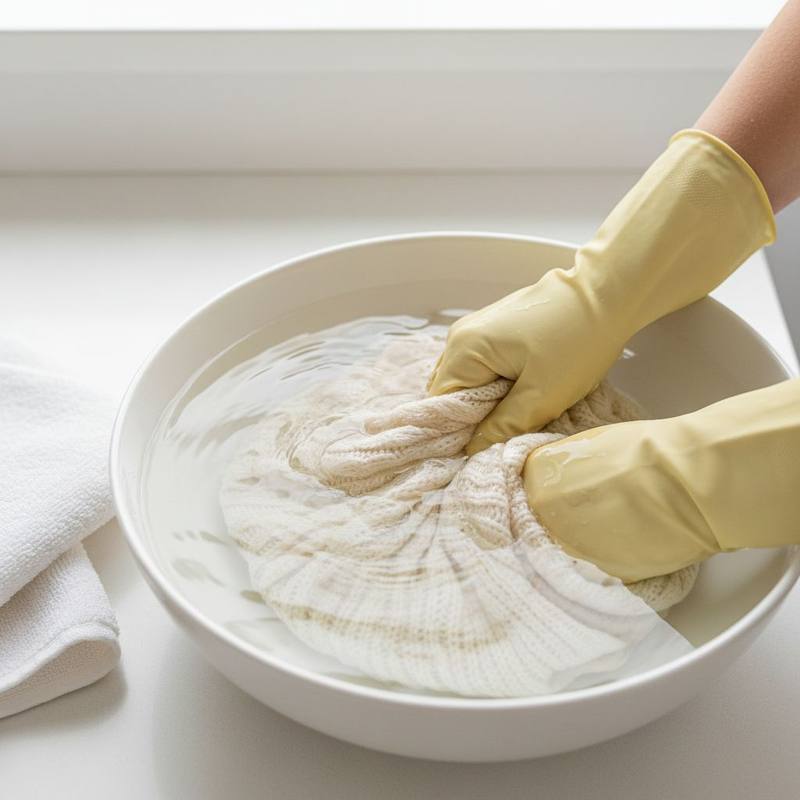
Immerse and gently knead
Maximum 3-5 minutes of gentle immersion and kneading of the fabric in water with detergent. No rubbing, no wringing, no aggressive mixing.
- 4
Rinse 2-3 times in the same temperature
Sudden temperature change in water between washing and rinsing is a thermal shock that increases felting risk. Rinse with water at exactly the same temperature you used for washing.
- 5
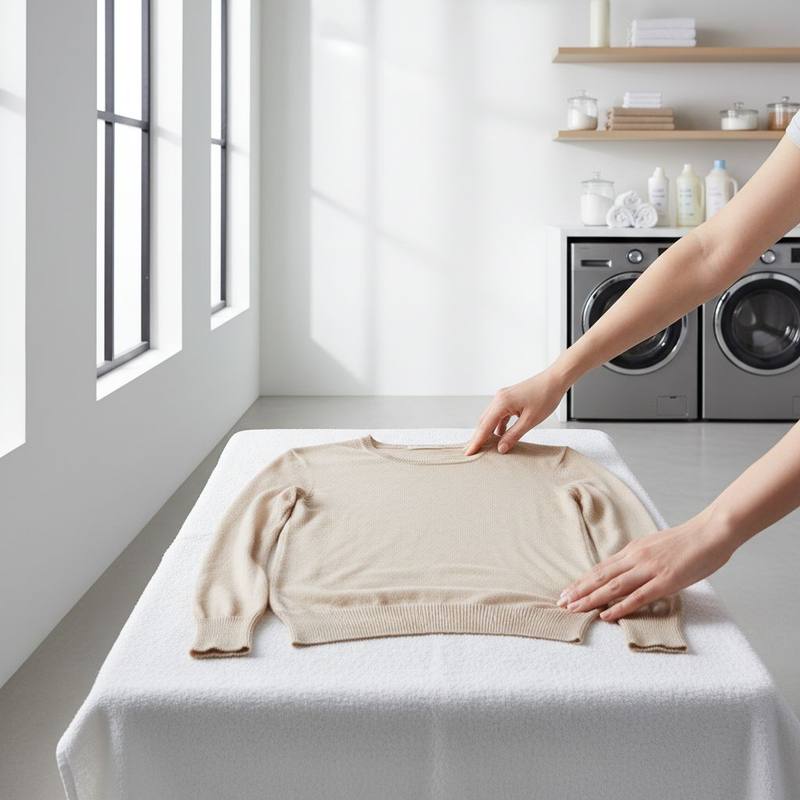
Dehydrate by rolling in a towel
Wrap the wet sweater in a dry terry cloth towel and gently squeeze to absorb excess water. Never wring or twist the fabric: this is the easiest way to cause permanent stretching and deformation.
If the label explicitly permits machine washing, select the dedicated "wool" program. The drum movement in such a program simulates gentle water mixing rather than fabric friction. This is a key difference from standard or even delicate cotton programs.
Machine washing cashmere
Basic condition: the label must explicitly permit water washing. Below are three parameters whose adherence minimizes felting and stretching risk.
Program and mesh wash bag
"Wool" or "cashmere" program and a mesh wash bag (laundry bag) are mandatory: reduces friction against other laundry and the drum itself.
Temperature
Maximum 30°C, exactly the same as with hand washing.
Spinning and detergent
Spinning maximum 600-800 rpm, preferably off or very short. Detergent dosing about 20-30 ml per 2-3 kg load.
Never do this
Absolute ban on chlorine and chlorine bleaches: they destroy keratin structure irreversibly, with no possibility of repair. Also check detergent composition for proteolytic enzymes (protease): they digest the protein from which cashmere fiber is built and weaken it even on single contact.

Now you know the theory. Practice can be less forgiving.
If you would rather not risk your favourite piece, leave it to the specialists at Gorące Żelazko laundry in Lublin.


Frequently asked questions
Yes, but only if the label explicitly allows it. Select a dedicated "wool" or "cashmere" program, maximum temperature 30°C, spinning maximum 600-800 rpm and a mesh wash bag is mandatory.
Maximum 30°C, both by hand and in the machine. Ideal temperature for hand washing is 20-25°C, that is, cool but not ice-cold water.
Detergent with pH 5.5-7.0, without proteolytic enzymes (protease) and without optical brighteners. Dedicated wool and cashmere products work best.
Not quite. Both are animal keratin, but cashmere has finer fiber (14-19 µm versus 17-24 µm in merino), shorter length, and noticeably less lanolin, which translates into different care rules.
About the author
Małgorzata Małecka
Owner of the Gorące Żelazko laundry
Małgorzata Małecka runs the Gorące Żelazko laundry in Lublin. Together with her team, she makes sure customers' clothes, shoes and fabrics come back clean and in the best possible condition.