Rescuing a cashmere sweater: what can actually be done after shrinking
Shrinking and felting are two different problems with different chances of recovery

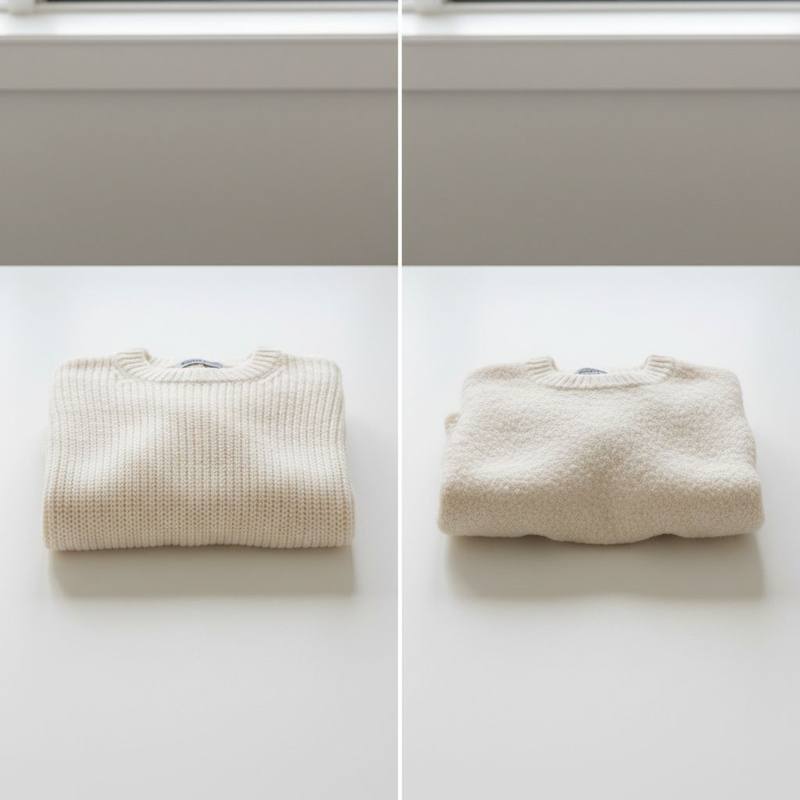
Your favorite sweater that came out of the wash smaller than before requires one key distinction at the start: you need to separate two different problems. Shrinking from bad temperature or too intense spinning is partly reversible by home methods.
Felting, which is the simultaneous action of friction, moisture and heat, is a completely different matter: irreversible tangling of the fiber scales. With complete felting the surface shrinkage can be very significant, on the order of tens of percent, though the exact value depends on the weave and weight. These are two different problems with different chances of recovery: tell them apart before you act.
What happens to cashmere fiber during shrinking
keratin and cuticle scales: the difference between a temporary and a permanent change of shape
Cashmere is pure animal keratin, thinner and more delicate than sheep's wool, with microscopic cuticle scales on the surface, similar to those on human hair. On contact with heat and moisture the bonds inside the keratin temporarily loosen, and the fiber becomes susceptible to a change in shape.
At too high a wash temperature or intense spinning, the knit loses the tension it had on the needles and shrinks, but the scales of individual fibers do not yet interlock permanently. That is why mild shrinking can be partly reversed: you just need to loosen the bonds again with heat and moisture, then stretch the knit back to its proper size before the bonds harden in the new position.
Felting proceeds differently. Friction acting together with moisture and heat makes the scales of neighboring fibers interlock like a one-way ratchet: they move in only one direction, so the fibers tangle irreversibly.
Shrinking versus felting
Mild shrinking
Effect of heat and moisture
The fiber scales have not yet permanently interlocked, so loosening the bonds again and stretching the knit usually brings the sweater close to its original size.
Felting (matting)
Effect of friction and mechanical action
The scales of neighboring fibers have interlocked permanently, so no soaking or stretching will untangle them.
Home method for mild shrinking
four steps before the knit dries in the wrong shape
The steps below apply only to mild shrinking, not felting. If the fabric is visibly felted, skip directly to the warning below.
- 1
Soak in warm water with conditioner
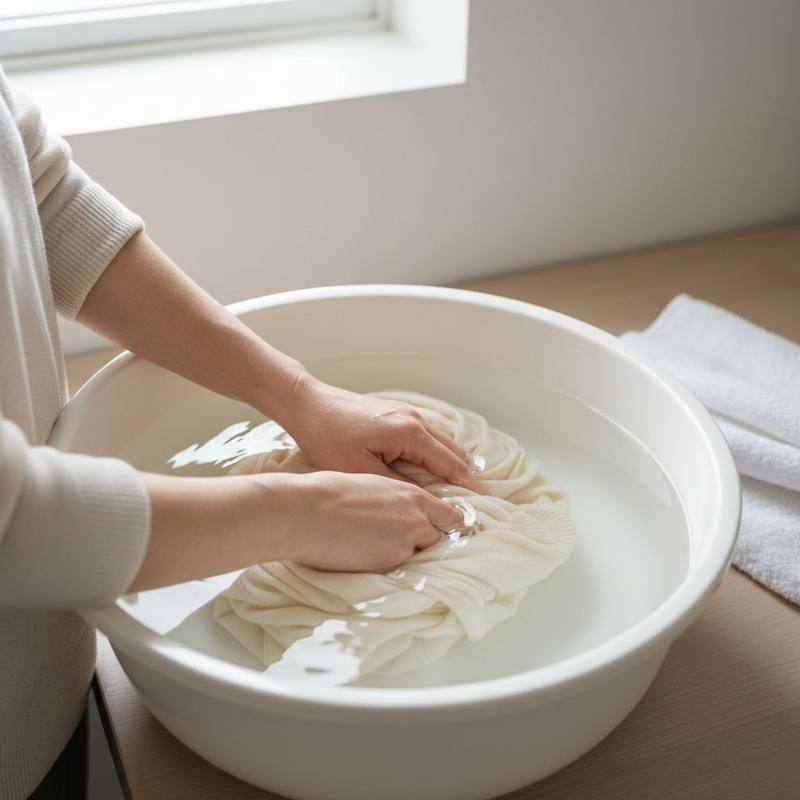
Soak the sweater in warm water, about 20-25°C, with the addition of hair conditioner or a few drops of glycerin, for 15-20 minutes. These substances temporarily loosen the bonds in the keratin, making the knit more receptive to stretching.
- 2
Gently stretch the wet knit
Remove the sweater, lay it on a towel and gently stretch the wet fabric to its original size, without jerking or violent movements.
- 3
Pin to the target shape
Unfold or pin the sweater flat to the target shape, ideally comparing it against a size tag or another unshrunk piece of the same model.
- 4
Dry without moving it
Dry it in this position flat, without moving or rearranging, away from heat sources, until completely dry.
Check the progress as you go
While stretching, compare the sweater against the size tag or another unshrunk piece of the same model every so often. It is easier to catch the right moment before the knit dries slightly too big or still too small than to fix it after it has dried completely.
Common mistakes when rescuing shrunk cashmere
what to watch for so you do not make things worse
Rescuing cashmere in a nutshell
Do
- Soak only in warm water, 20-25°C
- Stretch the knit gently, comparing it against the size tag
- Always dry flat, away from a radiator and sunlight
- Blot away excess water with a towel before stretching
Don't
- Do not wring or tug the wet knit
- Do not dry cashmere on a hanger, because the wet knit will stretch under its own weight
- Do not dry it in a tumble dryer or near a radiator
- Do not repeat the soak endlessly hoping for a miracle on visibly felted fabric
With visible felting, the effect is irreversible even under professional conditions. Attempts to rescue felted fabric at home can only make things worse, for example by further twisting and matting the fibers. Professional restoration, meaning combing the fiber and stretching it on a form, can partly reverse mild cases of shrinking but not full felting.
When to hand the sweater to a laundry instead of rescuing it at home
situations where it is worth entrusting cashmere to specialists
It is worth handing the sweater to a laundry when you are not sure whether it is mild shrinking or already felting, or when the knit is made of a cashmere blend with other fibers, for example silk or wool, which react differently to moisture and heat. The same applies to valuable, collectible sweaters, where one failed attempt at home can cost more than the professional service.
A professional laundry has tools you simply do not have at home: forms for stretching the knit in a controlled way, and fiber-combing techniques that even out its structure without adding extra tension. Sweater washing starts from 40 PLN, which for a valuable cashmere piece is often the wiser choice over another attempt at home.
Parameters for a safe home rescue
Warm, 20 to 25 degrees, never hot
15 to 20 minutes, with conditioner or glycerin
Flat, away from a radiator and direct sunlight
One, at most two: repeating it weakens the fiber

Now you know the theory. Practice can be less forgiving.
If you would rather not risk your favourite piece, leave it to the specialists at Gorące Żelazko laundry in Lublin.


Frequently asked questions
If it is mild shrinking, soak it in warm water with conditioner or glycerin, gently stretch it to its original size and dry it flat without moving it. With visible felting, home methods will not help.
Shrinking from the wrong temperature or spin cycle is partly reversible with home methods. Felting, the simultaneous action of friction, moisture and heat, is an irreversible tangling of the fiber scales that not even a professional laundry can undo. Tell the two problems apart before you try to rescue anything.
Soak it in warm water (20 to 25°C) with hair conditioner or a few drops of glycerin for 15 to 20 minutes to loosen the bonds in the keratin. Then gently stretch the wet knit back to its original size, pin it flat and dry it without moving it.
No, without moisture the bonds in the keratin will not loosen enough to safely change the shape of the knit. Stretching a dry sweater only risks tearing the fiber, so always start by soaking it in warm water.
When the knit is visibly felted, stiff and dull, when the sweater is made of a fiber blend, or when it is simply valuable. In such cases it is better to hand it to a laundry rather than risk another failed attempt on an already weakened material.
About the author
Małgorzata Małecka
Owner of the Gorące Żelazko laundry
Małgorzata Małecka runs the Gorące Żelazko laundry in Lublin. Together with her team, she makes sure customers' clothes, shoes and fabrics come back clean and in the best possible condition.