Why flannel pills after just a few washes
The same process that gives softness weakens loose fibers on the surface of the fabric

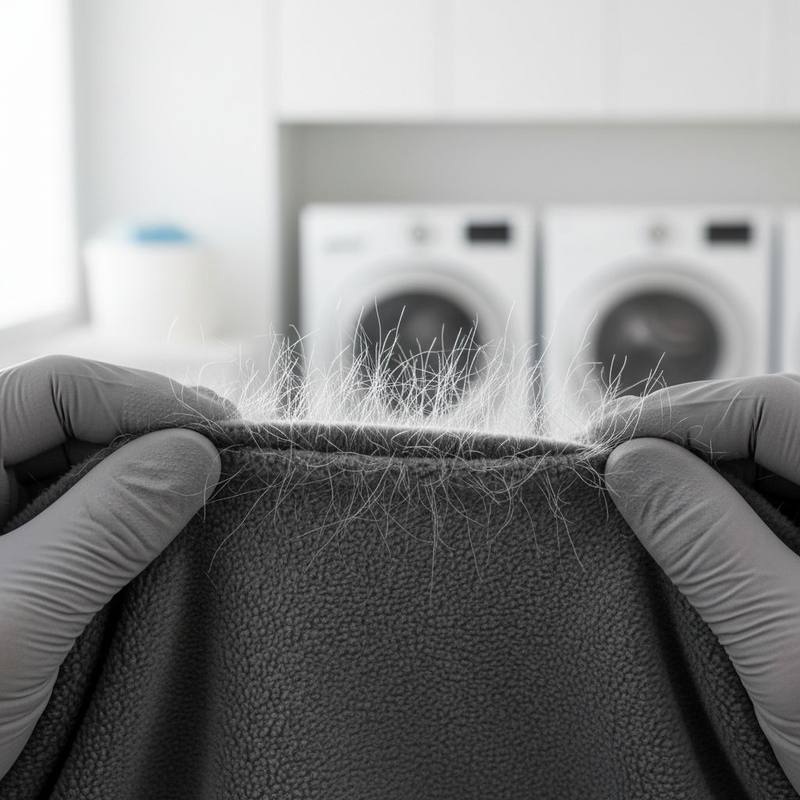
Flannel pilling comes directly from the same napping process that gives it its characteristic softness and fluffiness. While the raw fabric is brushed, short fibers are teased up above the surface of the weave. Those same loosely bound fibers that create the soft-to-the-touch nap easily tangle under friction. This happens most often in the washer drum, on contact with hook-and-loop fasteners, zippers, or buttons, and also during ordinary wear, at points with the most contact with the body or a bag strap.
Pilling resistance is tested using the Martindale method per ISO 12945-2. A sample of fabric is rubbed against a control surface for a set number of cycles, and the degree of pilling is assessed visually on a scale of 1 to 5, at test points after 2,000, 5,000, and 7,000 cycles. Good quality cotton flannel usually maintains a rating of 4 to 5 after 5,000 cycles, meaning minimal or no visible pilling. Lower quality wool flannel tends to be less resistant: its rating can drop to 2 to 3 after just 2,000 to 5,000 cycles, meaning visible bobbles appear far sooner than with good quality cotton.
What speeds up flannel pilling
Washing and wear conditions that shorten the lifespan of the fabric's surface
Laundry customers report visible pilling most often after 8 to 15 home washes, meaning already in the first season of regular use. It's precisely during this period that the most loose fibers left over from the napping process are shed from the fabric's surface, so bobbles appear more densely than at later washes.
The problem clearly accelerates when washing rough fabrics together, for example denim, terry towels, or garments with metal zippers and hook-and-loop fasteners. Spin speeds that are too high work the same way: the harder the fabric rubs against itself and the drum, the faster loose fibers tangle.
Factors that speed up flannel pilling
Denim, terry towels, and garments with metal zippers or hook-and-loop fasteners increase friction in the washer drum
A stronger spin means more friction between layers of fabric in a short time
More loosely twisted yarn sheds more fibers than densely twisted, good quality flannel
A bag strap on the shoulder, armrests, or a car seat rub the fabric in the same spot every time
How to rescue pilled flannel
From household lint shavers to treatments available only at a laundry
A fabric shaver (mechanical lint remover) removes pilling without damaging the base weave, provided you use the right technique. The effect is partial: a shaver visibly reduces pilling but the result is temporary and requires repeating after subsequent washes.
- 1
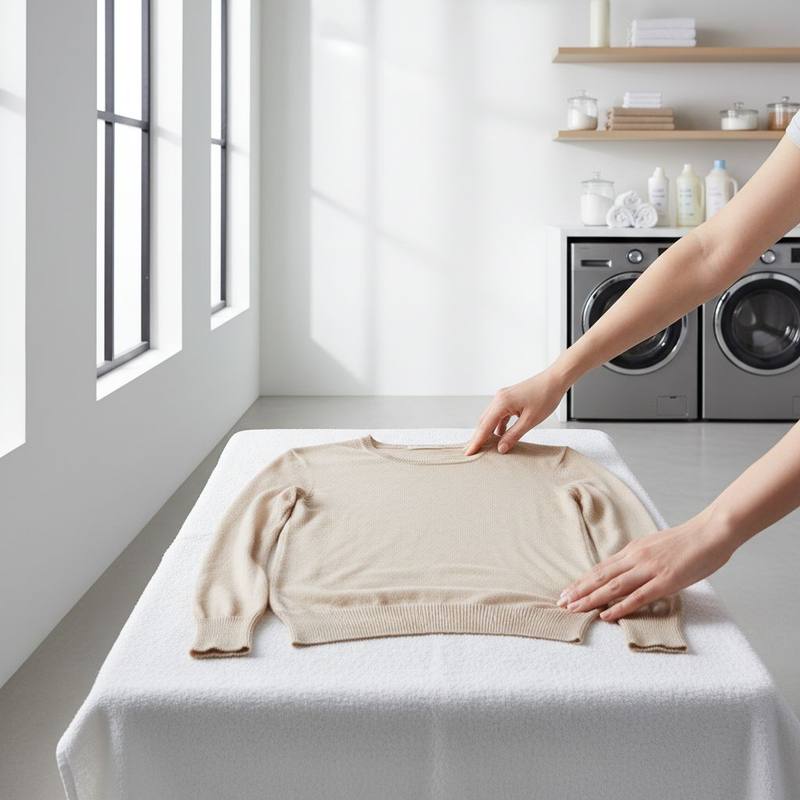
Make sure the fabric is dry and laid flat
A shaver works best on dry, stretched surface. Lay flannel on a hard base like an ironing board instead of holding it in the air.
- 2
Use a fabric shaver with gentle pressure
Move the shaver in one direction without heavy force. Too much pressure or bidirectional strokes risk wearing through the fabric.
- 3
Wash separately at lower temperature
After treatment, wash flannel separately from rough fabrics at a lower temperature than usual. This slows the return of pilling at subsequent washes.
Professional laundries use industrial de-pilling combined with antistatic treatment, which gives a more lasting effect than a home shaver. The treatment smooths the fabric's surface and reduces the electrostatic charge responsible for attracting dust, which later reinforces the pilling effect.
How to prevent pilling from coming back
Washing habits that extend the time between shaver treatments
Flannel pilling in a nutshell
Do
- Wash flannel separately from rough fabrics like denim or terry towels
- Choose a delicate program with lower spin speeds
- Fasten buttons, zippers, and hook-and-loop closures before washing to reduce friction against other fabrics
- Use a fabric shaver on dry fabric laid flat
Don't
- Don't wash flannel together with garments with exposed hook-and-loop fasteners or metal zippers
- Don't set maximum spin speeds for delicate fabrics
- Don't press a fabric shaver hard or move it back and forth
- Don't expect a single pass with a shaver to solve the problem for good
When pilling signals something more serious
No method, home or professional, regenerates already damaged fibers: a shaver and industrial de-pilling remove visible bobbles but don't reverse the process that created them. Treat them as ongoing maintenance, not fabric repair. The situation looks different with wool flannel that, alongside pilling, starts felting or shrinking. Felting is nearly irreversible at home, because wool fibers permanently interlock at the structural level, not just on the surface. If, besides bobbles, you notice stiff, matted patches of fabric or a clear change in the garment's dimensions, stop washing it yourself and hand the item to a professional laundry. There they will match the temperature, program, and any enzymatic treatments to the material's current condition, instead of risking further damage with another home wash.

Now you know the theory. Practice can be less forgiving.
If you would rather not risk your favourite piece, leave it to the specialists at Gorące Żelazko laundry in Lublin.


Frequently asked questions
The same napping process that makes flannel soft loosens fibers on the surface. They tangle under friction from the washer drum or contact with zippers and hook-and-loop fasteners, forming the characteristic bobbles.
A mechanical fabric shaver removes the bobbles without damaging the fabric, using gentle pressure and one-directional strokes. The effect is partial and temporary, requiring repeating after subsequent washes.
With wool flannel, felting is nearly irreversible at home. A professional laundry may partially improve the structure with enzymatic or mechanical treatments, but full recovery of the original dimensions usually isn't possible with advanced felting.
It can't be eliminated entirely, since it comes from the same napping process that gives flannel its softness. It can, however, be clearly slowed down: wash flannel separately from rough fabrics, choose lower spin speeds, and regularly remove bobbles with a shaver before they build up.
A shaver can be used every time bobbles become visible, provided you use gentle pressure and one-directional strokes. Shaving the same spot too often and too hard thins the fabric, so treat it as an occasional treatment, not a daily routine.
About the author
Małgorzata Małecka
Owner of the Gorące Żelazko laundry
Małgorzata Małecka runs the Gorące Żelazko laundry in Lublin. Together with her team, she makes sure customers' clothes, shoes and fabrics come back clean and in the best possible condition.