Drying and ironing microfiber
rules for the final and most risky stage of caring for microfiber

Drying and ironing are the final stage of microfiber care, the one where a mistake is irreversible. Melted microfiber cannot be restored to its original state, unlike loss of absorbency or softness, which can be partly reversed with another wash.
The material itself forgives more mistakes at the washing stage than at the drying and ironing stage. So before a microfiber cloth, towel, or bedding item goes into the dryer or under an iron, it is worth knowing the exact temperature thresholds and understanding why this particular stage tends to be the riskiest.
Why overheating melts microfiber
the fiber structure that explains its low heat tolerance
Microfiber is a synthetic fiber, most often a blend of polyester and polyamide, split into dozens of microscopic strands thinner than a human hair. This structure is responsible for its softness, absorbency, and dust-trapping ability, but also for the low heat tolerance typical of most plastics.
When overheated, the split strands start to stick together and flatten, losing the space between them where water and dust used to collect. The overheated spot becomes harder, shiny, and noticeably less absorbent than the rest of the fabric. This is a permanent change to the physical structure of the fiber, not ordinary soiling or pilling, which is why another wash cannot undo it.
Care symbols relevant to microfiber
Washing
Wash up to 40°C (clothing and bedding)
A bowl of water with the numeral 40 is the standard marking for microfiber clothing and bedding. Higher temperature, up to 60°C, is allowable only on labels for cleaning cloths and mops.
Softener ban
A crossed-out bottle on a cleaning cloth label is an absolute ban, not a suggestion. The same symbol on bedding can be conventional, the specific label always decides.
Drying
Tumble dry on low
A square with a circle and one dot inside indicates a low-temperature program, where outlet air should not exceed approximately 60°C. Air drying remains the preferred method for the entire microfiber family.
Air dry (recommended)
A square with a line at the top, the safest option for the structure of split fibers, especially for cloths and mops used daily.
Ironing
Iron up to 110°C
One dot on an iron is the maximum temperature per ISO 3758 allowable for microfiber. Ironing is usually unnecessary for cloths and sportswear, since the fiber returns to shape on its own after drying.
Drying and ironing step by step
a safe sequence of actions after taking microfiber out of the washer
- 1
Shake the fabric out right after washing
A gentle shake separates fibers stuck together in the drum and shortens drying time, so the fabric does not sit unnecessarily long in a damp state.
- 2
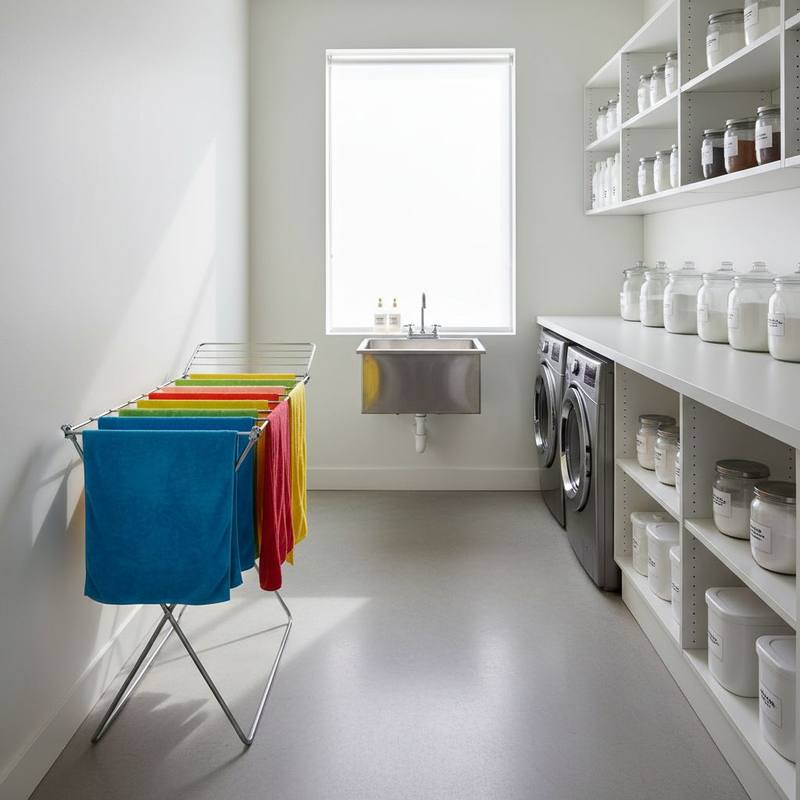
Choose air drying as the default method
This is the safest option for the structure of split fibers, especially for cloths and mops used daily. Dry colored microfiber away from direct sunlight to avoid uneven fading.
- 3
If drying in a machine, set a low-temperature program
Outlet air should not exceed approximately 60°C. Do not dry microfiber together with fabrics that shed their own fibers, such as terry towels, since stray fibers then work their way into the microfiber structure.
- 4
Check the fabric is fully dry before folding it away
Residual moisture in a folded cloth or bedding item encourages a musty smell, especially once it sits in a closet or drawer for a longer time.
- 5
Iron only when it is actually needed
Microfiber usually returns to shape on its own after drying. If ironing is necessary, for example for peach-skin bedding, do it through a cotton pressing cloth, at a maximum of 110°C.
Microfiber in a nutshell
Do
- Air dry as the default method
- Set the dryer to a low-temperature program, max. approximately 60°C
- Iron through a cotton pressing cloth, max. 110°C
- Shake and smooth the fabric right after washing
Don't
- Do not dry microfiber together with fabrics that shed fibers, such as terry towels
- Do not use fabric softener, since it clogs the spaces between the strands and reduces absorbency
- Do not iron peach-skin bedding without a pressing cloth
- Do not leave microfiber near a radiator or in direct sunlight for long
Never do this
Overheating an iron or dryer melts or permanently flattens the microfibers. The result is local, shiny marks and an irreversible loss of sheen and softness in that spot. Even a professional laundry cannot reverse melted fiber structure. Only local tailoring repair is possible, not restoring the fabric to its pre-damage state.
Different uses, different rules
a cleaning cloth tolerates more than bedding or a sports jacket
Cleaning cloths and mops
daily use
No prints or laminated layers, so they usually tolerate a higher temperature than clothing-grade microfiber.
Peach-skin bedding
large surface, visible creases
The only microfiber type where ironing can be justified for appearance.
Sportswear and outdoor gear
prints and membranes sensitive to heat
Prints and vapor-permeable membranes lower the allowable temperature below the general microfiber thresholds.
When to take microfiber to a laundry
If microfiber has lost its sheen and softness in one spot, has stiff, shiny marks from overheating, or clearly absorbs water worse than before, correct home drying and ironing will not undo that anymore. In that case, it is worth taking the item to a professional laundry, which can assess whether anything can still be improved locally or whether the damage is permanent. Professional drying controls temperature more precisely than a home dryer, which limits the risk of repeating the mistake on the next wash.
Test the temperature on a hidden spot
When ironing a new microfiber item for the first time, especially bedding or a decorative throw, test the iron on a hidden spot first, such as an inside seam. A few seconds of contact is enough to see whether the fabric reacts with shine or stiffening, before the iron touches the visible surface.

Now you know the theory. Practice can be less forgiving.
If you would rather not risk your favourite piece, leave it to the specialists at Gorące Żelazko laundry in Lublin.


Frequently asked questions
Yes, but on a low-temperature program where outlet air doesn't exceed approximately 60°C. Air drying remains the safest method for the structure of split fibers.
Rarely necessary, since the fiber returns to shape after drying. If ironing is needed, for example peach-skin bedding, the maximum temperature per ISO 3758 for one dot is 110°C, preferably through a cotton pressing cloth.
Overheating melts or permanently flattens the microfibers, leaving local shiny marks and an irreversible loss of sheen and softness. Not even a professional laundry can undo this; only local tailoring repair is possible. The maximum iron temperature is 110 degrees Celsius (one dot).
No. Cleaning cloths and mops tolerate a higher temperature and rarely need ironing. Peach-skin bedding sometimes needs ironing through a pressing cloth, while sportswear with prints and membranes needs air drying only, with no ironing.
When the fabric has stiff, shiny marks from overheating, has lost its sheen and softness in one spot, or clearly absorbs water worse than before. Correct home drying and ironing will not undo that anymore, and a professional laundry can better assess whether anything can still be improved locally.
About the author
Małgorzata Małecka
Owner of the Gorące Żelazko laundry
Małgorzata Małecka runs the Gorące Żelazko laundry in Lublin. Together with her team, she makes sure customers' clothes, shoes and fabrics come back clean and in the best possible condition.