When to send modal to the laundry
The risks of home washing versus professional care for a delicate premium fiber

Not every modal wash needs to be done by you, and not every one is worth risking in a home machine. Several situations clearly tip the balance toward professional care.
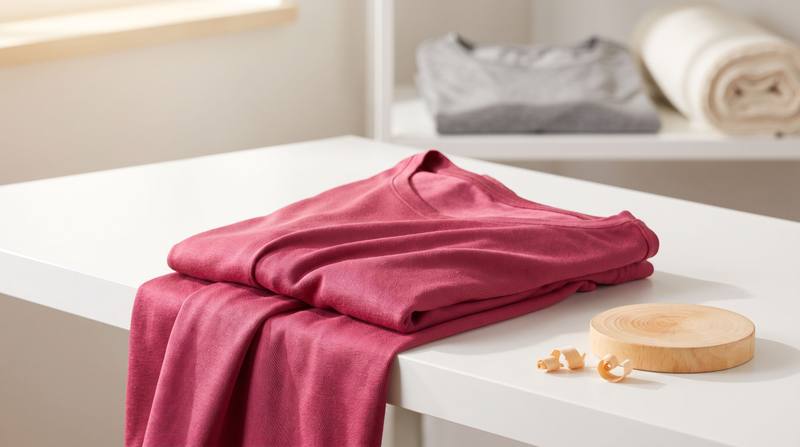
A premium garment, like MicroModal underwear bought at a higher price, is a situation where a single error in the washer program can irreversibly damage fiber structure. Large modal bedding carries a different risk: uneven drying and creasing if your home lacks flat drying space. A separate problem is a garment with no care label: you then have no certainty about composition or the presence of elastane, which determines the safe temperature.
Why modal is more demanding than cotton
A short look at the fiber before you decide where to wash it
Modal is a cellulose fiber made mostly from beech wood pulp, in a process similar to viscose production but with extra chemical treatment that raises the fiber's strength and shrink resistance. Despite that improvement, modal loses more of its strength when wet than cotton does, so aggressive spinning, wringing, or rough hand washing weakens the fiber structure and leads to stretching or pilling on the fabric surface.
Many modal items, especially underwear, pajamas, and stretch bedding, contain a small percentage of elastane. It is that addition, not modal itself, that usually limits the safe washing and drying temperature: elastane loses elasticity and durability above a certain temperature, so the program label really refers to it. That is why, for expensive, delicate, or unlabeled items, the margin for error is noticeably narrower than for a plain cotton t-shirt.
Modal care rules
Wash at low temperature
Wash modal on a delicate program, at 30 to 40 degrees. A higher temperature weakens the fiber and encourages shrinking, especially when the fabric contains elastane.
Dry flat, no tumble dryer
Lay modal flat on a terry towel or a drying rack, away from a radiator. Hanging a wet item stretches the fibers under their own weight, and high heat in a tumble dryer speeds up wear.
Iron at low temperature
Iron modal inside out, ideally still slightly damp, at a low temperature. A soleplate that is too hot can scorch the fiber or leave a shiny mark on the surface.
No chlorine bleach
Do not use chlorine bleach, even on white modal. It weakens the cellulose structure and permanently yellows the fabric, so use only oxygen-based products for brightening.
When to definitely take modal to a laundry
Four situations where professional care is safer than the risk at home
Modal: home or laundry
Do
- Take to a laundry premium and MicroModal items, stains older than 48 hours or of unknown origin, large bedding with no flat drying space, and garments with no care label
- Wash yourself regular, everyday underwear and modal pajamas if you follow a delicate program and a 40°C temperature
Don't
- Don't risk home washing expensive underwear without first testing on an unseen section
- Don't spin modal on high speed or dry it in a tumble dryer
The most common mistakes with home modal washing
The biggest mistake is treating modal like plain cotton: washing at a high temperature, spinning at full speed, and drying in a hot tumble dryer together with heavier fabrics. Each of these steps on its own rarely ruins the item right away, but their combination over several washes leads to permanent stretching, pilling, and a loss of the softness that was the main reason for buying modal in the first place.
Never do this
Do not use chlorine bleach on modal, even diluted. Chlorine permanently breaks down the cellulose structure and leaves yellow or grey stains that can no longer be removed, either at home or at a laundry.
Good to know
MicroModal is a variant of modal made from an even finer fiber, which makes the fabric softer and lighter than standard modal. A finer fiber, however, means lower mechanical strength, so makers of premium MicroModal underwear almost always recommend hand washing or a very delicate program, not an everyday cycle.
Large modal bedding: a separate case
Size changes the rules of the game, even when the fabric is the same
Practical tip
Before you lay out wet modal bedding to dry, gently press out excess water with a dry towel instead of wringing the fabric by hand. This lets the bedding dry faster and more evenly, and it clearly lowers the risk of permanent creasing and stretching at the edges.
Before you take an item to a laundry
A few minutes of preparation help the laundry choose the right program.
- 1
Check the label
If the label is still there, photograph it or write down the composition and care symbols. This is the fastest way for the laundry to choose a safe program.
- 2
Note the stain's history
Write down when the stain appeared and what caused it. The age and type of the stain affect the choice of cleaning method.
- 3
Don't guess with home chemicals
Skip home stain removers and bleaches before taking the item to a laundry. An unknown chemical reaction can make professional cleaning harder instead of easier.

Now you know the theory. Practice can be less forgiving.
If you would rather not risk your favourite piece, leave it to the specialists at Gorące Żelazko laundry in Lublin.


Frequently asked questions
For premium items like MicroModal, stains older than 48 to 72 hours, large bedding without flat drying space, and garments without care labels. In these cases the risk of a home error is clearly higher than the cost of handing the item to specialists.
Large modal bedding needs to be dried flat so it doesn't stretch under its own weight, and there's rarely room for that at home. Add the risk of uneven drying and creasing. A laundry lays it out and dries it in controlled conditions.
Carefully. Without a label you can't be sure of the composition or whether it contains elastane, which sets the safe temperature. Test on a hidden spot at a low temperature, or take the item to a laundry, especially if it's expensive.
Not quite. Elastane tolerates lower temperatures and less aggressive spinning than modal alone, so for blends stick to the lower end of the recommended program, meaning 30 degrees and a gentle spin. When in doubt, take the item to a laundry, especially for premium underwear.
Yes, even brief contact with chlorine bleach permanently weakens the cellulose structure and leaves yellow or grey discoloration. Use only oxygen-based products to brighten modal, and if there's a visible bleach mark, ask a laundry instead of trying more products.
About the author
Małgorzata Małecka
Owner of the Gorące Żelazko laundry
Małgorzata Małecka runs the Gorące Żelazko laundry in Lublin. Together with her team, she makes sure customers' clothes, shoes and fabrics come back clean and in the best possible condition.