Satin
A complete guide to the weave, its types, care and washing

What satin actually is, and how it differs from a single fiber
a weave, not a fabric made from one fiber
If you bring a "satin blouse" to the laundry and assume you know what it's made of, you're probably wrong. This is the most common misunderstanding about this fabric: satin is not a type of fiber, it's the name of a weave.
The satin weave is one of three basic weaving patterns, alongside the plain weave and the twill weave. Each of these three ways of crossing threads produces a different texture and different properties in the finished fabric.
Since satin is a weaving technique rather than a raw material, it can, in principle, be made from almost any filament fiber, and even from some spun ones. In practice you'll find satin made of silk, polyester, viscose, cellulose acetate, nylon, and even cotton. Each of these materials behaves completely differently in washing, drying and ironing, despite looking identical on a shop hanger.
It's also worth knowing that in English, "satin" is often used as a descriptive adjective ("satin dress", "satin finish"), which muddies the waters further. The adjective itself says nothing about fiber content. It only describes the weaving method and the shine that results from it.
To understand where satin's characteristic shine comes from, it helps to look at the structure of the weave itself. Weaving describes every pattern by how often the threads cross. The warp thread runs lengthwise along the loom, the weft thread runs crosswise, and how often they intersect defines the type of weave.
The plain weave crosses threads after every single strand, alternating over-under. The satin weave works differently: the warp thread passes over several weft threads in a row, forming a long, unbroken section called a "float", before finally being tied down at a single point.
This float typically runs 3 to 7 threads long. The longer the float, the larger the smooth, unbroken surface exposed to light, and so the stronger the shine. But this same physics comes at a price: a long, loosely bound thread section is easier to catch and pull than a short, tightly interlaced section of plain weave. We'll come back to this later in the article.
The direction of the float matters too. Classic garment satin has the warp dominating the surface, which is why it's described as a "warp-faced" weave. This distinction has practical significance, because it separates satin from its close cousin, discussed next.
Technical parameters of the satin weave
4 (4-harness satin, rarely used, low durability)
5 (5-harness satin, most common in apparel)
8 (8-harness satin, bedding and upholstery)
3-7 threads, the longer the float the greater the shine
warp-faced, distinguishes satin from sateen
Before moving on to the satin types described below, it's worth learning one distinction that really clears up the topic. It concerns two related but different fabrics: satin and sateen.
Satin, meaning true satin in the broad sense, is a satin weave made from filament threads, that is, continuous ones. This group includes silk, polyester, nylon and acetate. Filament threads have no natural surface fuzz, which makes the fabric shinier and noticeably more slippery to the touch.
Sateen, sometimes called "cotton satin", is exactly the same weave. It's made, however, from carded or combed yarn, meaning twisted, shorter fibers. This usually means mercerized cotton. The effect is more subtle: less intense shine, but a noticeably warmer texture to the touch. Sateen is exactly what's hiding under the label "300 thread count satin bedding" you'll find in bedding shops.
For a laundry, this distinction matters in practice. Cotton sateen tolerates much higher washing and ironing temperatures than any filament-fiber satin. Treating both fabrics the same way, just because both are called "satin", is a sure way to ruin the more delicate one.
Appearance alone, that is shine and surface smoothness, won't let you tell silk from polyester by eye or by touch. The only reliable source of information is the fiber content label, not the care label with symbols. A solvent test, for example acetone, which dissolves acetate but doesn't affect polyester or silk, should only be performed under professional conditions. Don't try it at home on the whole garment; the risk of permanent damage is too high.
What satin is made of
silk, polyester, cotton, viscose, acetate and elastane under the same name
Before you start exploring washing or ironing rules, you need an answer to one question: what exactly is your item made of. Without that, every instruction in this article is just theory with no practical use.
The first step is always to read the fiber content label, usually sewn into a side seam or near the yoke. Only the second step is the care label with symbols, which we cover in more detail in the washing section. The order matters: the care label tells you how to wash a given item. The content label, however, explains why that particular instruction ended up on it.
The problem is that appearance alone gives no certainty. The shine and smoothness of silk charmeuse and polyester satin can be practically indistinguishable to an eye untrained in working with fabrics. At the laundry front desk, this is an everyday situation, not an exception. A customer brings in a "satin dress" and doesn't herself know whether it's silk, polyester or viscose inside. A product name on a store tag, something like "satin blouse", says nothing about the fiber. It only describes the weaving method.
How to identify the material before you start washing
Do
- Check the fiber content label before the care label
- Keep the label when dropping the item at the laundry, even if it's already torn loose
- Ask the seller about fiber content at the moment of purchase, especially for wedding and evening gowns
Don't
- Don't guess the fabric content "by eye" based on shine alone
- Don't iron or wash an item without checking the label first
- Don't trust a product name like "satin blouse", it describes the weave, not the material
Natural silk can trigger allergic reactions in people sensitive to sericin, the protein coating the fibroin fiber, causing redness and itching wherever it touches the skin directly, for example on the décolletage or under the arms. Acetate and polyester more rarely cause allergies from the fiber itself; more often the problem is detergent residue left after incomplete rinsing, so for garments worn directly against the skin an extra rinse cycle is worth the effort.
Why satin shines, and why it snags
the mechanics of the satin weave in one paragraph
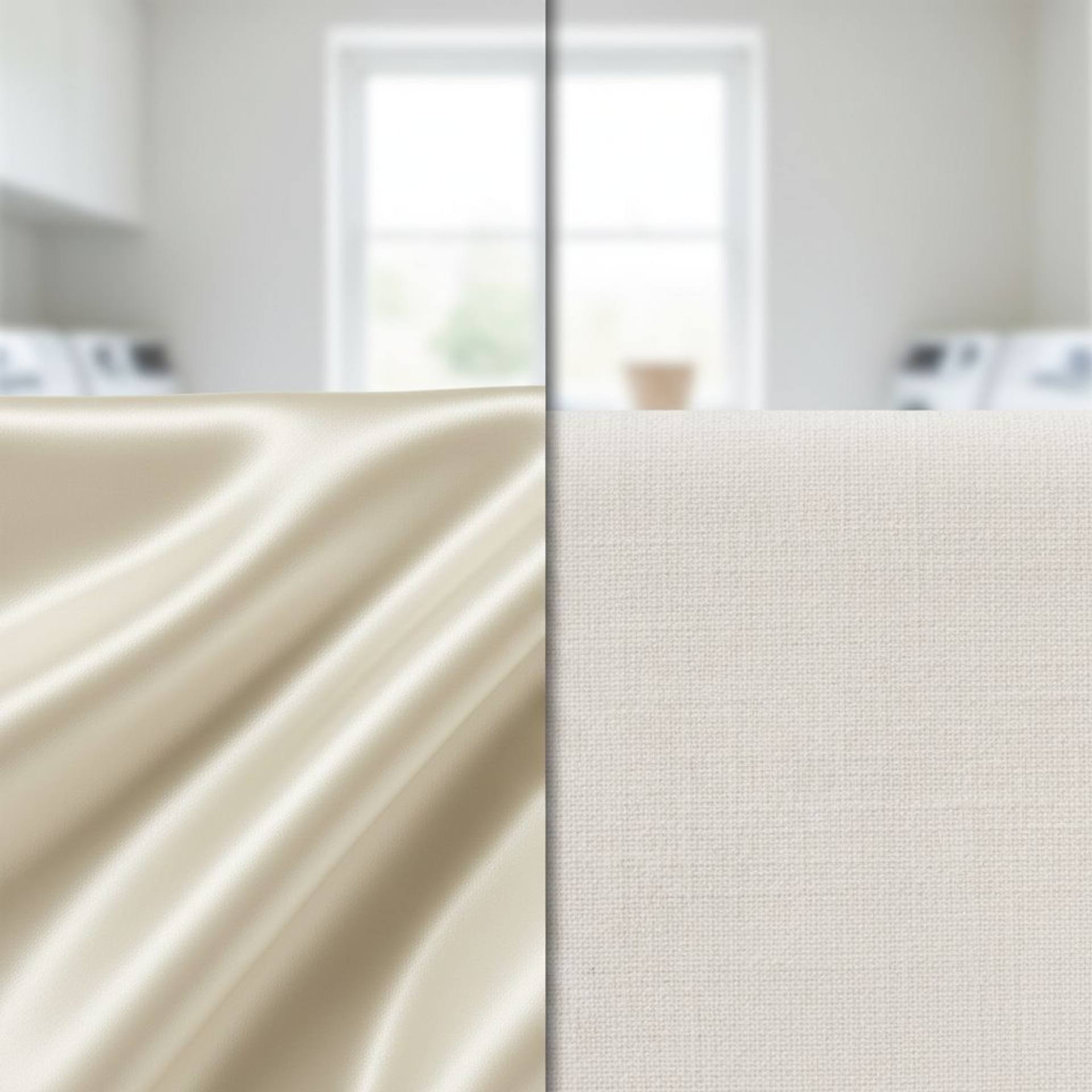
The entire mechanics of satin's shine come down to one optical phenomenon. Long, unbroken sections of fiber reflect light almost like a mirror, instead of scattering it across many small crossing points, the way a plain weave does.
The longer the float, meaning the closer to the upper limit of 7 threads, the stronger and more "wet-looking" the shine. But float length alone isn't everything. The effect depends just as much on the raw material: filament threads, meaning continuous ones with no natural fuzz, such as silk or polyester, produce a much stronger shine than the carded yarn used for cotton sateen. In the latter, tiny fibers on the thread surface scatter part of the light.
The same feature that gives satin its characteristic shine is also the source of its most common problem. Customers bring this complaint to the laundry more than any other: snagged threads.
A long float is far easier to catch on a fingernail, jewelry or velcro than a short, tightly bound section of plain weave. A single moment of carelessness, brushing against a handbag zipper for instance, is enough. A single thread gets pulled and leaves a visible, light-colored distortion on the fabric surface.
Fabric resistance to this kind of mechanical damage is measured with the Martindale method, described in standard ISO 12945-2. In this test, silk satin performs worse than cotton sateen, precisely because of the smoothness and slipperiness of the filament fiber. Less friction between fibers means a single thread is easier to pull out. Paradoxically, that same smoothness protects silk satin from another problem: pilling. Pilling, the formation of small fiber balls from friction, is more typical of short, coarser fibers.
Satin characteristics
90/100
The effect of long floats and filament threads. The longer the float and the smoother the fiber, the closer the fabric gets to the mirror-like finish of charmeuse or duchesse.
25/100
Satin's weakest point. A long, loosely bound float is easy to catch on a fingernail, jewelry or velcro, resulting in a pulled thread.
65/100
Smooth filament fiber generates less inter-fiber friction than carded yarn, so pills form less often than on a sweater or flannel.
85/100
The absence of fuzz on filament threads accounts for satin's characteristic, slippery touch, clearly different from matte cotton or wool.
Types of satin
silk, polyester, cotton, duchesse and stretch
The same look, the same shine and the same smooth surface can hide completely different technical requirements. This is the main challenge with this fabric, and the main reason this article devotes so much space to it.
The five groups described below cover the vast majority of items customers bring to the laundry: a wedding gown, a bedding set, an evening blouse, shapewear, or an elegant dress for a wedding party. Find your category before moving on to the washing rules in the next section.
Silk charmeuse
Natural silk, Bombyx mori
Silk weight is traditionally given in momme (1 momme ≈ 4.3 g/m² at a standard width of 45 inches), not in grams per square meter like most other fabrics.
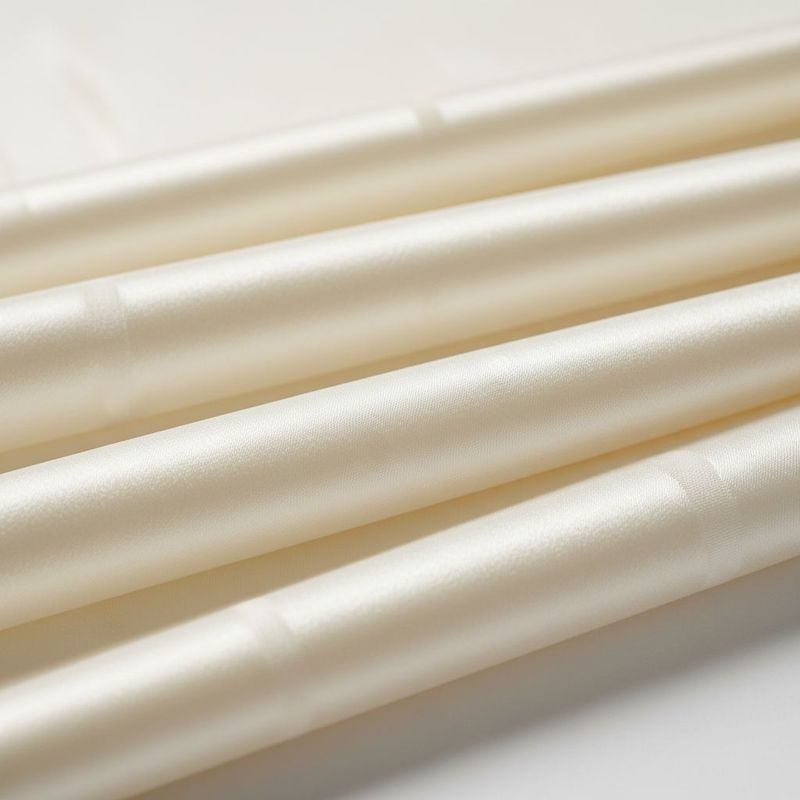
Charmeuse is the classic silk satin, most often the first thing people think of when they hear the word "satin". It has the highest shine among the varieties described here and an exceptionally soft, fluid drape, which makes it work well in lingerie, blouses and evening gowns. Moisture absorption around 11% means comfort when worn directly against the skin, but it also means sensitivity to water, detergents with the wrong pH, and high temperature. This is the most delicate of the five varieties, requiring hand washing or a "silk" program at low temperature.
Polyester satin
Filament polyester (PET)
Low moisture absorption means the fabric dries quickly, but it also means excess detergent is harder to rinse out of the fiber surface.
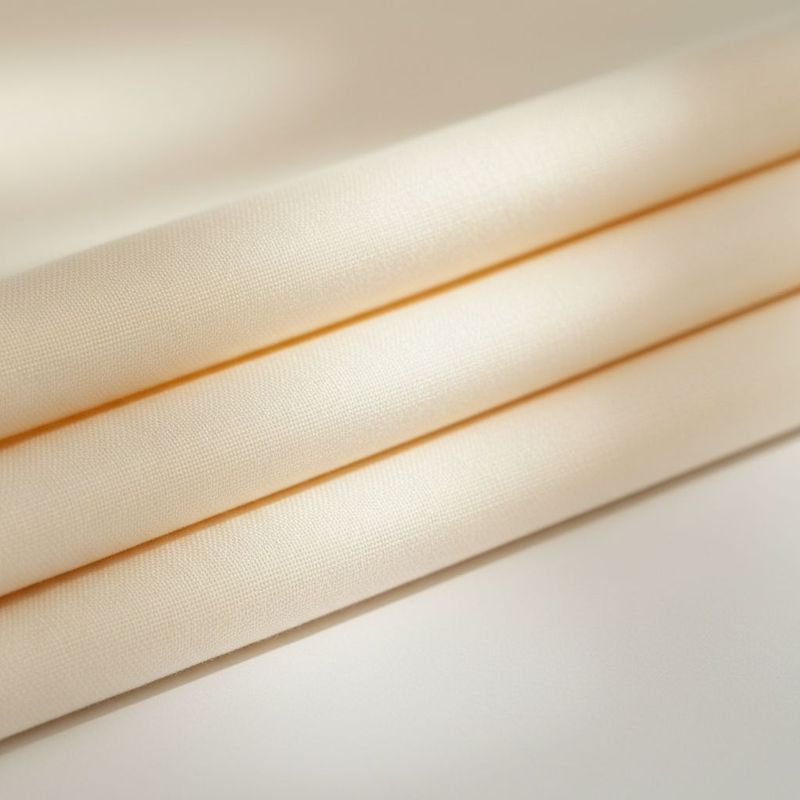
Filament polyester is a budget-friendly and exceptionally practical alternative to silk, found in linings, bedding and lower-priced evening wear. Moisture absorption of just 0.4% means the fabric dries fast and rarely wrinkles. It's also by far the most resistant to mechanical damage and washing mistakes among all five varieties, making it a safe choice for everyday use and machine washing on a synthetics program.
Cotton sateen
Combed or mercerized cotton
This is exactly the variety hiding under the label "300 thread count satin bedding", popular in bedding shops.
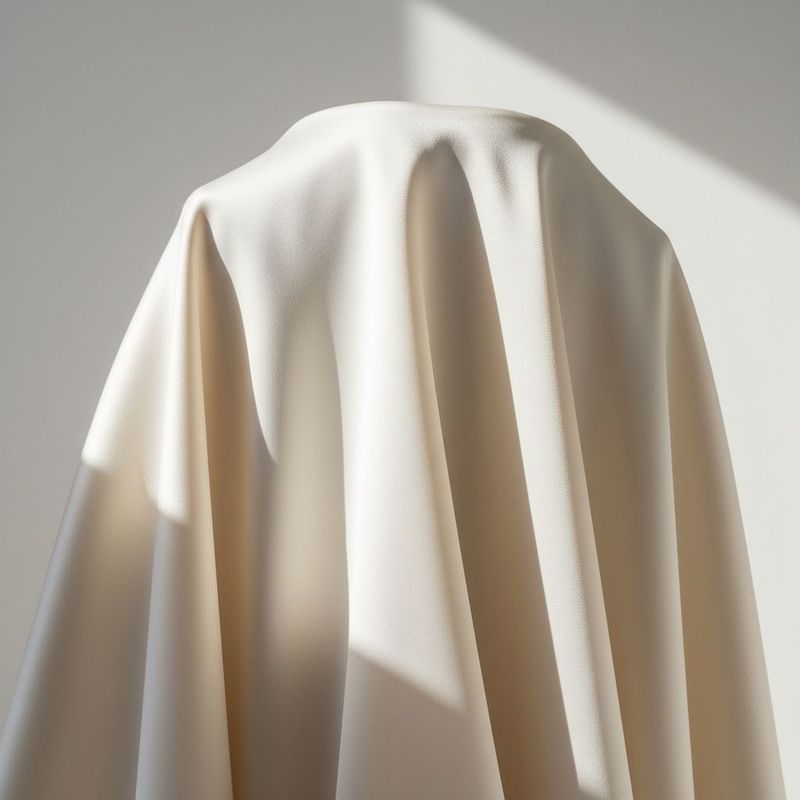
Sateen is cotton satin: the same satin weave, but made from combed or mercerized yarn instead of filament thread. The shine is more subtle than silk or polyester, but the texture is much warmer to the touch, which explains this fabric's popularity in bedding, shirts and tablecloths. Thread density in sateen bedding is usually given in a range of 200 to 600 per square inch; the higher the number, the smoother and more abrasion-resistant the surface. Cotton sateen tolerates noticeably higher washing temperatures than any filament-fiber satin.
Duchesse satin
Duchesse satin
The heaviest and stiffest satin variety, most often made of silk or a silk-viscose blend.
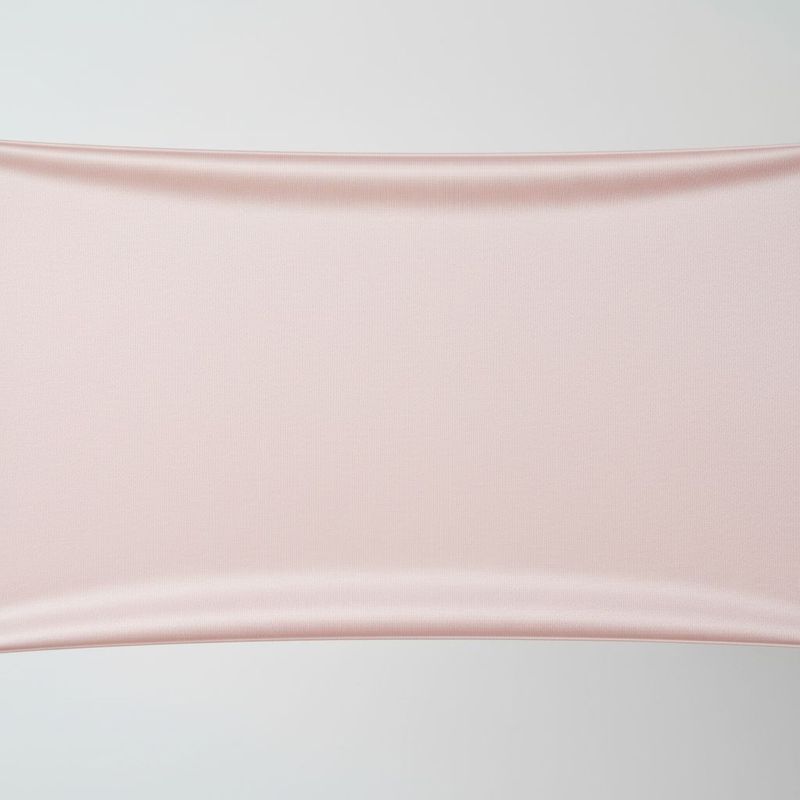
Duchesse is the heaviest and most structured satin variety, typically made from pure silk or a silk-viscose blend. A weight of 300 to 400 grams per square meter gives it a characteristic stiffness and architectural drape, ideal for wedding gowns and evening costumes where the fabric needs to hold its own shape without extra stiffening. Despite the high weight, the raw material itself, silk or a silk-viscose blend, remains chemically delicate and requires the same care regime as thinner charmeuse, just with a greater mass of fabric to dry.
Stretch satin
Polyester/elastane
Elastane permanently loses elasticity above 50°C with prolonged exposure, regardless of how resistant the polyester itself is.
An elastane content of 4 to 8% changes the character of classic polyester satin, adding the stretch needed in shapewear, corsets and fitted evening wear. Polyester alone would tolerate higher washing temperatures without trouble, but it's the elastane that sets the real limit: above 50°C with prolonged exposure, the elastomeric fiber permanently and irreversibly loses its elasticity, even if the polyester itself looks unharmed.
Beyond the five groups described above, some less common variants exist too. Acetate satin, made from cellulose acetate, is mostly found in linings, jabots and vintage-style dresses. Viscose (rayon) satin appears in blouses and decorative accessories.
Both of these varieties require their own, fairly specific care rules, which we cover in detail in the washing section below, since they differ from both silk and polyester.
We cover each aspect of satin care separately, in short guides, so you reach a specific answer faster instead of scrolling through one long text. Below is the whole series:
- How to wash satin
- How to iron satin
- When satin snags or pills
- How to restore satin's shine
- Stains on satin
- When to take satin to a laundry

Now you know the theory. Practice can be less forgiving.
If you would rather not risk your favourite piece, leave it to the specialists at Gorące Żelazko laundry in Lublin.


