Can Jute Be Machine Washed
what's allowed and what you should never do with a bag, small rug or jute carpet

The short answer is: almost never. Most jute products have a label saying “dry clean only” or directly “do not wash”, and this is not the manufacturer being overly cautious.
The reason is purely mechanical. Jute in the washing machine felts and deforms because its technical fibers with low elasticity cannot withstand spin mechanics. Cotton or even ramie deal with this much better. The result is a fabric that after one wash cycle loses its original shape and texture irreversibly.
The only exception is simple, small items: bags and sacks, without glued seams and without stiffening. You can wash such items, but only by hand, never in the machine. Below you will find the mechanism behind this, the properties of jute fiber, a safe hand-washing routine step by step, and situations where it is better not to risk washing it yourself at all.
Why jute does not tolerate machine washing
the mechanism at work: lignin, fiber structure and lost wet strength
Jute is a bast fiber, taken from the plant's stem, not a seed fiber like cotton. Its structure contains far more lignin, a substance that stiffens the cell wall and gives jute its rigidity, while at the same time limiting the elasticity of the individual fiber. When such a fiber is soaked for a long time and then put through the mechanical spinning of a washing machine drum, it loses a large part of its wet strength and starts tangling with neighboring fibers.
The effect resembles wool felting, although it happens for a different reason. The fabric surface thickens, turns stiff and uneven, and the original weave stops being visible. Unlike cotton or ramie, whose fibers are more elastic and tolerate repeated bending in water much better, jute never returns to its original shape, even after careful ironing.
Properties of jute fiber
High, around 12 to 15%. Responsible for stiffness and susceptibility to felting in water
15 to 25 micrometers, noticeably coarser than cotton, hence the scratchy feel
Noticeably lower than dry strength, so prolonged soaking and spinning are risky
Very good, but slow drying encourages a musty smell if the fabric is left damp
What can be hand-washed and what should never go in a machine
the line between a simple accessory and a rug with a stiffened backing
The dividing rule is simple, though it is often overlooked at the time of purchase. Simple jute accessories, shopping bags, sacks or baskets without stiffening, can be hand-washed, because they have a small surface in contact with water and no elements that react with moisture. The risk with such items is limited, as long as washing is brief and there is no spinning.
The situation is entirely different with carpets, rugs and larger jute decorations. They usually have a glued or latex-coated backing that holds the fibers in place and gives the whole thing stability. Contact between that backing and water dissolves the adhesive and starts a fraying process that home methods cannot reverse. That is why larger jute items with a stiffened backing should only go to dry cleaning, and day to day should only be vacuumed regularly.
Jute care rules
Hand washing
Allowed only for simple accessories without stiffening: brief contact with water, temperature around 30 degrees, no spinning.
Large items and decorations
Carpets, rugs and decorations with a glued backing should never go into water, whether by hand or in a machine.
No bleach
Chlorine bleach causes yellowing of the lignin present in the fiber and permanently changes the fabric's color.
No tumble drying
Drum mechanics act on jute the same way spinning in a washing machine does, so a tumble dryer is out of the question.
How to hand-wash a jute bag or accessory, step by step
four stages of safe hand washing
- 1
Check the label and test color fastness
Before you start, check whether the label actually allows washing. Then dampen an inconspicuous area of the fabric and press it against a white cloth to check whether the dye bleeds.
- 2
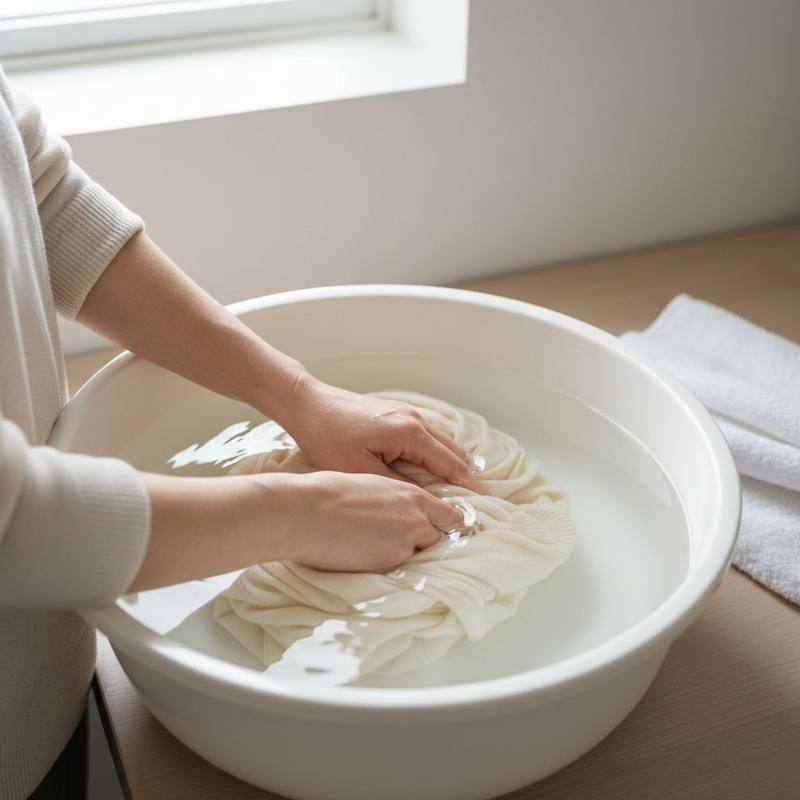
Hand-wash in cool water
Use lukewarm water at around 30 degrees and a mild detergent. Submerge and gently knead the fabric, avoiding scrubbing and prolonged soaking.
- 3
Rinse briefly, without twisting
Rinse in clean water at a similar temperature, pouring it through a few times rather than keeping the fabric submerged for long. Never twist jute the way you would an ordinary wash.
- 4
Wring between towels and dry flat
Wrap the wet item in a dry terry towel and press gently to draw out excess water. Dry laid flat, away from a radiator and direct sunlight.
Jute: What's Allowed and What Never to Do
Do
- Test color fastness on an inconspicuous area before washing
- Wash by hand at 30 degrees, short contact with water, no spinning
- Wring gently between towels, never twist the fabric
- Dry laid flat, away from a radiator and direct sunlight
Don't
- Do not put in the washing machine, because spinning felts and deforms fibers
- Do not use chlorine bleach, it causes yellowing of lignin
- Do not dry in a tumble dryer
- Do not soak carpets and rugs with glued backing
Never Do This
Never soak jute carpets and rugs with latex or adhesive backing in water. The adhesive dissolves in contact with water, and technical fibers begin to fray in a process that cannot be reversed. The only safe route for such rugs is regular vacuuming and professional dry chemical cleaning.
When to take jute to a professional laundry
signs that hand washing at home is no longer enough
When to take jute to a professional laundry
If a jute carpet or rug has developed an unpleasant smell, has visible discoloration or soiled patches, do not try to clean it with water on your own. Professional dry cleaning handles this kind of soiling without the risk of dissolving the glued backing and without felting the fiber. The same applies to larger jute accessories, for example bags with a stiffened lining or items combined with leather or metal fittings. Such material combinations are better left to a laundry, which will choose a cleaning method suited to the most delicate element of the whole piece.

Now you know the theory. Practice can be less forgiving.
If you would rather not risk your favourite piece, leave it to the specialists at Gorące Żelazko laundry in Lublin.


Frequently asked questions
Usually not. Most jute items have a “dry clean only” or “do not wash” label, because the washing machine felts and deforms jute fibers. The exception is simple, small items washed only by hand.
Test color fastness on an inconspicuous area. Wash by hand at 30 degrees, short water contact, no spinning. Finally, wring gently between towels and never twist the fabric.
Not recommended. Most jute items should not go in the washing machine or dryer at all, because the drum mechanics felt and deform jute fibers.
Stiffness comes from high lignin content, 12 to 15%, and the prickling sensation from the thicker individual fiber diameter, 15 to 25 micrometers. This is mechanical irritation, not an allergic reaction.
It is not recommended. The high humidity and temperature of steam act on a rug's glued backing much like plain water and can start fraying. It is safer to vacuum regularly and take the rug to professional dry cleaning.
About the author
Małgorzata Małecka
Owner of the Gorące Żelazko laundry
Małgorzata Małecka runs the Gorące Żelazko laundry in Lublin. Together with her team, she makes sure customers' clothes, shoes and fabrics come back clean and in the best possible condition.