The technique for washing terry at home
How to preserve softness, fluffiness, and full absorbency of terry towels with every wash at home

Before you judge whether your towel absorbs water well, check whether it ever had the chance to do so. New terry towels carry a finishing coating, a layer of silicones, waxes, or finishing agents applied at the factory for a better look and a soft grip on the shop shelf. This layer is hydrophobic and blocks water's capillary access to the fibre, so even the best towel does not absorb the way it should from day one.
The good news is that terry only gets ruined in the wash by a handful of repeatable mistakes, not by washing itself. Below you will find where the absorbency problem comes from, what temperature and how often to wash towels, and what to avoid so the loops stay soft and fluffy for years.
Why new towels do not absorb water
the factory finishing coating blocks the fibre's capillary contact with water until the first washes
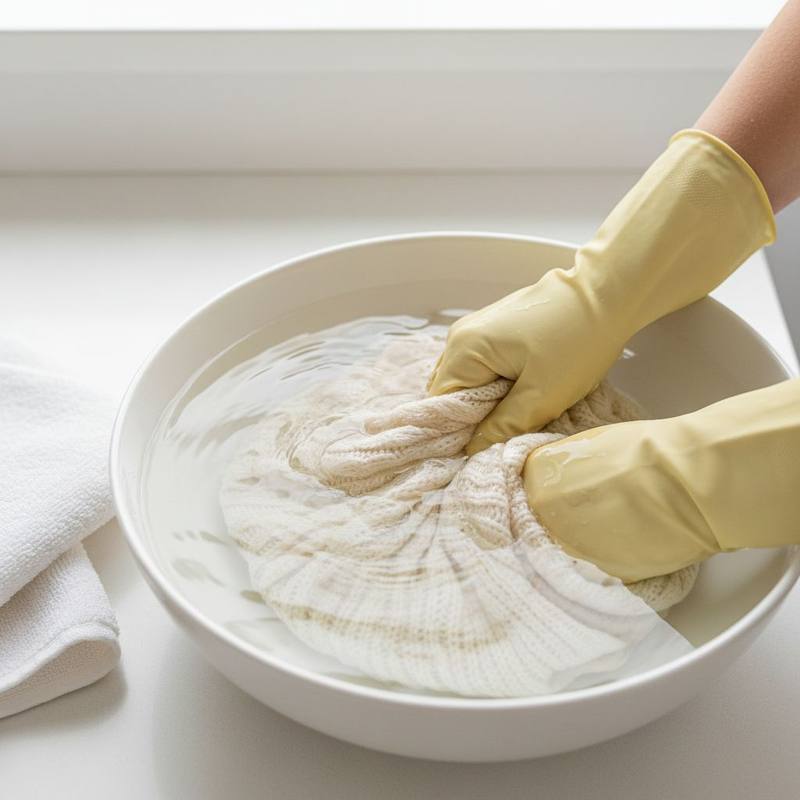
Activation is simple: two to three wash cycles at 60°C without softener before first use remove most of the finishing coating and open the loops up to capillary contact with water. Only after this stage does the towel start working the way its GSM suggests.
For the first wash, it is worth adding about 120 ml of white spirit vinegar instead of a standard fabric conditioner. Vinegar dissolves leftover finishing agents and does not leave any coating on the fibre, unlike a softener, which would additionally block water absorption.
Hard water and the condition of towels
terry's dense loops trap mineral scale more strongly than other household fabrics
Water hardness thresholds in Poland
up to 140 mg CaCO₃/l, no extra steps needed
140-300 mg/l, worth adding a water softener to the wash
above 300 mg/l, and above 400-500 mg/l it is very hard water
Temperature, spin speed, and load size
three wash parameters that together decide the softness and absorbency of terry
Rules for washing terry towels
Everyday wash
40°C, standard program, never delicate. Enough to remove typical soiling while preserving colour and the full loop structure.
Disinfection
60°C for kitchen towels, after a household member's illness, or whenever you want to reduce microorganisms. Many detergent manufacturers point to 60°C as the threshold for meaningful bacterial reduction.
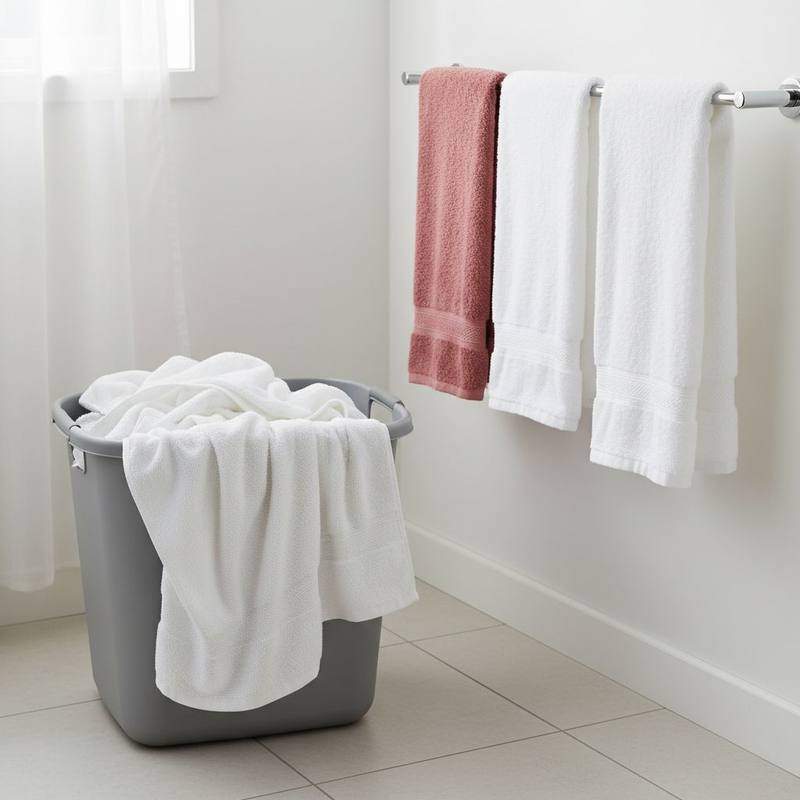
With daily use, washing the towel every 3 to 4 uses is enough, provided it fully dries between uses. If it hangs in a humid bathroom and does not have time to dry completely, shorten that cycle and hang it spread out rather than bunched on a hook, so air can reach the whole surface.
- 1
Sort the load
Wash towels separately from garments with exposed zippers, hooks, or hook-and-loop fasteners. Metal elements mechanically pull and cut the loops with every drum rotation.
- 2
Choose the powder dose
Pick a universal powder without scented gel capsules, since it rinses out of the loops better than gel. With moderately hard water, about two thirds of the packaging dose is enough.
- 3
Do not overfill the drum
Leave 40 to 50% of the drum empty. Towels need room to rub against each other and effectively rinse detergent out from deep inside the loops.
- 4
Spin at high speed and dry right away
800 to 1200 rpm shortens drying time and reduces the risk of a musty smell. Dry right after washing, ideally in the air or in a dryer on low heat.
The most common mistakes, and when to take towels to a laundry
what really ruins terry's absorbency, and when home methods stop being enough
Terry care in a nutshell
Do
- Wash new towels 2-3 times at 60°C before first use
- Choose powder instead of gel in capsules
- Hang the towel spread out to dry fully between uses
- With moderately hard or hard water, add a water softener to the wash
Don't
- Do not use fabric conditioner on terry towels
- Do not wash towels together with garments that have zippers or hook-and-loop fasteners
- Do not overfill the drum beyond 50-60% of its volume
- Do not leave a damp towel bunched up on a hook
Softener is the most common mistake
Fabric conditioner softens the fibre on the surface, but coats the loops with a thin film that blocks water absorption almost as much as the factory finishing coating. A towel treated with softener can smell fresh and feel pleasant to the touch, yet still dry the skin less effectively.
If, despite the right temperature and powder dose, towels are stiff, rough to the touch, or have a grey, dull tone, the cause is usually mineral scale and detergent residue built up deep inside the loops, which home washing can no longer remove. Professional laundry cleaning matches the temperature, detergent dosing, and program to the fabric's current condition, instead of repeating the same cycle over and over on already-tired fibre.

Now you know the theory. Practice can be less forgiving.
If you would rather not risk your favourite piece, leave it to the specialists at Gorące Żelazko laundry in Lublin.


Frequently asked questions
40°C on a standard program is enough for everyday use, to preserve colour and loop structure. For disinfection, for example of kitchen towels, choose 60°C.
Yes, but avoid garments with exposed zippers or hook-and-loop fasteners, since they mechanically pull the loops. Sort the load by fabric roughness before washing.
With daily use, washing every 3-4 uses is enough, provided the towel fully dries between uses. If it does not have time to dry completely, shorten that cycle and hang it spread out until fully dry.
Yes, 2-3 cycles at 60°C without softener remove the factory finishing coating that blocks water's capillary access to the fibre during the first uses. Without this step, even the best towel will not absorb the way it should, regardless of its GSM or raw material.
It is better to avoid it. Softener coats the loops with a thin film that blocks water absorption almost as much as the factory finishing coating, so the towel will dry the skin less effectively despite the pleasant scent and softness.
About the author
Małgorzata Małecka
Owner of the Gorące Żelazko laundry
Małgorzata Małecka runs the Gorące Żelazko laundry in Lublin. Together with her team, she makes sure customers' clothes, shoes and fabrics come back clean and in the best possible condition.