How to wash bamboo clothing
temperature, cycle, detergent and spin speed: five steps for safely washing delicate bamboo viscose

Since wet bamboo fiber loses even half its strength, every element of washing matters: temperature, cycle, spin speed and detergent. Together they determine whether the garment survives in its original shape, or comes back from the wash stretched or shrunk.
Below you will find the mechanism behind this, the five steps of the wash itself, from sorting to spinning, a table of care symbols, the most common mistakes when washing bamboo, and the situations where it is better to hand the item to a laundry than risk another attempt at home.
Why bamboo needs careful washing
regenerated cellulose that loses up to half its strength when wet
Bamboo reaches clothing almost exclusively as bamboo viscose, a fiber of regenerated cellulose. Bamboo pulp is dissolved chemically and then respun into thin fibers, so the finished fabric does not keep the natural strength of the plant it came from.
Regenerated cellulose has a looser internal structure than cotton or linen. On contact with water the fibers swell, the bonds between cellulose chains partly loosen, and mechanical strength can drop by as much as half. That is why wet bamboo knit stretches and deforms far more easily than dry fabric, and why an overly strong spin or aggressive wash can permanently distort a garment in a single cycle.
Properties of bamboo viscose
Can drop by up to half compared to the dry state, hence the careful spin and delicate cycle
Very high, clearly better than cotton, hence the cool feel and fast moisture wicking
Moderate to high above 40°C, lower at 30°C with a delicate cycle
Limited in dark colors, with a risk of dye bleeding during the first washes
Step by step: how to wash bamboo clothing
five steps that decide the shape and durability of the fabric
- 1
Separate new, dark colors
Bamboo viscose is usually dyed with dyes that have high affinity for cellulose, giving intense colors, but also increasing the risk of dye bleeding in the first washes. First wash of any new, dark item always separately, in lower temperature than final, 20 to 30C.
- 2
Set temperature to 30C
Standard recommendation is 30C, maximum 40C for cotton-reinforced blends. Above 40C shrinkage intensifies and further weakens already delicate fiber.
- 3
Choose delicate cycle
Delicate fabric cycle or silk cycle, with limited drum mechanics, treats bamboo viscose analogously to silk and wool. Reduction of mechanical friction is as important as temperature itself.
- 4
Neutral pH detergent, no chlorine
Detergent in pH range 6-8, without cellulase enzymes, which weaken cellulose fiber, and without a trace of chlorine. Strongly alkaline detergents above pH 10 weaken cellulose bonds with repeated exposure.
- 5
Limit spin to 400-600 rpm
Maximum 400 to 600 rotations per minute, and for thin knits it is safer to go down to 400. High spin speeds on low wet strength material is the quickest way to permanent fabric stretching.
Bamboo care symbols
The key label markings worth checking before washing
Washing
30C, delicate or silk cycle, limited drum mechanics and low spin
Bleaching
No chlorine and no strongly alkaline agents, which weaken cellulose bonds
Ironing
Low temperature, ideally through a cotton cloth or on the reverse side of the fabric
Drying
Laid flat or hung on a hanger, no tumble dryer, away from direct sunlight
The most common mistakes when washing bamboo
the ones that damage delicate knits fastest in practice
Bamboo in a nutshell
Do
- Wash at 30C, maximum 40C for cotton blends
- Choose a delicate or silk cycle
- Limit spin to 400-600 rpm
- Wash new, dark items separately the first time
Don't
- Do not tumble dry at high heat
- Do not use fabric softener, it builds up on the fiber and lowers absorbency
- Do not iron at high temperature directly on the fabric
- Do not ignore a missing spin-limit symbol on the label
When to hand bamboo to a laundry
If a garment came back from a home wash stretched, with stiff detergent marks, or with visible dye bleeding, another attempt at home usually only makes the damage worse. Fiber already weakened by washing at too high a temperature or too strong a spin does not return to its original shape through another home wash. In that situation it is better to hand the item to a professional laundry, where they will match temperature, cycle and detergent to the current state of the fabric. This applies especially to lightweight knits, thin tops or bamboo underwear, where the margin for error is smallest.
Labels on mass-produced bamboo knits can be inaccurate. It happens that there is no spin limit symbol despite the fiber having reduced wet strength. In practice it is better to treat bamboo viscose more carefully than the label suggests, especially with fabrics weighing below 150 g/m2.

Now you know the theory. Practice can be less forgiving.
If you would rather not risk your favourite piece, leave it to the specialists at Gorące Żelazko laundry in Lublin.


Frequently asked questions
Standard recommendation is 30C, maximum 40C for cotton-reinforced blends. Above 40C the risk of shrinkage increases and further weakens fiber that already loses up to half its strength when wet.
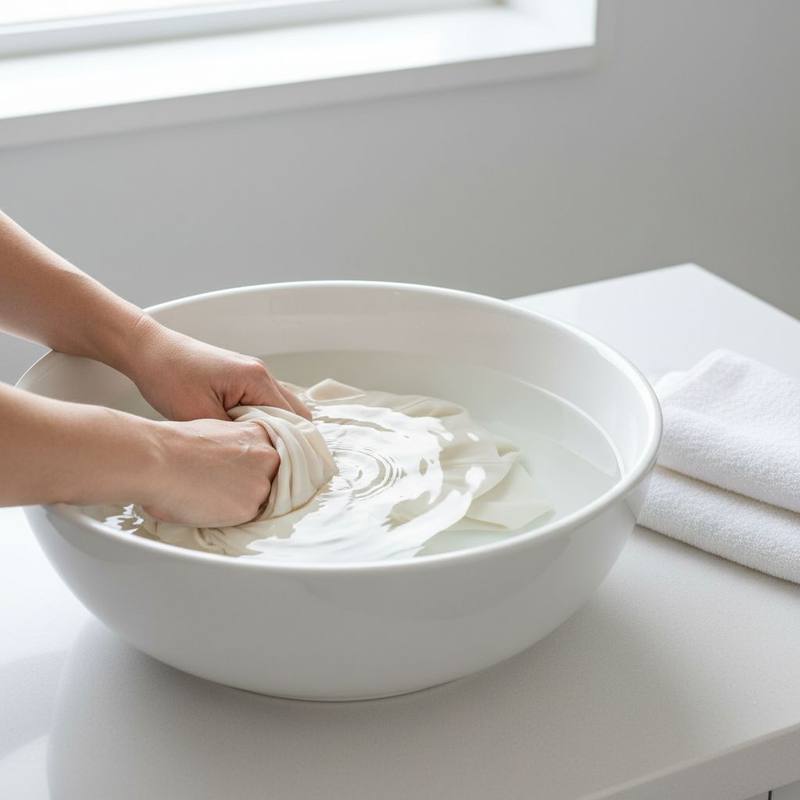
Can be washed in a machine, provided you select a delicate or silk cycle with limited drum mechanics, and low spin speed in the range of 400-600 rpm. Hand washing can be safer for thin, expensive fabrics, but is not necessary with the right machine cycle.
No. Wet bamboo fiber loses up to half its strength, so a strong spin stretches and deforms the garment. Choose a delicate program with a low spin and a mild detergent, and skip softener, because it builds up on the fiber and lowers its absorbency over time. Wash new dark items separately the first time, as they bleed.
Dry it laid flat or hung on a wide hanger, away from direct sunlight and radiators. A tumble dryer on high heat further weakens wet fiber and encourages shrinkage, so it is better to avoid one, especially for thin knits.
At 30C with a delicate cycle, shrinkage is usually minor. The risk rises above 40C and with tumble drying, since high heat further weakens the already delicate regenerated cellulose fiber.
About the author
Małgorzata Małecka
Owner of the Gorące Żelazko laundry
Małgorzata Małecka runs the Gorące Żelazko laundry in Lublin. Together with her team, she makes sure customers' clothes, shoes and fabrics come back clean and in the best possible condition.