How to Clean and Iron Tweed
Home washing verdict, professional dry cleaning step by step, and ironing without damaging the texture

This guide answers the three questions that come up most often with tweed: whether it can be washed at home at all, what professional dry cleaning of a blazer or coat looks like, and how to safely iron this fabric without risking damage to its texture. You'll find the definition, varieties and composition of tweed in the main guide to the fabric, linked at the bottom of the page.
Can you wash tweed at home
Structured blazer and coat versus loose fabric
This is the most frequently asked question about tweed, and rightly so: this is a material that can permanently damage itself at just one improper wash. Before we answer directly, you need to distinguish two completely different categories of tweed items.
The first is structural garments: blazer, coat, or jacket with lining and reinforcement. The second is loose items: scarf, blanket, or fabric length without any lining. The answer to the question "can I wash this myself" depends on which category your item belongs to, not on the fact that the material is tweed.
What you can wash yourself, and what requires dry cleaning
Do
- Scarf, blanket, or tweed fabric length without lining, with a label allowing water
- Brushing dry: dust and fine mud after completely dry
- Fresh, spot soiling removed immediately by dry method
Don't
- Blazers, jackets, coats, and suits with lining and reinforcement
- Items with leather or suede patches or horn buttons
- Stains older than 24-48 hours or label with P or F symbol
It's crucial to understand the mechanism, not just remember the prohibition. A tweed blazer is not a single piece of material, but a structure made of several layers. These include glued or sewn reinforcement of the fronts, called canvas, lining of viscose or polyester, and batting in the shoulders.
Water combined with mechanical mixing in the washing machine causes each of these layers to shrink at different rates and in different amounts. Tweed, reinforcement, and lining react to moisture completely differently, so the result is permanent, irreversible wrinkling and "blistering" of the front of the blazer, visible to the naked eye.
This effect cannot be fixed by just ironing. It requires unpicking the blazer and re-mounting the reinforcement by a tailor, which costs more and takes longer than a single professional dry clean, which is what the whole situation was supposed to avoid.
How to read the label on a tweed blazer or coat
Washing
Washing prohibited
Crossed-out wash tub. Typical marking for most blazers and coats with lining and reinforcement.
Dry cleaning
PERC dry cleaning
Circle with letter P. Standard perchloroethylene (PCE/PERC) solvent, the most common method for tweed without leather additions.
Hydrocarbon dry cleaning only
Circle with letter F. Milder hydrocarbon solvent, recommended with leather or suede additions.
Ironing
Ironing up to 150°C
Iron with two dots. Only through a protective cloth and with steam, never directly on the texture.
Bleaching
Do not bleach
Crossed-out triangle. Applies to practically all dyed wool fabrics, tweed is no exception.
The label is not the only construction issue you need to pay attention to. Classic hunting-style tweed blazers, known as Norfolk jackets, often have suede or leather patches on the elbows, horn buttons, and sometimes leather trim.
Leather and suede handle poorly both water and some solvents used in dry cleaning. In water they stiffen, lose texture, and can shrink unevenly relative to the fabric. In some solvents they over-degrease, leading to drying, cracking, and loss of elasticity. Therefore they require separate protection before full cleaning or dry spotting method, meaning point cleaning only.
What professional dry cleaning of tweed looks like
Solvent, protection of leather additions, and ironing on form
Since you now know that most blazers, coats, and tweed suits due to construction go only to dry cleaning, let's see what exactly happens to a garment at the dry cleaner. It's not one step, but a multi-stage process controlled by the technician.
Four stages of professional dry cleaning of tweed, from protecting additions to final pressing on form.
- 1
Assessment and protection of additions
The technician assesses the fabric condition and shields leather or suede patches and horn buttons from full solvent bath to prevent damage.
- 2
Actual cleaning
Standard perchloroethylene (PERC) at process temperature around 25-30°C, or hydrocarbons (e.g. DF-2000) for items with leather additions. The cleaning cycle usually lasts 10-15 minutes.
- 3
Drum drying
Low temperature, below 40°C, protects the fabric from further felting and loss of weave structure.
- 4
Finishing on form
Steam pressing on a form (steam press/mannequin), without direct pressure from the iron's foot on the texture, preserves the three-dimensional shape of the garment.
A professional dry cleaner has one more card up their sleeve: the wet cleaning method, which is controlled water washing with precise temperature control, detergent dosing, and mechanical mixing time. It can be applied even to some garments marked with dry cleaning symbols.
There's one condition: a positive test on an inconspicuous area of the fabric or seam. The dry cleaner always makes the final decision based on this test, not just the symbol on the label.
If you take vintage or second-hand tweed to the cleaner, ask directly about testing on an inconspicuous area or seam before full cleaning. With unknown origin and age of the fabric, this extra precaution takes a moment but protects the entire garment.
How to iron and refresh tweed
Iron temperature, cloth, and steam without risking texture damage
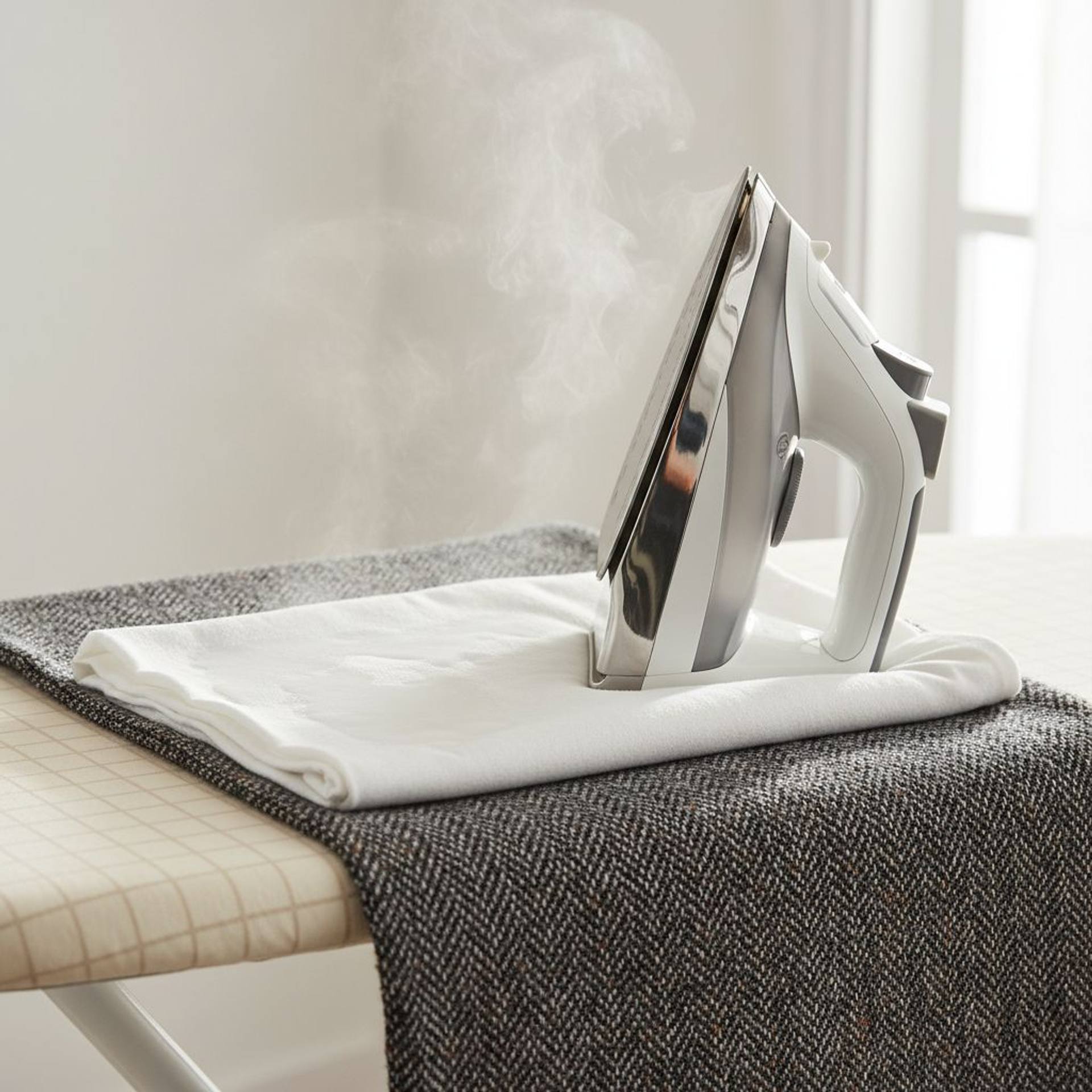
Before you reach for the iron, one important rule: direct dry ironing of tweed on the right side causes permanent flattening of the texture and shining of the wool fiber, known as the "shine" effect. This isn't something you can undo by ironing again: it requires full fabric restoration by a specialist, which means brushing and raising the nap with steam.
The good news is that safe home ironing of tweed is fully possible if you follow the simple sequence of steps described below.
Four steps that protect tweed texture while ironing at home.
- 1
Protective cloth
Always place a damp cotton cloth (pressing cloth) between the iron and fabric. This is the foundation of the entire procedure.
- 2
Temperature and steam
Set the iron to maximum 150°C, which is two dots per ISO 3758, and use steam instead of dry pressure.
- 3
Lift-and-press technique
Lift and lower the iron instead of sliding it on the fabric. Sliding flattens the characteristic tweed texture.
- 4
Tailor's cushion
Structural creases, such as lapels or cuffs, iron on a tailor's cushion (tailor's ham) to preserve the three-dimensional cut of the garment.
You don't have to iron tweed every time. Resting on a hanger for a minimum of 24 hours between wears allows fibers to partially recover their structure and evaporate moisture absorbed during wear. A professional steam dolly works with steam at about 100°C at pressure of 3-4 bars and smooths the fabric without any risk of shine effect.

Now you know the theory. Practice can be less forgiving.
If you would rather not risk your favourite piece, leave it to the specialists at Gorące Żelazko laundry in Lublin.


Most common questions about cleaning and ironing tweed
No, if it has lining and reinforcement of the fronts. Water and mechanical mixing cause uneven shrinkage of fabric layers, reinforcement, and lining, resulting in permanent, irreversible wrinkling. Loose items without lining, like scarves or blankets, can be washed according to the label.
Maximum 150°C, which is two dots per ISO 3758. Always iron through a damp protective cloth and use steam. Use lift-and-press technique, never slide the iron on the fabric.
Hang it for a minimum of 24 hours so fibers recover their structure and moisture evaporates. Brush dry to remove dust. For deeper refreshing, a professional steam dolly works with steam at pressure of 3-4 bars.
Roughly from 47 PLN for a blazer and from 70 PLN for a coat. Exact price depends on fabric condition, presence of leather additions, and scope of service.
With all structural items with lining, reinforcement, or leather additions, and with a label showing dry cleaning only (symbol P or F). Daily brushing and fresh, minor soiling on loose items you can handle yourself.
About the author
Małgorzata Małecka
Owner of the Gorące Żelazko laundry
Małgorzata Małecka runs the Gorące Żelazko laundry in Lublin. Together with her team, she makes sure customers' clothes, shoes and fabrics come back clean and in the best possible condition.