Your Sweater Lost its Fluff?
How to restore the halo effect after washing left your sweater flat and dull

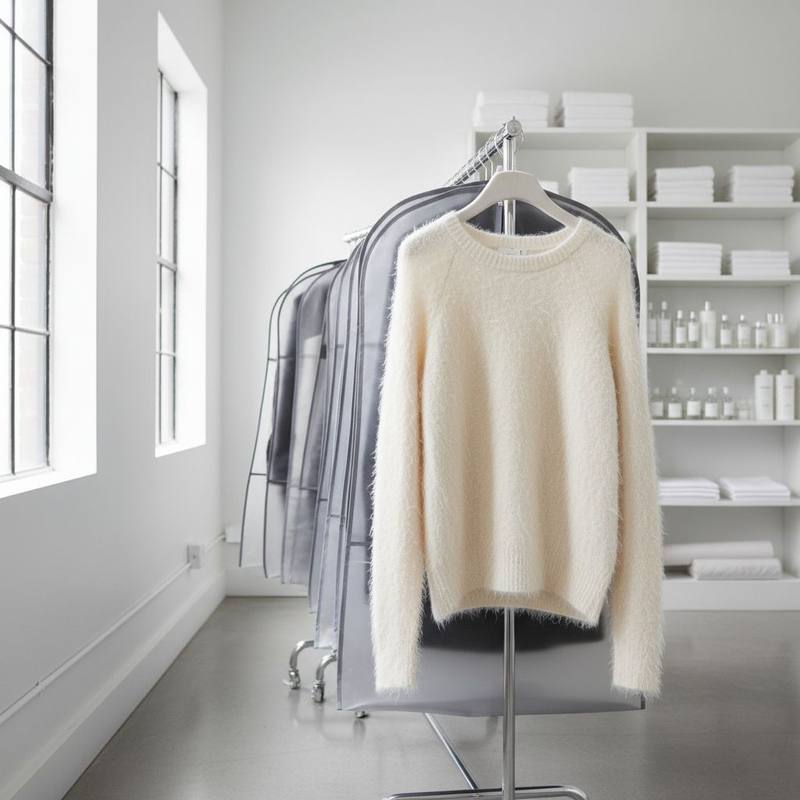
A flat, matte sweater without the characteristic fuzz, despite careful washing at low temperature and without wringing, is a very common situation. In most cases it does not mean permanent damage.
The cause is mechanical: the fibers that create the halo effect flatten and pack down under friction and moisture during washing and drying. The fuzz itself loses volume, but the yarn itself remains unharmed, so in most cases it is possible to restore it with simple methods at home.
Below we explain the mechanism behind fluff loss, how to restore it, and the point at which it is worth taking the sweater to a laundry.
Why angora loses its fluff
The halo effect, the characteristic fuzzy halo around the knit, comes from angora's very fine fibers, only 11 to 16 microns thick, which stand loosely above the surface of the yarn and scatter light.
During washing and drying, those same fibers rub against other parts of the garment, the drum walls, or neighboring clothes, and moisture further weakens their springiness. Under pressure they lie flat along the yarn instead of standing out, which makes the sweater look thinner and dull.
This is a different problem than shedding, which means losing individual fibers. With flattening, the fibers are still present in the yarn, just lying the wrong way, so in most cases they can be lifted back up without replacing anything.
Conditions that most risk flattening the fluff
Above about 30°C weakens the fiber and increases the risk of flattening
Strong pressure and twisting mechanically pack down the fluff, even at low temperature
Heat and friction combined in the drum is the fastest route to matting
Rubbing against zippers, buttons, or rough fabrics in the wash flattens fibers in spots
Step by step: how to restore your sweater's fluffiness
- 1
Brush Gently
Use a soft brush, for example for cashmere, and brush in short strokes along the grain. Do not press hard, the goal is to lift fibers, not pull them out.
- 2
Steam from a Distance
Hold a steam iron or garment steamer 5 to 10 cm away from the material. Steam relaxes flattened fibers, but direct iron foot contact will scorch and mat them.
- 3
Straighten the Knit by Hand
Gently pull and straighten the knit with your fingers, restoring the original shape of sleeves, hem, and collar.
- 4
Dry Patiently on Flat Surface
Dry flat on a towel, away from heat sources, without touching until completely dry. Rushing at this stage can undo the effects of the previous steps.
Fluff loss most often results from too-intense washing mechanics: friction and wringing. Sticking to the parameters described in the home washing section minimizes risk with each successive cycle, so better washing from the start means less restoration work later.
What not to do during recovery
Fluff recovery in a nutshell
Do
- Always brush along the grain, in short strokes
- Keep the steam source at a constant, safe distance from the material
- Dry the sweater lying flat, on a towel that absorbs moisture
- Repeat the treatment patiently, the full effect often only shows once fully dry
Don't
- Do not brush against the grain or too hard, you will pull fibers out instead of lifting them
- Do not touch the material with a hot iron plate
- Do not dry in a tumble dryer or near a heater
- Do not hang a wet sweater, the weight of moisture stretches the knit
Overly intense brushing causes harm
Brushing hard against the grain, or repeating the treatment too often, pulls individual angora fibers out instead of lifting them, which over time only deepens the fluff loss. If the effect is still weak after a few careful attempts, stop and check whether you might be dealing with felting instead.
When fluff cannot be restored at home
Flattening and felting are two different problems, even though they show up in a similar way: a lack of fluffiness. Flattening affects only individual fibers lying flat on the surface of the yarn, while felting is the irreversible interlocking of the keratin scales of whole fibers under the combined effect of heat, moisture, and friction.
You can tell the difference by touch. Flattened knit stays soft and elastic, and springs back into shape after gentle stretching. Felted knit becomes stiff and dense, and individual fibers can no longer be separated by hand. Felting is practically irreversible at home, so at that stage further home attempts usually only make things worse.
Good to know
A professional laundry has steamers and fiber-combing techniques not available at home, so if you are unsure about the sweater's condition, it is worth consulting a specialist before a DIY attempt makes things worse. Sweater washing costs 40 PLN, usually well below the cost of replacing a good angora sweater with a new one.

Now you know the theory. Practice can be less forgiving.
If you would rather not risk your favourite piece, leave it to the specialists at Gorące Żelazko laundry in Lublin.


Frequently asked questions
Angora has a relatively large, empty or partially empty central space (medulla) filled with air, and trapped air is one of the best thermal insulators. That is why it provides exceptional thermal insulation with low weight, and in the textile industry is often called the warmest animal fiber per gram of fabric.
Gently brush with a soft brush along the grain. Then steam from 5 to 10 cm away without iron contact and straighten the knit by hand. Finally, dry patiently on a flat surface away from heat sources.
Shrinkage combined with stiffening usually indicates felting, an effect largely irreversible in home conditions. With slight shrinking without felting you can try to gently stretch the damp knit to its original shape, but with advanced felting it is worth consulting a professional laundry.
Gentle brushing with a soft brush along the grain is safe, but too much pressure or brushing against the grain pulls individual angora fibers out instead of lifting them. If the effect is weak after a few careful attempts, it is better to stop than to brush more intensely.
No, it is the opposite of the safe method. Heat and friction combined in the dryer drum is one of the main causes of flattening and felting the fluff, so a dryer deepens the problem instead of solving it. Always dry angora flat, in the air.
About the author
Małgorzata Małecka
Owner of the Gorące Żelazko laundry
Małgorzata Małecka runs the Gorące Żelazko laundry in Lublin. Together with her team, she makes sure customers' clothes, shoes and fabrics come back clean and in the best possible condition.